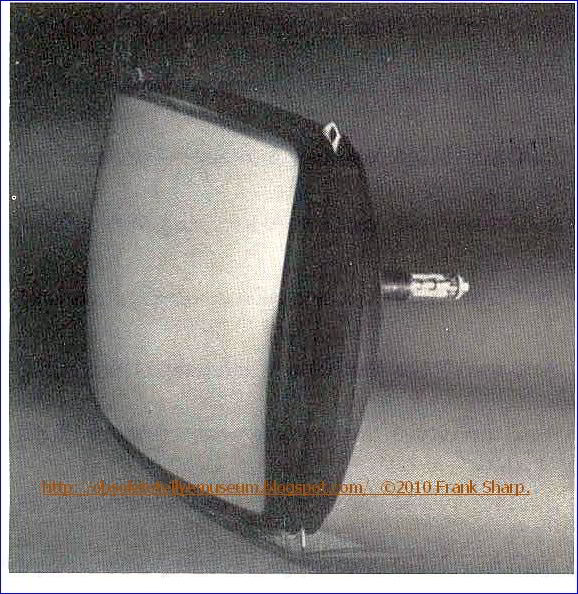
Richtige Fernseher haben Röhren!

Richtige Fernseher haben Röhren!

In Brief: On this site you will find pictures and information about some of the electronic, electrical and electrotechnical Obsolete technology relics that the Frank Sharp Private museum has accumulated over the years .
Premise: There are lots of vintage electrical and electronic items that have not survived well or even completely disappeared and forgotten.

Or are not being collected nowadays in proportion to their significance or prevalence in their heyday, this is bad and the main part of the death land. The heavy, ugly sarcophagus; models with few endearing qualities, devices that have some over-riding disadvantage to ownership such as heavy weight,toxicity or inflated value when dismantled, tend to be under-represented by all but the most comprehensive collections and museums. They get relegated to the bottom of the wants list, derided as 'more trouble than they are worth', or just forgotten entirely. As a result, I started to notice gaps in the current representation of the history of electronic and electrical technology to the interested member of the public.

Following this idea around a bit, convinced me that a collection of the peculiar alone could not hope to survive on its own merits, but a museum that gave equal display space to the popular and the unpopular, would bring things to the attention of the average person that he has previously passed by or been shielded from. It's a matter of culture. From this, the Obsolete Technology Tellye Web Museum concept developed and all my other things too. It's an open platform for all electrical Electronic TV technology to have its few, but NOT last, moments of fame in a working, hand-on environment. We'll never own Colossus or Faraday's first transformer, but I can show things that you can't see at the Science Museum, and let you play with things that the Smithsonian can't allow people to touch, because my remit is different.

There was a society once that was the polar opposite of our disposable, junk society. A whole nation was built on the idea of placing quality before quantity in all things. The goal was not “more and newer,” but “better and higher" .This attitude was reflected not only in the manufacturing of material goods, but also in the realms of art and architecture, as well as in the social fabric of everyday life. The goal was for each new cohort of children to stand on a higher level than the preceding cohort: they were to be healthier, stronger, more intelligent, and more vibrant in every way.

The society that prioritized human, social and material quality is a Winner. Truly, it is the high point of all Western civilization. Consequently, its defeat meant the defeat of civilization itself.

Today, the West is headed for the abyss. For the ultimate fate of our disposable society is for that society itself to be disposed of. And this will happen sooner, rather than later.

OLD, but ORIGINAL, Well made, Funny, Not remotely controlled............. and not Made in CHINA.

How to use the site:
- If you landed here via any Search Engine, you will get what you searched for and you can search more using the search this blog feature provided by Google. You can visit more posts scrolling the left blog archive of all posts of the month/year,
or you can click on the main photo-page to start from the main page. Doing so it starts from the most recent post to the older post simple clicking on the Older Post button on the bottom of each page after reading , post after post.

You can even visit all posts, time to time, when reaching the bottom end of each page and click on the Older Post button.

- If you arrived here at the main page via bookmark you can visit all the site scrolling the left blog archive of all posts of the month/year pointing were you want , or more simple You can even visit all blog posts, from newer to older, clicking at the end of each bottom page on the Older Post button.
So you can see all the blog/site content surfing all pages in it.

- The search this blog feature provided by Google is a real search engine. If you're pointing particular things it will search IT for you; or you can place a brand name in the search query at your choice and visit all results page by page. It's useful since the content of the site is very large.

Note that if you don't find what you searched for, try it after a period of time; the site is a never ending job !

Every CRT Television saved let revive knowledge, thoughts, moments of the past life which will never return again.........

Many contemporary "televisions" (more correctly named as displays) would not have this level of staying power, many would ware out or require major services within just five years or less and of course, there is that perennial bug bear of planned obsolescence where components are deliberately designed to fail and, or manufactured with limited edition specificities..... and without considering........picture......sound........quality........
..............The bitterness of poor quality is remembered long after the sweetness of todays funny gadgets low price has faded from memory........ . . . . . .....
Don't forget the past, the end of the world is upon us! Pretty soon it will all turn to dust!

Have big FUN ! !
-----------------------
©2010, 2011, 2012, 2013, 2014 Frank Sharp - You do not have permission to copy photos and words from this blog, and any content may be never used it for auctions or commercial purposes, however feel free to post anything you see here with a courtesy link back, btw a link to the original post here , is mandatory.
All sets and apparates appearing here are property of Engineer Frank Sharp. NOTHING HERE IS FOR SALE !
All posts are presented here for informative, historical and educative purposes as applicable within Fair Use.


Showing posts with label Obsolete Technology Information. Show all posts

Monday, September 20, 2021

THE GREAT MAN CARLO VICHI MIVAR FOUNDER PASSED AWAY !! !!


A truly sad day today and one of the sadiest of ever !.

MR CARLO VICHI MIVAR FOUNDER PASSED AWAY..


 (Above pictured: Carlo VICHI and his Wife Anna in 1936 !!)
 

 (Above pictured: Carlo VICHI and his  TV PRODUCTION IN 1988)

-----------------------------------------------------------------------------------------------------------------------------------------------

this great entrepreneur has remained in history for having brought television into the homes of Italians at the helm of his company, Mivar.

From transistor radios to color TVs, the patron of Mivar is a legend who leaves a model factory as a monument to the career of a genius.

He was certainly a genius

Because only a genius could start by repairing transistor radios in 1945 and end up creating a colossus capable of producing a million televisions a year and undermining the market shares of brands such as Telefunken, Grundig and, later, Sony. Those were the days of cathode ray tubes. When televisions were deeper than they were wider and Color (Pal system) had arrived in 72, experimented (only experimented) during the Olympic Games in Munich.

A magic man. And he immediately took possession of that magic. Mivar (the acronym stands for Milano Vichi radio equipment), thanks to its excellent price and quality (its televisions only broke down when hit with a baseball bat) made its way into the world of big brands.The recipe is a winner: competitive prices, an efficient service network and minimized expenses. Popular appliances, with minimalistic pragmatic chassis technology, intended for a public that doesn't want to spend too much. In 1988, out of every 100 televisions sold, 12 were Mivar. Those were pharaonic numbers in those years, when the production lines churned out about 300,000 color TVs and 60,000 black and white ones. An (initially) winning bet, given that in 1999 Mivar reached its peak: 950,000 sets built and a market share of 35%, ahead of several multinational electronics companies. The crisis for Mivar begins at the beginning of the 2000s with the entry into the flat screen television market.


Vichi has never spent a single penny on advertising and has a relationship with marketing that is similar to that of cats and water.  Its innovation lay in its production process, which was absolutely original and profitable.


In 2008, the production of cathode ray tubes tellyes ended, but the crisis became more and more acute. Turnover dropped, as did the number of employees. A black crisis that destroyed every piece of the company. Over the years, Vichi has said that he has spent about 100 million euros  of his own funds to cover the losses and allow his company to guarantee a formal break-even.

Carlo Vichi would like to die in his factory, at his table, among the workers. He has never had a CEO's office. He has always been the "boss", but in the midst of his workers; one of them, even if of a higher rank.

 Mivar was Carlo Vichi and Carlo Vichi was Mivar. Mivar was a company with an unusual imprint of Italian capitalism, as its founder imagined it: poorer, simpler, but with strong ideas.

Today Mivar has lost its founder.


He was a concrete man, and there was no distance between him and the workers, as they used to say.
The workers greeted him, without deference, without running away. As if he were just another colleague. He looked at you, understood what you were thinking and said: "I have no problems with the unions. Here, people who work well are treated well. The brusque manners was perhaps just a pose on that he was well known . A theatrical affectation of someone who knows he has become a character in spite of himself. 

He may eventually have made three mistakes: not preparing himself for the succession of the company (his sons decided to take a different path), not believing in the development of flat screens, and setting up a second factory in Abbiategrasso, a very modern and perfect one, 120,000 square meters, but it never came into operation. He continued to keep it clean, ready to become operational.

In 2014, he announced his willingness to rent for free the factory built in the 1990s on the Naviglio di Bereguardo - which he designed himself - of 120000 m², which has never come into operation, to anyone who intends to produce televisions and employ 1,200 Italian workers there. Three years later, in 2017, Vichi addresses this invitation to the South Korean multinational Samsung, from which he gets no response.


 He was willing to offer it for free to anyone who would hire 1,200 people.

Perhaps the true monument to  and his tellyes.

His life coincided with that of the company: born in Montieri, in the province of Grosseto, he moved to Milan at a young age. In the post-war period Var was founded and in 1955 it took on a new name, Mivar (Milano Vichi Apparecchi Radio), and the following year it marketed its first radio with a frequency modulation system. Due to the success of this new transmission standard in Italy, the company expanded and in 1958 it opened its first factory with 400 employees in Via Giordani 30 in Milan. There were born, next to the normal table radios, portable models or also equipped with built-in turntable, with plates and mechanics almost always manufactured by Lesa.

(Carlo Vichi Montieri, 5 febbraio 1923 – 20 settembre 2021)


 ---------------------------------------------------- 


  I GREET YOU AS YOU DESERVE:


A NOI !!


THANK YOU CARLO  R.I.P.

 -----------------------------------------------------------------------------------------------------------------------------------------------


 MIVAR an Italian Brand no more active since 20/12/2013.


MIVAR is a Factory site in the near of Milan (italy) in a Industrial city conglomerate called Abbiate Grasso.

Founded in 1945 by Mr. Carlo Vichi class of 1923, The activity started in 1945 - in Milano, Via Ugo Tommei 5 street with fabrication of little radio apparates.


HISTORY OF MIVAR.

1945 - Milan, Via Ugo Tommei 5: Begin the activity
assembling small radios.


1950 - Via Curtatone 12: developed with the construction of more direct major radio components fabricants.

1956 - 13 Street Strigelli: industrial production is manily targeted to first radio devices with frequency modulation (FM).

1958 - Via P. 30 Jordanians: TV become a reality, the industries is doubling his ACTIVITY, always in Milan, we build the first "real" plant with 400 employees.

1963 - Abbiategrasso, Via Dante 45: in the wake of decentralization and the rampant success of the television, building a facility that will become important in place 800 employees occupying between 1968-70.

1990 - Abbiategrasso Canal towpath: aware of the physiological importance that television plays in society? Modern, rich expertise and resources, we began construction of a factory area of ​​120,000 m? which covered 30.00o , for the viabilit with parking spaces and 60,000 park trees.

In origin the factory was brand named as Radio Var and indeed the tellye here in collection is internally marked as Radio VAR. After 1985 they were marked rightly MIVAR.
Today's activity is oriented in virtual production of LCD crap but with very low market penetration due to "unfair" asian competitors presence and a local governement which don't care about.

(You call it global
market, I call it WORLD DESTRUCTION combined toghether with mass Afro scum crap Immigration (EUROPEAN INVASION) to obtain destruction on a large scale in all places and to help more and better the loose of all OUR workplaces and firms , lives, people).


 “If our buildings, our highways, and our railroads should be wrecked, we could rebuild them.

If our cities should be destroyed, out of the very ruins we could erect newer and greater ones.

Even if our armed might should be crushed, we could rear sons who would redeem our power.


Anyway Obsolete Technology Tellye will show even this model as a Time machine which looses nothing of the good tellyes ! ! !


    Further Notes:

^ "MIVAR: tutto iniziò in via Tommei", articolo tratto dal sito quattronet.it Archiviato il 14 novembre 2011 in Internet Archive.^ [Maker], Mivar ; Milano from Audiphon to Trader, 703 pictures, 124 sc, su www.radiomuseum.org. URL consultato il 13 giugno 2018.^ NUOVO ASSALTO AL CARROZZONE REL - la Repubblica.it, in Archivio - la Repubblica.it. URL consultato l'11 gennaio 2018.^ LA MIVAR FA UTILI SENZA SPENDERE PER LA PUBBLICITA' - la Repubblica.it, in Archivio - la Repubblica.it. URL consultato l'11 gennaio 2018.^ MIVAR, MIRACOLO AD ABBIATEGRASSO - la Repubblica.it, in Archivio - la Repubblica.it. URL consultato l'11 gennaio 2018.^ Archivio Corriere della Sera, su archiviostorico.corriere.it. URL consultato l'11 gennaio 2018.^ Archivio Corriere della Sera, su archiviostorico.corriere.it. URL consultato l'11 gennaio 2018.^ notizia del sito Adnkronos del 4 maggio 2005 Archiviato il 19 ottobre 2006 in Internet Archive.^ JOB MILANO, in archive.is, 10 dicembre 2012. URL consultato l'11 gennaio 2018 (archiviato dall'url originale il 10 dicembre 2012).^ Mivar rilancia in Full Hd - Il Sole 24 ORE, su www.ilsole24ore.com. URL consultato l'11 gennaio 2018.^ (IT) Mivar In Crisi Ma Il Riscatto Avverrà Con I Led, su www.paid2write.org. URL consultato l'11 gennaio 2018.
MonrifNet, Televisori Mivar: fine dei programmi il 30 novembre - Il Giorno - Legnano, su www.ilgiorno.it. URL consultato l'11 gennaio 2018.
^ “La mia Mivar chiude, l’affitto gratis a chi assume 1200 italiani”, in Fanpage. URL consultato l'11 gennaio 2018.
 

Amatori, Colli, p. 263.


B. Viganò, Mivar, fine della storia, in Job., n. 1, Job Network, febbraio-marzo 2014, pp. 18-21.

Carlo Vichi: Italiani! Ve la do io la tivù, in L'Espresso, 15 gennaio 2004, p. 63.
^ S. Biagini, MIVAR: tutto iniziò in via Tommei (PDF), in Quattro. Giornale di informazione e cultura della Zona 4 Vittoria Forlanini, n. 85, Associazione culturale Quattro, maggio 2007, p. 7.

G. Villani, Una intervista con Carlo Vichi: la MIVAR, in La Scala Parlante, n. 1, AIRE, gennaio 2020, pp. 15-19.

Redazione, Abbiategrasso, signore & signora Mivar: 75 anni da fiaba, in Il Giorno.it, 13 aprile 2019. URL consultato il 6 marzo 2021.
  1. ^ V. Conte, "Affitto gratis la mia Mivar a chi assume 1200 italiani", in La Repubblica, 7 marzo 2014, p. 28. URL consultato il 7 marzo 2021.
  2. ^ Redazione, L'appello di Carlo Vichi: "Samsung, ti do la Mivar se produci le tv in Lombardia", in Il Giorno.it, 11 marzo 2017. URL consultato il 7 marzo 2021.
  3. ^ Fausta Chiesa, Carlo Vichi, morto il re dei televisori italiani Mivar di Abbiategrasso: aveva 98 anni, su corriere.it, 20 settembre 2021.
  4. ^ J. Piromallo, Mivar, Carlo Vichi: ‘Hitler è il mio eroe’, in Il Fatto Quotidiano.it, 20 marzo 2014. URL consultato il 7 marzo 2021.
  5. ^ Redazione, “Solo mister Samsung può salvare la mia Mivar”, in Ticino Notizie, 6 febbraio 2017. URL consultato il 7 marzo 2021.
  6. ^ Memento con una targa al monumentale ricorda i martiri fascisti di Milano. Lo sdegno dell'Anpi, in Fascinazione.info, 22 marzo 2019. URL consultato il 7 marzo 2021.
  7. ^ S. Garzillo, Milano, l’estrema destra al cimitero monumentale per il Centenario del fascismo, in Fan Page, 23 marzo 2019. URL consultato il 7 marzo.


"Home page Mivar" (in Italian). Mivar. Retrieved 31 July 2020.
Maggi, Francesco (2016-05-16). "La coerenza delle politiche di gestione delle risorse umane: il caso Mivar" (in Italian). Università di Pisa. Retrieved 5 August 2020. "Mivar". Archivio Storico (in Italian). Fondazione Fiera Milano. Retrieved 31 July 2020.

"Catalogo/archivio" (in Italian). Mivar. Retrieved 31 July 2020.

Rusconi, Gianni (2008-02-22). "I Tv Lcd sorpassano i Crt: il tubo catodico alza bandiera bianca" (in Italian). Il Sole 24 Ore. Retrieved 4 August 2020.

"Televisori LED" (in Italian). Mivar. Retrieved 31 July 2020.

Faggiano, Roberto (2013-06-02). "Mivar resiste e presenta la sua prima Smart TV Android". DDay.it (in Italian). Retrieved 31 July 2020.

Maria Fagnani, Giovanna (15 October 2013). "Mivar, addio alla tv made in Italy Carlo Vichi: "Produrremo mobili"" (in Italian). Corriere della Sera. Retrieved 31 July 2020.

Azzimonti, Michele (2013-10-11). "Televisori Mivar: fine dei programmi il 30 novembre" (in Italian). Il Giorno. Retrieved 31 July 2020.

"Tv Mivar: Sono Ancora In Produzione?". PLC Forum (in Italian). Retrieved 31 July 2020.

"Arredi razionali" (in Italian). Mivar. Retrieved 31 July 2020.

Noto, Sergio (17 October 2013). "Carlo Vichi, la Mivar e la dura vita di un imprenditore-contro" (in Italian). Il Fatto Quotidiano. Retrieved 31 July 2020.

Piromallo, Janauria (20 March 2014). "Carlo Vichi: 'Hitler è il mio eroe'" (in Italian). Il Fatto Quotidiano. Retrieved 31 July 2020.

Leone, Angelo (2017-08-08). "Eppure lo diceva anche Rocky. Mivar da leader di mercato in Italia a "Regalo la mia Fabbrica". Meglio cambiare o fallire?" (in Italian). Retrieved 31 July 2020.

"Il caso Mivar - Le strategie di costo". SlidePlayer (in Italian). Università La Sapienza di Roma. Retrieved 31 July 2020.

Wednesday, March 8, 2017

IT'S BETTER TO KEEP YOUR OLD CRT TELEVISION TODAYS.


In these years it's clearly emerged at  Obsolete Technology Tellye !  that  we  traded a superior technology for an inferior one...................


Also todays is emerging the fact that it may better  NOT sending  to recycling your Old CRT Tv.


  A tidal wave of televisions is headed for the electronics hereafter. As the United States / Europe transitions to all-digital TV, the shutdown of analog broadcasting happened actually won't affect most televisions in the countries , 87 percent of U.S. / European television-watching households already get their TV through cable or satellite or aerial . Nevertheless, the deadline is perhaps the most significant nail in the coffin for one of the most successful consumer electronics products of the 20th century: the cathode-ray tube (CRT) display. The digital changeover is by no means a mandate for the elimination of old-school sets, but it will certainly bring a lot of people into electronics stores to shop for new digital TVs typically flat-panel LCD crap and plasma sets, and that means that a lot of tube televisions are moving toward obsolescence or moved to dump.

How many CRT televisions are out there? ...... It's hard to say. People don't always dispose of old televisions. Many still work, but have been pushed into attics or closets by fresh-off-the-shelf HDTVs shit. In an attempt to gain perspective, I took a look at some Environmental Protection Agency estimates on televisions—and, trust me, the numbers are staggering. The EPA has sales figures back to 1980, and since then, 704.9 million CRT televisions have been sold only in the U.S.  and a minor quantity in Europe An estimated 42.4 percent of those are still in use. In 2008, the EPA estimates that 23.9 million tube TVs will be disposed of by Americans (that's 711,029 tons of televisions). Numbers for end-of-life TVs have been over 20 million per year since 2005, and are expected to go up to almost 25 million by 2010. Compare this to 10 years ago, when the numbers were closer to 12 million sets disposed of per year.

Thank heavens or hell , you're probably thinking or not at all, for recycling programs that take those old TVs and keep their toxic materials out of landfills. Not so fast. According to the EPA's estimates for 2006 to 2007 (the latest years for which information is available) only 18 percent of TVs (by weight) were recycled. The rest went to landfills. And 18 percent is considered an improvement, since the recycling rate from 1999 through 2005 was only 15 percent. The EPA concludes that this 3 percent improvement is probably due to mandatory collection and recycling programs for electronics.In the grand scheme of American garbage, TVs are only a drop in the bucket. All e-waste (including TVs, printers, monitors—even cellphones) makes up only 2 percent of the municipal solid-waste stream. But CRTs are a significant drop. Up to 8 percent of the weight of a television tube is lead. This lead is largely trapped in the glass of the set—ironically, CRT glass contains lead to block the emission of harmful X-rays.

So long as the lead is locked within the glass of a CRT, it presents no real threat, but if 711,029 tons of CRT TVs were disposed of in 2008, and only 18 percent were recycled, then 583,044 tons of CRT TVs found their way into landfills. If 8 percent of that weight is lead, that means 46,643 tons of lead is deposited inside fragile glass ampoules in landfills each year.

And CRT TVs are really only half of the story. In 2008, 19.5 million CRT computer monitors were also disposed of. LCD crap computer screens became the norm before flat-panel TVs, so the peak of CRT dumping in the PC world occurred in 2005 when 28.5 million monitors were tossed.

As a result of the replacement of cathode ray tube
screens (CRTs) by flat screens, the world is
confronted with stranded end-of-life CRTs. CRTs contain 1 to 1.5 kg of lead per screen; mainly found in the funnel and neck glass for radiation protection purposes. The lead content makes this CRT glass
unsuitable in most glass applications. Thus, there is an urgent need for alternative recycling options that are able to use up the CRT leaded glass while safely retaining the lead out of contact with humans and
the environment. 


The major constituent of a cathode ray tube screen (CRT) is glass. Most of this glass is made of a barium- strontium mix, similar to the one used for container glass . However, about 35% of the CRT glass, specifically the funnel and neck glass contains lead oxide (PbO) . The PbO content is 11% to 28% the mass of the leaded CRT glass.
Figure 1 sketches a CRT and the different types of glasses that it comprises.
As a result of a technological replacement, the recycling of CRT glass into new CRTs is no longer possible . Large amounts of end-of-life CRT must therefore be recycled into other products or disposed of. The recycling or disposal of the CRT leaded glass is of particular concern as the high PbO content makes the glass unsuitable for most current
glass applications .
Lead is a toxic heavy metal, which causes adverse
effects to human health when inhaled or ingested. The Provisional Tolerable Weekly Intake

(PTWI) for lead determined by the Joint Food and Agriculture/World Health Organization Expert Committee on Food Additives (JECFA) has been dropping since a first led toxicity assessment in 1972. In accordance with new scientific evidence relating lead to irreversible health damages in humans, currently, the JECFA declares that it is not possible to establish a PTWI for lead that would be
considered health protective. Given the quantities of the toxic metal lead in CRT
leaded glass and the shrinking lead exposure limits, an updated review of the recycling routes in which CRT leaded glass is used in other products, with a particular focus on the fate of lead during use, is necessary.

The use of CRT leaded glass as concrete aggregate would represent the largest demand for such glass among the options considered, followed by lead metal extraction and the use as aggregate in clay brick manufacturing. However, lead is not indispensable for neither concrete nor clay bricks.
In the case of concrete, CRT leaded glass would replace 10% of the volume of fine aggregates, which in turn represent 30% of the volume in concrete. In the case of clay bricks, CRT leaded glass would replace only 3% of the mass of sand, which represents 55% of the mass in clay bricks. Thus, the large demand for CRT glass in these two products is mainly due to the large masses of product worldwide. According to definition of recycling by the European Waste Framework Directive, and taking into account that lead does not accomplish a function in concrete or clay, the potential low mass fraction replacements (however leading to a large mass replacement due to the large
quantities of the construction materials produced worldwide) represent a “dilution” of CRT leaded glass into vast amounts of other materials rather than a recycling of it. Nevertheless, provided that the leaching of lead from these products is kept under regulated limits, these options may be considered as interim storage of CRT leaded glass instead. The lead would be entrapped in the concrete and clay matrixes until the end of life of construction structures, from which the final,
environmentally sound, disposal of lead must be guaranteed.


CRTs cost more to recycle than the commodities inside them can be sold for, meaning that old TVs have a net negative recycling value. And new guidelines for the amount of lead exposure that is safe for humans have cut down on the total number of possible uses for leaded glass (ECS's workers have their blood tested for lead content quarterly).

Maybe you took your old TV to a community e-waste collections center after you upgraded to a flat-screen. If the collection center was responsible, maybe it sent that television to recycling factory . If it wasn't, maybe that TV eventually ended up in a  Closed ring.

 Demanufacturing the televisions is hard manual labor that works as a reverse assembly line, as the components from these old TVs are separated by hand and moved down a conveyor belt. First, they use a crowbar to remove the back case. They cut, strip, and sort the power cords. They remove internal screws with drills. What's left of the TV is then hammered, to separate the front screen from the cathode-ray vacuum tube. They strip the wires for copper. Wood will eventually be composted or turned into sawdust. Plastic is put through a shredder so that it can be melted. A handheld grinder spews sparks as it separates the screen from whatever is left of the tube. Then, more smashing this time, the glass.

They run the glass through an ultraviolet-light chamber on a conveyor belt to determine whether it contains lead. This lead content about four pounds per television, and difficult to separate from the glass itself  has caused an ongoing economic and environmental problem for the nation's electronics recyclers.

 The results of this critical review point out that the more compelling recycling options are the usage of CRT leaded glass as smelting flux and as source for lead metal extraction; provided that lead leaching from slag is kept under regulated limits and that the demand for secondary lead is granted.
Products in which lead does not accomplish a function should not be considered as recycling options but as interim storage; such as concrete, clay bricks and foam glass.
Options such as nuclear waste vitrification require additional analysis regarding the indispensability of lead and the ultimate benefits related to radiation shielding. Disposal options represent an environmentally sound treatment for CRT leaded glass. However, in cases in which the glass in mixed with other hazardous wastes, these options diminish the future availability of lead. In general, it is still necessary to carry out assessments of the industrial upscaling and  economic feasibility of the options in which lead accomplishes a function. Additionally, to assure a stable throughput of CRT leaded glass for the specific products, a country or regional based
assessment of the current stock and expected end of life flows of CRT screens is necessary.

 If there is a silver lining here, it's that leaded glass can be recycled if you're willing to pay for it. Many recyclers in the US send their processed CRT glass to a Spanish company called Camacho, which uses it as part of the filler in ceramic tile. An Indian company called Videocon is the last remaining company in the world still producing new CRTs using recycled glass. The glass-to-glass recycling facility of Videocon has been a major receiver of CRT glasses from the US. The company used to consume nearly 108,000 tons of CRT glasses per annum, which in turn were used towards manufacturing new CRT televisions. The company had announced abrupt closure of furnaces in October 2015
 in order to perform heavy maintenance activities at both the furnaces and cullet equipment. Videocon is the only company in the world to make new CRTs by recycling old ones. The Bharuch facility had been a key outlet for US CRTs over the past several years.
And leaded glass can be used as a flux at mining facilities or in lead-acid batteries.

  What should scare us, though, is that newer electronics are more difficult to recycle than CRTs, not easier. In the quest to make thinner devices, batteries which catch fire if put through a recycler's shredder are glued down and are hard for recyclers to remove; they're also used in an increasing number of electronics.

 Some want the televisions traced back upstream to the recycling centers where consumers originally dropped them off. But this solution will bankrupt more companies and could eventually push the cost back onto the original generator of the waste: us.


References: 
https://blogger.googleusercontent.com/img/b/R29vZ2xl/AVvXsEhBNghv8mTVpHvUm3AHISNE-99unWpksNjoK_L4yCCjl21i8BnFS-dUo94_qG_n5jFEBWhA7A3GyLvh3Y-j9CH8X0OfkEShArt9pirGPHAqipb9KGwiK7xr6nkz42C2I9eQ6hNz87ABKiR_/s1600/IMGH_01006.jpg
D. Diederich and J. Daniel, “Aufbereitung von Bildschirmglas: Einsatz von Frontglas aus
aufbereeiteten Bildröhrengläsern in der Behälterglasfertigung.” Recycling technischer
Gläser GmbH, n.d. (a).

F. Andreola, L. Barbieri, A. Corradi, A. M. Ferrari, I. Lancellotti, and P. Neri, “Recycling of EOL CRT
glass into ceramic glaze formulations and its environmental impact by LCA approach,” The
International Journal of Life Cycle Assessment, vol. 12, no. 6, pp. 448–454, Sep. 2007.

F. Andreola, L. Barbieri, A. Corradi, and I. Lancellotti, “CRT glass state of the art. A case study: recycling in ceramic glazes.,” Journal of the European Ceramic Society, vol. 27, no. 2–3, pp. 1623–1629, Jan. 2007.

Industry Council for Electronic Equipment Recycling, “Materials Recovery from Waste Cathode Ray Tubes (CRTs),” UK, 70, 2004.

Evaluation of certain food additives and contaminants: seventy-third report of the Joint FAO/WHO Expert Committee on Food Additives,” World Health Organization, Geneva, Switzerland, 960, 2011.

W. Yuan, J. Li, Q. Zhang, F. Saito, and B. Yang, “Lead recovery from cathode ray tube funnel glass
with mechanical activation,” Journal of the Air & Waste Management Association, vol. 63, no. 1, pp. 2–10, Jan. 2013.

Q. Xu, M. Yu, A. Kendall, W. He, G. Li, and J. M. Schoenung, “Environmental and economic evaluation of cathode ray tube (CRT) funnel glass waste management options in the United States,” Resources, Conservation and Recycling, vol. 78,
pp. 92–104, Sep. 2013.

J. Huisman, “QWERTY and Eco-Efficiency Analysis on Treatment of CRT-containing Appliances at Metallo–Chimique NV,” Huisman Recycling Research, 2004.

European Parliament and The Council, Directive 2008/98/EC on waste (Waste Framework Directive). 2008.

M. Chen, F.-S. Zhang, and J. Zhu, “Lead recovery  and the feasibility of foam glass production from funnel glass of dismantled cathode ray tube through pyrovacuum process,” Journal of Hazardous Materials, vol. 161, no. 2–3, pp. 1109–
1113, Jan. 2009.

 P. G. Yot and F. O. Méar, “Lead extraction from waste funnel cathode-ray tubes glasses by reaction
with silicon carbide and titanium nitride,” Journal of Hazardous Materials, vol. 172, no. 1, pp. 117–123, Dec. 2009.
 X. Lu, K. Shih, C. Liu, and F. Wang, “Extraction of metallic lead from cathode Ray Tube (CRT)
funnel glass by thermal reduction with metallic iron,” Environmental Science & Technology, vol. 47, no. 17, pp. 9972–9978, Sep. 2013.

 T.-C. Ling and C.-S. Poon, “Development of a method for recycling of CRT funnel glass,” Environmental Technology, vol. 33, no. 22, pp. 2531–2537, Nov. 2012.

 Y. Wang and J. Zhu, “Preparation of lead oxide nanoparticles from cathode-ray tube funnel glass by  self-propagating
method,” Journal of  Hazardous Materials, vol. 215–216, pp. 90–97, May 2012.

 M. Dondi, G. Guarini, M. Raimondo, and C. Zanelli, “Recycling PC-TV waste glass in clay bricks and roof tiles,” Waste Management, no. 29, pp. 1945–1951, 2009.

 C. F. Cadavid, X. E. Castells, D. Ott, P. A. Hoyos, G. Niffenegger, and F. Gomez, “Alternativas de valorización de vidrios CRT procedentes de monitores y televisores,” EMPA/CPE/CNPML/EAFIT, Colombia, Fase 1&2 1&2, 2011.

 D. Romero, J. James, R. Mora, and C. D. Hays, “Study on the mechanical and environmental properties of concrete containing cathode ray tube glass aggregate,” Waste Management, vol. 33, no. 7, pp. 1659–1666, Jul. 2013.

 T.-C. Ling and C.-S. Poon, “Use of recycled CRT funnel glass as fine aggregate in dry-mixed concrete paving blocks,” Journal of Cleaner  Production, vol. 68, pp. 209–215, Apr. 2014.

 F. O. Méar, P. G. Yot, M. Cambon, R. Caplain, and M. Ribes, “Characterisation of porous glasses prepared from Cathode Ray Tube (CRT),” Powder Technology, vol. 162, no. 1, pp. 59–63, Feb. 2006.

 S. Mostaghel, Q. Yang, and C. Samuelsson, “Recycling of cathode ray tube in metallurgical processes: Influence on environmental properties of the slag,” Global J. Environ. Sci. Technol, vol. 1, p. 19, 2011.
 T. Engelhard, “Vitrification of nuclear waste, the winning proposal of the CRT challenge of the Consumer Technology Associaton,” Digital Dialogue, 2013.

Available:
http://www.ce.org/Blog/Articles/2013/October/CRT-Challenge-The-Winning-Proposal.aspx.
[Accessed: 03-Jun-2014].


Sure Fun Times, A working TV  Discovered with a CRT Oscilloscope !