Richtige Fernseher haben Röhren!

Richtige Fernseher haben Röhren!

In Brief: On this site you will find pictures and information about some of the electronic, electrical and electrotechnical Obsolete technology relics that the Frank Sharp Private museum has accumulated over the years .
Premise: There are lots of vintage electrical and electronic items that have not survived well or even completely disappeared and forgotten.

Or are not being collected nowadays in proportion to their significance or prevalence in their heyday, this is bad and the main part of the death land. The heavy, ugly sarcophagus; models with few endearing qualities, devices that have some over-riding disadvantage to ownership such as heavy weight,toxicity or inflated value when dismantled, tend to be under-represented by all but the most comprehensive collections and museums. They get relegated to the bottom of the wants list, derided as 'more trouble than they are worth', or just forgotten entirely. As a result, I started to notice gaps in the current representation of the history of electronic and electrical technology to the interested member of the public.

Following this idea around a bit, convinced me that a collection of the peculiar alone could not hope to survive on its own merits, but a museum that gave equal display space to the popular and the unpopular, would bring things to the attention of the average person that he has previously passed by or been shielded from. It's a matter of culture. From this, the Obsolete Technology Tellye Web Museum concept developed and all my other things too. It's an open platform for all electrical Electronic TV technology to have its few, but NOT last, moments of fame in a working, hand-on environment. We'll never own Colossus or Faraday's first transformer, but I can show things that you can't see at the Science Museum, and let you play with things that the Smithsonian can't allow people to touch, because my remit is different.

There was a society once that was the polar opposite of our disposable, junk society. A whole nation was built on the idea of placing quality before quantity in all things. The goal was not “more and newer,” but “better and higher" .This attitude was reflected not only in the manufacturing of material goods, but also in the realms of art and architecture, as well as in the social fabric of everyday life. The goal was for each new cohort of children to stand on a higher level than the preceding cohort: they were to be healthier, stronger, more intelligent, and more vibrant in every way.

The society that prioritized human, social and material quality is a Winner. Truly, it is the high point of all Western civilization. Consequently, its defeat meant the defeat of civilization itself.

Today, the West is headed for the abyss. For the ultimate fate of our disposable society is for that society itself to be disposed of. And this will happen sooner, rather than later.

OLD, but ORIGINAL, Well made, Funny, Not remotely controlled............. and not Made in CHINA.

How to use the site:
- If you landed here via any Search Engine, you will get what you searched for and you can search more using the search this blog feature provided by Google. You can visit more posts scrolling the left blog archive of all posts of the month/year,
or you can click on the main photo-page to start from the main page. Doing so it starts from the most recent post to the older post simple clicking on the Older Post button on the bottom of each page after reading , post after post.

You can even visit all posts, time to time, when reaching the bottom end of each page and click on the Older Post button.

- If you arrived here at the main page via bookmark you can visit all the site scrolling the left blog archive of all posts of the month/year pointing were you want , or more simple You can even visit all blog posts, from newer to older, clicking at the end of each bottom page on the Older Post button.
So you can see all the blog/site content surfing all pages in it.

- The search this blog feature provided by Google is a real search engine. If you're pointing particular things it will search IT for you; or you can place a brand name in the search query at your choice and visit all results page by page. It's useful since the content of the site is very large.

Note that if you don't find what you searched for, try it after a period of time; the site is a never ending job !

Every CRT Television saved let revive knowledge, thoughts, moments of the past life which will never return again.........

Many contemporary "televisions" (more correctly named as displays) would not have this level of staying power, many would ware out or require major services within just five years or less and of course, there is that perennial bug bear of planned obsolescence where components are deliberately designed to fail and, or manufactured with limited edition specificities..... and without considering........picture......sound........quality........
..............The bitterness of poor quality is remembered long after the sweetness of todays funny gadgets low price has faded from memory........ . . . . . .....
Don't forget the past, the end of the world is upon us! Pretty soon it will all turn to dust!

Have big FUN ! !
-----------------------
©2010, 2011, 2012, 2013, 2014 Frank Sharp - You do not have permission to copy photos and words from this blog, and any content may be never used it for auctions or commercial purposes, however feel free to post anything you see here with a courtesy link back, btw a link to the original post here , is mandatory.
All sets and apparates appearing here are property of Engineer Frank Sharp. NOTHING HERE IS FOR SALE !
All posts are presented here for informative, historical and educative purposes as applicable within Fair Use.


Showing posts with label 1968. Show all posts

Monday, April 4, 2022

UNIVERSUM FK100 (ART.06664) (CROWN CTV-18) YEAR 1968.


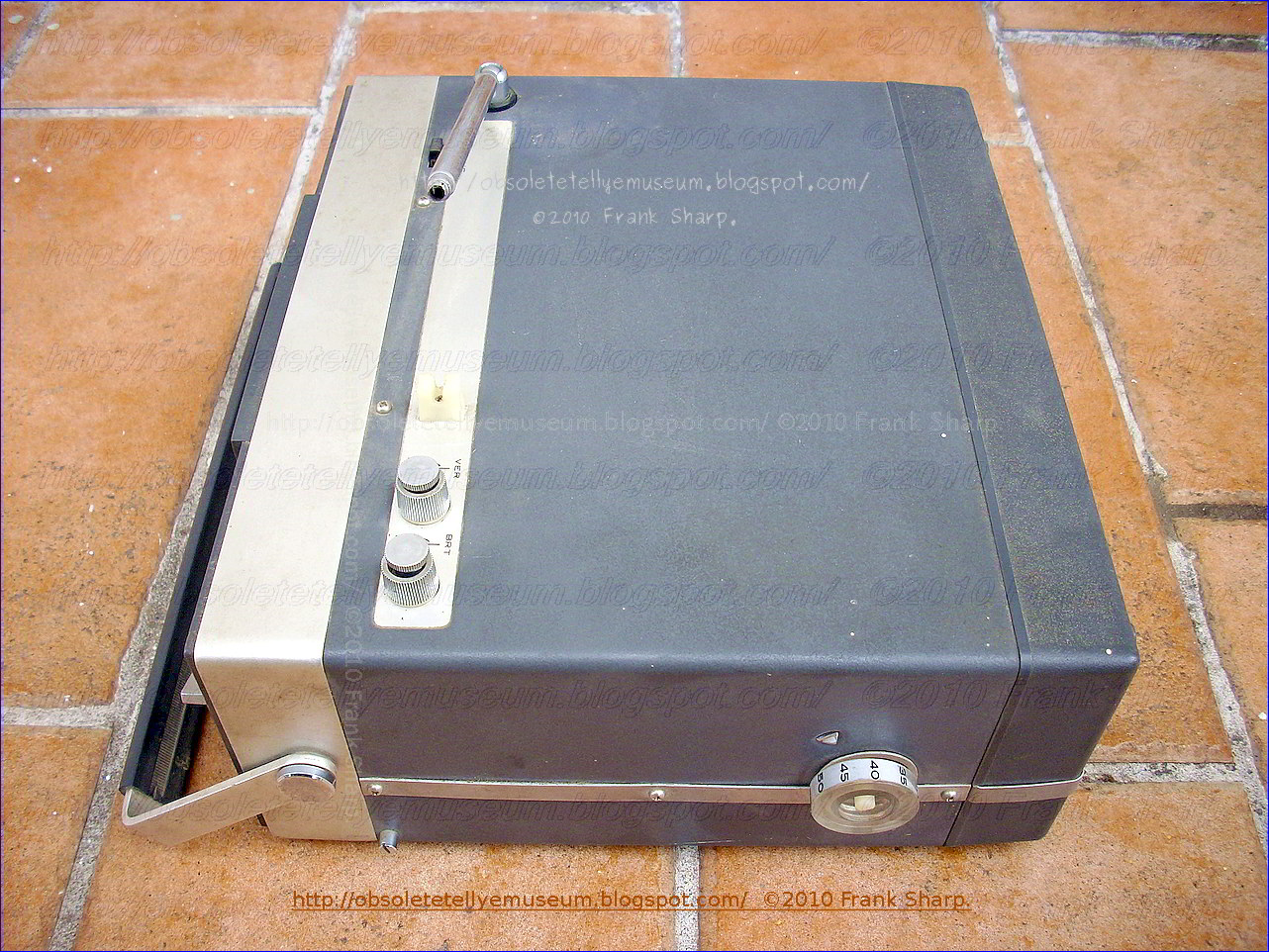
 The  UNIVERSUM FK100 (ART.06664) GROSSVERSANDHAUS QUELLE GmbH (CROWN CTV-18)  is a portable 8 inches ( 12 cm ) B/W television with VHF and UHF Rotatable transistorized tuners.Superheterodyne (common); ZF/IF 38400/5500 kHz,

Reception ranges : TV bands I and III with drum tuner, bands IV and V with capacitive tuned tuner without preamplifier.
 

The tuning has a automatic discrete AFC .
 The general concept of Automatic Frequency Control (AFC) for television receivers is known in the art and has been adapted to radio receivers as well as to television receivers of both the monochrome and color variety. The general purpose of such a system is to assist the user in attaining proper fine-tuning of the receiver without requiring critical manual adjustment. The advantage of such a system is self-evident but its value to a color receiver is markedly increased due to the fact that improper tuning of a color receiver manifests itself in incorrect colors, or even a total lack of color, in the reproduced image.
 Typically, the AFC system is tuned to a reference or center frequency corresponding to the desired video IF frequency and so long as the tuning is reasonably close, within the response of the AFC system, an error voltage is developed to correct the tuning. If the user of the television receiver makes the fine-tuning adjustment while the AFC system is operative, he may adjust it to a point where the picture is acceptable but a substantial amount of AFC correction voltage is required.

With dimensions of 255x95x230 mm and a screen diagonal of 12 cm, the device is no larger than a normal portable radio at that time.

  • The set can be powered both 110/220 volt mains AC or battery pack with modular power supply or even a 12volt DC car supply.
  •  In the device there is a battery box for 9 mono cells. However, with a power consumption of 5 watts, mains-independent TV was an expensive pleasure.
    A power supply and an adapter cable for operation on the car battery could be purchased for an additional charge.The power supply unit or the battery box are inserted into the housing, for which the rear cover can be removed by means of two knurled screws
    The power supply  contains a simple (selenium) rectifier and an electrolytic capacitor. A regulation is not built in. The feedback of the mains voltage is not very lush and the picture can occasionally "belly dance".

Loudspeaker:   Permanent Magnet Dynamic (PDyn) Loudspeaker (moving coil)  Power out  0.1 W

  • The FK100 was also installed as a control monitor in the desks of news editors at German ZDF in Studio 3 "Unter den Eichen".
  • In Wolfgang Menges WDR feature german  film "Das Millionenspiel" this radio version can also be seen.


  • The following accessories were available: Antenna adapter for 240Ohm, battery box, earphone (all three included), cable set for car connection and carrying case with shoulder strap. The instruction manual was also accompanied by the circuit diagram,
  • optionally, the RF signal can be fed in via an RCA socket on the right side or via the built-in telescopic antenna.


All the innards are in a sturdy sheet metal frame. The upper and lower casing shells are made of aluminum sheet. The lid on the back is made of plastic. The red and brown models are covered with imitation leather.

  • The TV line is easy to maintain, as it is equipped with fold-out modules that are plugged into female connectors.

It's, a nice, simple but solidly built device that is fun to work on. The technology is nice  and simple.
 

 The UNIVERSUM FK100 (ART.06664) (CROWN CTV-18)  tv  was manufactured in JAPAN , BY Crown Radio Corporation, 17-4, 3-Chome-Ueno, Taito-Ku, Tokyo. Production of radio receiving sets, television sets, tape recorders, transceivers, record players, pick-ups for record players, phonograph records, microphones, electric cells and electronic applied units.

 The  UNIVERSUM FK100 (ART.06664) GROSSVERSANDHAUS QUELLE GmbH (CROWN CTV-18) is an example of a light weight TV with great transportability feature and commodity.

  • Net weight (2.2 lb = 1 kg) 3.8 kg / 8 lb 5.9 oz (8.37 lb)

  •  Original price DM 295.

Quelle Group story

Nürnberger Strasse 91-95
8510 Fürth
Germany
(911) 742 3157
Fax: (911) 626 224

Private Company
Incorporated: 1927 as Gustav Schickedanz
Employees: 39,300
Sales: DM12.59 billion (US$8.31 billion)

The Quelle Group, headed by Gustav Schickedanz KG, is one of Germany’s largest retail and mail-order organizations. The mail-order business in Germany and adjacent countries is at the core of Quelle’s success. Quelle is the country’s second largest supplier of fashions and textiles, with its own trademarks and household catalog names: Shöpflin, Madeleine, Elégance, Peter Hahn, Euroval, and others. It makes its own Mars bicycles. Its own electrical goods are sold under the Matura, Universum, and Privileg trademarks. Quelle also operates 21 department stores, 151 technical speciality shops, 100 Apollo optical shops, 169 travel bureaus, 14 garden centers and is the franchiser of 1,103 partners in Foto-Quelle film and development shops. In the fiscal year ended January 1991, sales were up 23 % from the previous year.

Gustav Schickedanz, Quelle’s founder, was born in 1895, the son of a craft factory employee in Fürth, a small city adjacent to Nuremburg. He left school at the age of 15 to work at Speed and Son, the local branch of a sportswear firm. He soon was due to be appointed as a company representative in South America, but he decided to complete his army-service obligation first. World War I broke out and an expected service period of one year turned into seven. He was wounded and discharged in 1919. Schickedanz returned to Fürth where he worked as a salesman and married Anna Zehnder, a local master baker’s daughter, in September 1919. In 1922, he opened a small haberdashery business and struggled to keep the firm going in the midst of Germany’s period of hyperinflation. His employees were his father, wife, and sister.

Economic reforms led to a degree of stabilization and a short period of improvement. Schickedanz’s observations of customer behavior led him to believe that he could sell to a larger market through the mail. With the resulting low overheads and greater volume, he could offer lower prices. These ideas were not new, but hyperinflation presented great difficulties to mail-order firms. The new stabilization convinced him that mailorder could work. The mail-order venture opened in November 1927. The name chosen for the company, Quelle, means “source” in German. Schickedanz hired 15 new workers. One, Grete Lachner, would one day become his second wife and play an essential role in the company’s future.

His first catalogs emphasized wool, thread, and materials for home sewing, rather than ready-to-wear clothes. The company enjoyed a modest success in its first 18 months of operation. Schickedanz’s 33-year-old wife Anna and their 5-year-old son were killed in an auto accident in July 1929; his 72-year-old father died shortly afterward. His problems were compounded by the Wall Street crash, which halted the German economy’s faltering recovery and threw millions out of work. Schickedanz’s sister, Liesl Kiesling, stepped into Anna’s position in the company.

By the end of 1930, five million Germans were unemployed. Schickedanz’s new business survived, however, and, especially by the standards of the Great Depression, prospered. Quelle was able to offer lower prices than many shops, and quickly developed a reputation for reliability and good value. Soon Schickedanz began to offer more clothes and accessories. By 1934 Quelle had 250,000 customers. By 1936 this number had grown to a million, the majority of whom were women.

This success came about despite the restrictions on trade introduced by Adolf Hitler’s new Nazi regime, which came to power in January 1933. As Jews began to leave or face imprisonment, they disappeared as competitors in the clothing trade. In 1935 Schickedanz bought VP, a paper factory, to publish catalogs and make cartons. This factory had been Jewish property. Some suspected him of having an invisible Jewish partner, but this was never proved. World War II began on September 1, 1939, and the Nazis required that the paper factory be turned over to war work. Schickedanz continued to operate under severe restrictions and clothing rationing, but the dislocations of the war meant that mailorder provided an alternative source of supply to people in bombed-out cities. Schickedanz was offered several positions as an economic administrator, but he preferred to remain with the business.

In 1942 Schickedanz married Grete Lachner. One year later their only child was born in a bomb-proof bunker. As Allied bombers began to attack the Nuremburg-Fürth area, the Schickedanz family moved out to quarters in the nearby forest village of Hersbruck. In August 1943 Quelle was virtually put out of business when an Allied bombing raid destroyed 90% of the company’s warehouse in Fürth. On April 19, 1945, American troops occupied the ruins of Fürth and Nuremburg. Three weeks later, Germany surrendered. Although the Schickedanzes were fortunate to find themselves in the U.S. zone of occupation, their enterprise was not initially encouraged. Schickedanz was classified as a Nazi by the occupation authorities and prohibited from reopening his business. Buildings were in ruins or requisitioned by the occupation authorities and customer records had been lost.

Grete Schickedanz opened a small clothing shop in Hersbruck to support the family. It was a success, but was closed by the military authorities. Eventually, the Schickedanzes were able to use the influence of the anti-Nazi politician and economist Ludwig Erhard, a family friend who was also from Fürth, to gain permission to reopen. The Hersbruck shop remains open as one of Quelle’s smallest retail outlets.

Gustav Schickedanz remained under a prohibition and, in theory, could not even discuss business with former employees. The ban was removed in 1949. Former employees were found and Quelle was off to a fresh start. It was just in time to benefit from Ludwig Erhard’s currency reforms of the previous year. Following the founding of West Germany in 1949, Erhard moved as quickly as possible to remove restrictions and rationing and to encourage competition. He believed that sales of consumer goods would encourage production and jobs.

After many years of hardship, Germans responded by going on a buying spree. The Quelle name was remembered and respected by many former customers. By utilizing previous contacts, Grete Schickedanz was able to obtain superior but inexpensive goods for sale. It was on this foundation that the new Quelle was built. By the end of 1949 Quelle had a turnover of DM12 million and mailing list of 100,000 addresses, but the couple had also opened their first department store.

Germany, especially, benefited from the economic expansion stimulated by the Korean War in the early 1950s. Between 1949 and 1952 the company’s turnover rose by 900%. By 1952 Quelle had one million credit customers and sales of DM103 million. The company now faced the classic problems of a successful business: how to expand without overextending and damaging a reputation for quality. The answer was to invest in new computer and data processing technology that was just appearing in the United States and barely known in Europe.

Schickedanz hired the best experts and gave them a free hand to design systems that would enable Quelle to handle millions of mail-order and credit transactions per year. Thirtyfive engineers from the firm SEL in Stuttgart worked for two years to develop and set up a system appropriate for Quelle’s needs. In 1955 the first phase of the company’s new mailorder center was finished. By 1957 SEL had completed the building of the new system. It was one of the most sophisticated mail-order computer information systems and attracted worldwide interest. Quelle was able to rationalize its operations and achieve even greater efficiency. The company has continued to give high priority to updating its computer and data information systems. In 1990 it maintained information on some 32 million customers.

A new emphasis was placed on quality control. In 1953 Schickedanz set up an institute for testing products to be sold through Quelle. It became known as the Quelle Institute fur Warenprüfung and is the largest institute of its kind in German commerce. At first only textiles were tested, but gradually it began to examine other product types. In 1990 it had made more than 25,000 annual tests. The institute also attracted international interest.

Grete Schickedanz was increasingly responsible for buying. She also directed careful attention to new catalogs and added more color pages. By 1954 more than half the pages of the spring-summer catalog were in color. She carefully monitored fashion trends. Later, the company hired prominent German designers such as Heinz Oestergard as advisers.

The range of mail-order products was continually expanding. In 1954 the company bought a bicycle factory and began to sell bicycles. The next year, a favorable response to a line of small electronic appliances led to the introduction of washing machines and large appliances, which Quelle was able to offer at very competitive prices. In 1957 one of its most successful ventures was into photographic equipment, where it was able to offer large mail-order discounts. By the early 1960s it was even offering travel services.

Quelle learned how to target special-interest groups and to develop special catalogs alongside its main catalog to spotlight lifestyle groups and hobbies such as gardening. A bank, NORIS Bank GmbH (later Quelle Bank) was started in 1956 and developed to help customers with credit. By 1958 Quelle had a turnover of DM406 million. It had become the largest mail-order firm in West Germany.

From the early 1960s, Grete Schickedanz traveled to the Far East on buying trips. In 1962 Quelle opened an office in Hong Kong. Eventually, the region became one of the company’s most important sources of supply. Later, Grete Schickedanz established important business contacts in the People’s Republic of China and opened an office in Shanghai.

In 1964 Quelle had a turnover of DM1.64 billion and called itself “the largest mail-order house in Europe.” The 1960s and 1970s were a period of continued growth for Quelle in Germany, but unlike its competitor, Otto Versand, which made a very successful investment in Spiegel in the United States, Quelle has been more cautious about foreign expansion. The process has been slow, mainly into neighboring countries. It began in 1959 with Austria, where results were so encouraging that the company decided in 1966 to make a much more risky move into France, opening a new mail-order facility in Orleans.

Gustav Schickedanz died on March 27, 1977, in the 50th anniversary year of the company. He was succeeded as chairperson by Grete Schickedanz. Because the two had worked as partners for many years, Gustav’s death did not disrupt the company or bring about any major policy changes. Grete continued her worldwide buying trips. By 1981, Quelle had a turnover of DM10 billion.

In May 1985 Grete Schickedanz broke new ground in West German-East European trade politics by signing an agreement with Hungarotex, the Hungarian foreign trade organization. The agreement allowed Quelle to sell by mail in Hungary and included plans for a new chain of jointly owned department stores. In 1990 Quelle started Intermoda, a joint-venture catalog operation in the Soviet Union. In 1987 Grete Schickedanz relinquished her position as chairperson of the board of Quelle, but she remained as head of its supervisory board. Into the 1990s she still traveled widely on behalf of the company.

The speedy German reunification process, which began with the collapse of the East German regime in November 1989 and culminated a year later, presented both new markets and challenges from Otto and other German competitors. Quelle moved quickly to distribute its catalog to nine out of ten households in the former East Germany. New stores and facilities were opened in Gera, Jena, and Erfurt. A huge new regional mail-order complex was opened in Leipzig, creating 3,000 new jobs. Quelle described its investment in the new Germany as the largest in its history, creating a total of 7,000 new jobs.

At the end of 1990, Quelle surprised many German financial institutions by entering into a new agreement, through its subsidiary Quelle Bank, with the Bank of Scotland to enter the undeveloped German credit card market. The German market had been thought to be resistant to credit cards. According to the plan, Quelle was to offer direct banking and credit card services using its mail-order data base, with more than 30 million customers in Germany, France, and Austria. Bank of Scotland would handle the processing in its facilities in Dunfermline, Fife, Scotland. Quelle expected to issue about one million cards in its first five years. With the 1992 European economic unification approaching, Quelle sought to acquire a foothold in the United Kingdom and began negotiations with Littlewoods for its mail-order division.
Principal Subsidiaries

Quelle Beteiligungs GmbH; Quelle AG; Foto Quelle; Apollo-Optik GmbH; Möbel Hess GmbH; Quelle Bank GmbH (25%); Sinn AG (51%); Grossversandhaus Schöpflin GmbH (99%); Peter Hahn GmbH; Elégance; Madeleine Mode GmbH; UTS Universal Technik-Service GmbH; Quelle S.A. (France, 99%); Distribución Quelle S.A. (Spain, 51%); Peter Hahn AG (Switzerland).
Further Reading

Grete Schickedanz: Ein Leben für die Quelle, Fürth, Quelle, 1986.

some references:


Rüdiger Dingemann, Renate Lüdde: Die Quelle-Story. Ein deutsches Unternehmen im Spiegel der Zeit. Bucher, München 2007, ISBN 978-3-7658-1616-1.
Peter Zinke: „Er drohte wieder mit der Gauleitung“ – Gustav Schickedanz und die Arisierungen. In: Nurinst 2008. Beiträge zur deutschen und jüdischen Geschichte: Schwerpunktthema: Entrechtung und Enteignung. Antogo, Nürnberg 2008, ISBN 978-3-938286-34-0, S. 63–80

Weblinks


Commons: Quelle-Versandhaus – Sammlung von Bildern, Videos und Audiodateien
quelle.de
quelle.at
quelle.ch
travel.quelle.de (REISE QUELLE hat den Betrieb der reisequelle.de zum 30. November 2009 eingestellt)
Quelles düstere Vergangenheit. In: Cicero.
Gustav Schickedanz: Seine Nachfolger hatten nie eine Chance. In: FAZ.net, 20. Oktober 2009.
Gunhild Lütge: Maximaler Schaden - Quelle wird abgewickelt. In: Die Zeit. 44/2009, 22. Oktober 2009.
Abschied vom Quelle-Katalog - Der Besteller-Bestseller. In: Spiegel online. 23. Oktober 2009.
Gelungener Neustart – 100 Tage Quelle.de Pressemitteilung vom 1. August 2013
Quelle – von Versandkatalogen, Konsumgeschichte und Technikläden In: Retropie, 28. Dezember 2019.


Arcandor Konzerngeschäftsbericht 2007/2008 (Memento vom 11. Juni 2009 im Internet Archive) S. 112. (pdf; 1,8 MB)
Quelle ist wieder da – als Online-Marktplatz. auf: www.heise.de, 10. August 2011.

[Korrektur] Arcandor weist Quelle-Umsätze von 2,45 Mrd. Euro aus. (Memento vom 30. Januar 2013 im Internet Archive) www.excitingcommerce.de

(Seite nicht mehr abrufbar, Suche in Webarchiven: Impressum der Website)

Fräulein Gretel von der Quelle. In: Die Zeit. 24/2003, abgerufen am 24. Oktober 2009.

Süddeutsche Zeitung. 24. Juli 2009, S. 12.

Klaus-Dietmar Henke, Johannes Bähr, Dieter Ziegler, Harald Wixforth: Die Dresdner Bank im Dritten Reich. Band 2: Die Dresdner Bank und die deutschen Juden. Oldenbourg Wissenschaftsverlag, München 2006, ISBN 3-486-57781-6.

Familie Schickedanz: Mit dem Quelle-Katalog wurde sie steinreich. auf: www.bild.de, abgerufen am 24. Oktober 2009.

Biografie Grete Schickedanz. auf: www.whoswho.de, abgerufen am 19. Mai 2010.

Peter Zinke: „Er drohte wieder mit der Gauleitung“ – Gustav Schickedanz und die Arisierungen. In: nurinst 2008. ISBN 978-3-938286-34-0, S. 63–80 (antogo-verlag.de [PDF; 145 kB; abgerufen am 24. Oktober 2009]).

Quelle: „Wollen! Wägen! Wagen!“ auf: www.handelsblatt.com, abgerufen am 24. Oktober 2009.

Hans Dedi: Ein Quelle-Chef aus Murg. auf: suedkurier.de, 23. Oktober 2009, abgerufen 18. Dezember 2012.

Quelle-Verkauf: Otto kauft die Marke Quelle, zeit.de, 5. November 2009

(Seite nicht mehr abrufbar, Suche in Webarchiven: Quelle wird von Otto zum Leben erweckt.) auf: www.unternehmer.de

Quelle auf einen Blick: Größtes Homeshopping-Unternehmen in Europa. (Memento vom 29. Januar 2009 im Internet Archive) auf: www.quelle.com, abgerufen am 27. März 2009.

Spiegel Online vom 19. Dezember 2009: Quelle schließt endgültig seine Türen, abgerufen am 24. Juli 2019.

nordbayern.de vom 19. Dezember 2009: Quelle-Kaufhaus – Der allerletzte Feierabend, abgerufen am 24. Juli 2019.

Sabine Stoll: Der Quelle-Komplex geht an großen Immobilien-Entwickler. In: Nürnberger Nachrichten. 27. Juni 2018. (online auf www.nordbayern.de)

Neuer Investor: Quelle-Komplex wird kein Shoppingcenter. auf: www.nordbayern.de, 5. Juli 2018.

Druck des Quelle-Katalogs angelaufen. (Memento vom 28. März 2010 im Internet Archive) auf: druck-medien.net, 22. Juni 2009.

Archiv von Foto-Quelle-Katalogen, abgerufen am 6. August 2011.

Quelle nimmt Möbel-Eigenmarke Casamaxx in den Katalog auf. In: Horizont. (horizont.net [abgerufen am 31. Juli 2018]).

Deutschland liegt beim Internethandel zurück. In: IT Times. 13. Dezember 2007.

Arcandor stellt Insolvenzantrag. auf: finanznachrichten.de, 9. Juni 2009.

Zehn Gründe für den plötzlichen Quelle-Tod. auf: www.bild.de, abgerufen am 24. Oktober 2009.

Der Kredit für Quelle kann fließen. auf: www.focus.de, 7. Juli 2009, abgerufen am 24. Oktober 2009.

Notkredit für Quelle beschlossen. bei: tagesschau.de, 29. Juni 2009.

Massekredit für Quelle wird ausgezahlt. auf: www.focus.de, 10. Juli 2009, abgerufen am 24. Oktober 2009.

Der Quelle-Katalog kommt. auf: www.focus.de, 14. Juli 2009, abgerufen am 24. Oktober 2009.

Insolvenz – Quelle ist am Ende. (Memento vom 31. Juli 2012 im Webarchiv archive.today) In: Financial Times Deutschland. 19. Juli 2009.

Versandhaus Quelle vor dem Ende. auf: diepresse.com, 15. Oktober 2009.

Engültige Liquidation des Traditionshauses Quelle. (Memento vom 15. Dezember 2009 im Internet Archive) auf: www.unternehmer.de, 11. November 2009.

«Lagerräumung» - Quelle räumt die Lager - Kundenbestellungen werden ausgeführt. (Memento vom 20. Oktober 2009 im Webarchiv archive.today) In: AD HOC NEWS.

Schnäppchen-Jäger aufgepasst: Am Sonntag beginnt Quelle-Ausverkauf. auf: www.merkur.de, 30. Oktober 2010.

Zu hohe Kosten: Quelle stellt den Internet-Ausverkauf ein. auf: www.stern.de, 26. November 2009.

Bei Quelle gehen die Lichter für immer aus. (Memento vom 31. Juli 2012 im Webarchiv archive.today) In: Financial Times Deutschland. 18. Dezember 2009.

Abwicklung trotz Staatshilfe – Bei Quelle ist vor Weihnachten Schluss. (Memento vom 24. Oktober 2009 im Internet Archive) In: Financial Times Deutschland. 19. Okt. 2009.

Aus für Quelle: Region Nürnberg/Fürth unter Schock. auf: www.merkur.de, 21. Oktober 2009.

Aus für Quelle. (Memento vom 4. Januar 2010 im Internet Archive) auf: augsburger-allgemeine.de, 20. Oktober 2009.

Bei Quelle lächelt nur noch Madeleine Schickedanz. auf: www.welt.de, abgerufen am 24. Oktober 2009.

Nürnberg und die Quelle-Pleite. In: Spiegel online. 23. Oktober 2009, abgerufen am 24. Oktober 2009.

Arbeitsagentur richtet Außenstelle bei Quelle ein. auf: www.welt.de, abgerufen am 24. Oktober 2009.

Deutsche Post: Nach Quelle-Aus drohen Stellenstreichungen bei DHL. In: Focus Online. 22. Oktober 2009, abgerufen am 7. Dezember 2014.

Quelle Österreich-Konkurs. auf: www.konsument.at, 17. November 2009.

Kurier: Quelle-Packerln wandern ins Otto-Reich. (Memento vom 8. März 2010 im Internet Archive) auf: kurier.at, 5. März 2010.

QUICK 24 – Magazinul dumneavoastra online. (Memento vom 3. Januar 2013 im Internet Archive) Vorstellung der Umbenennung der Quelle Rumänien in Quick24.

Homepage von Quelle in Ungarn. Abgerufen am 19. Oktober 2010.

Bei Quelle gibt es keine Waschmaschinen mehr. auf: www.welt.de, abgerufen am 6. November 2009.

Quelle-Lieferanten fühlen sich von Görg betrogen. auf: www.welt.de, 6. November 2009, abgerufen am 6. November 2009.

Otto kauft die Marke Quelle. In: Spiegel Online. 5. November 2009, abgerufen am 7. Dezember 2014.

 (Seite nicht mehr abrufbar, Suche in Webarchiven)

Otto darf Quelle-Marken mit Einschränkungen nutzen. In: handelsblatt.com. 16. Februar 2010, abgerufen am 7. Dezember 2014.

Otto reaktiviert Quelle-Website. In: handelsblatt.com. 19. März 2010, abgerufen am 7. Dezember 2014.

Gläubigerausschuss genehmigt Verkauf von Home Shopping Europe. (Memento vom 13. November 2009 im Internet Archive) auf: www.arcandor.de.

Quelle-Call-Center werden übernommen. In: handelsblatt.com. 16. November 2009, abgerufen am 7. Dezember 2014.

Küchen-Quelle: Hamburg macht dicht - aber es besteht weiter Hoffnung. auf: www.moebelkultur.de

Investorengruppe „Franken“ übernimmt Küchen-QUELLE. (Memento vom 30. November 2009 im Internet Archive) auf: www.arcandor.de, 20. November 2009.

www.kuechen-quelle.de

Neustart für Website und Privileg - Quelle lebt. (Memento vom 27. März 2010 im Internet Archive)

ORWO Net übernimmt die Marke Foto Quelle. (Memento vom 20. August 2012 im Internet Archive) Pressemitteilung der ORWO Net GmbH, 27. November 2009. (PDF-Datei; 122 kB)

RTS Elektronik Systeme GmbH übernimmt Profectis. (Memento vom 4. Mai 2010 im Internet Archive) auf: www.profectis.de, 18. Dezember 2009.

https://web.archive.org/web/20160301103407/http://www.textilwirtschaft.de/business/Halens-uebernimmt-vier-Quelle-Landesgesellschaften_61507.html

Schwedischer Versandhändler kauft CEE-Quelle. auf: derstandard.at, 22. Jänner 2010.

 (Seite nicht mehr abrufbar, Suche in Webarchiven)

Investor für Quelle-Spezialkatalog gefunden - Mittelständler will Versand von Gesundheitsprodukten fortführen. (Memento vom 7. September 2012 im Webarchiv archive.today) In: Nürnberger Nachrichten. 6. Februar 2010.

www.dr-hein.com

Unito führt Quelle und Ackermann in der Schweiz weiter. auf: www.textilwirtschaft.de, 12. Mai 2010.

Otto erweckt Quelle 2011 wieder zum Leben. auf: www.nachrichten.at
 
* https://www.encyclopedia.com/books/politics-and-business-magazines/quelle-group

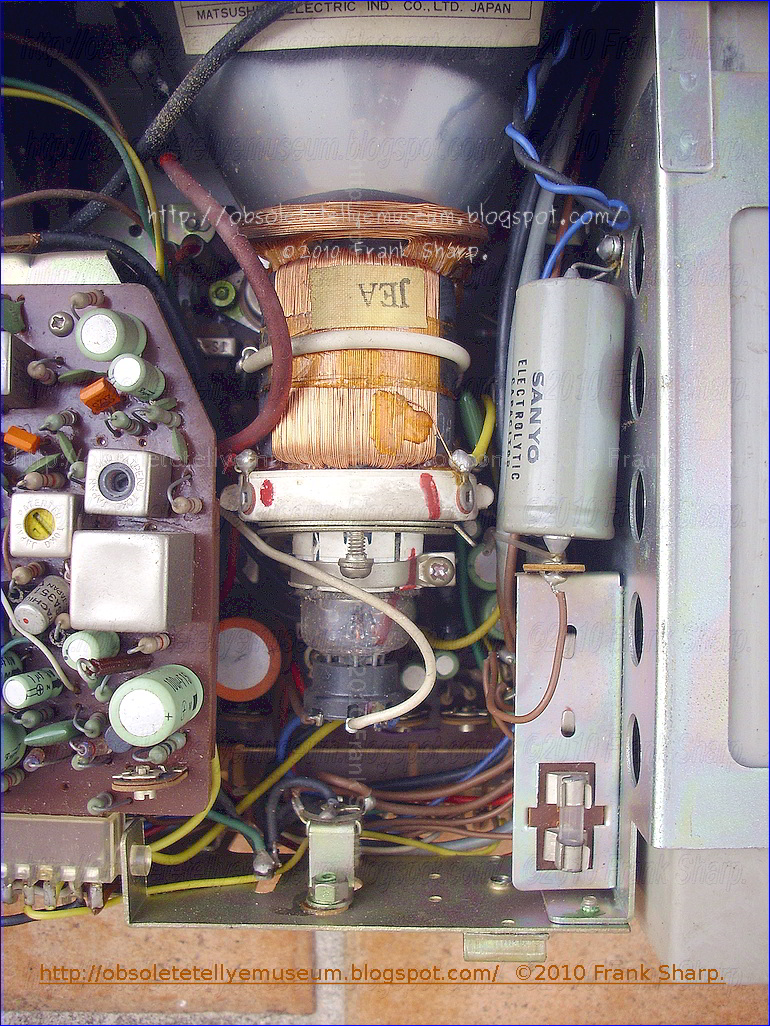
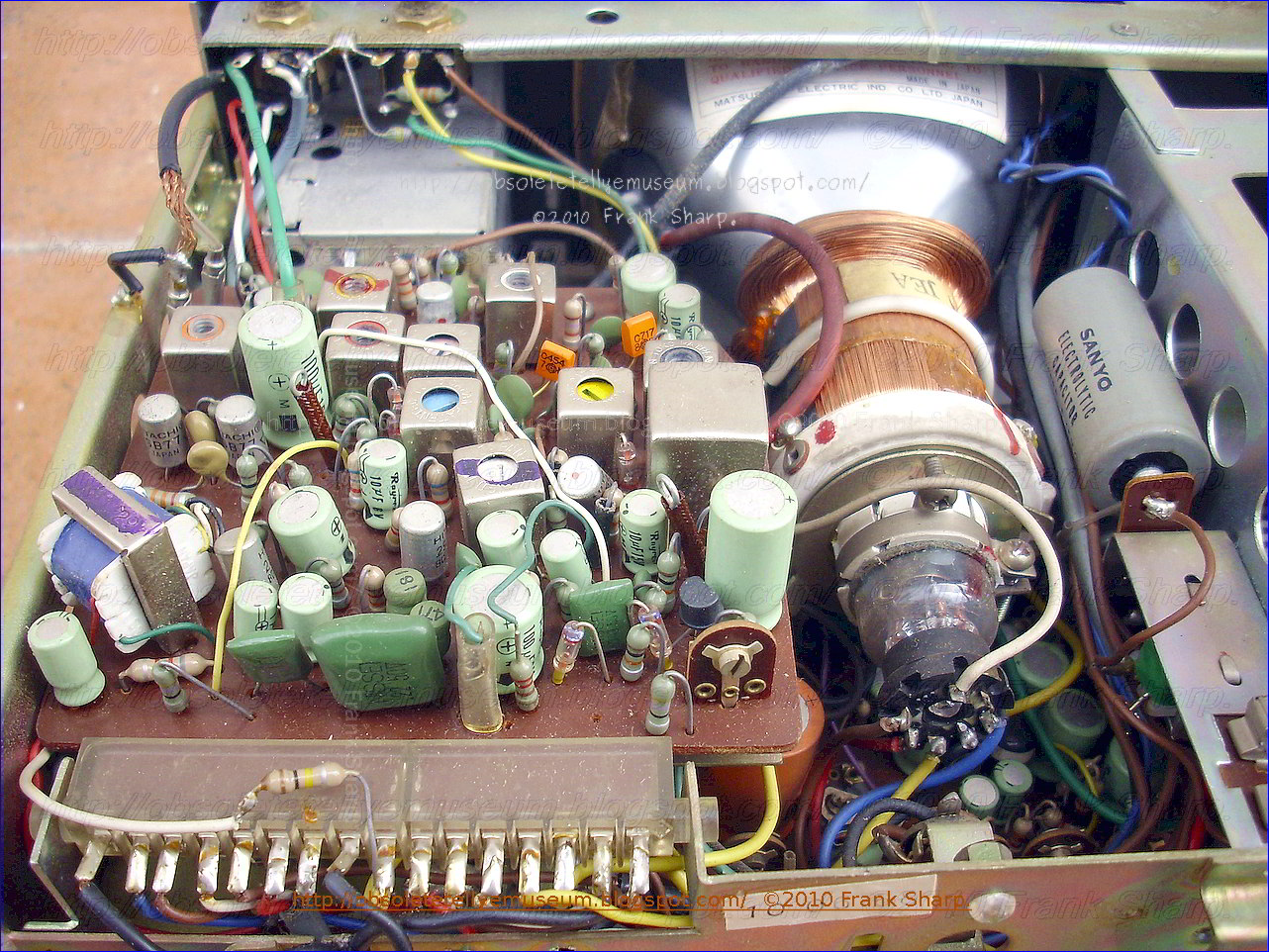
UNIVERSUM FK100 (ART.06664) (CROWN CTV-18) CHASSIS CROWN AM-B INTERNAL VIEW


Upside signals pwb, downside thw synch/deflections panels. 

  • A BLOCK CIRCUIT:  AM-B-332 ; 
  • B BLOCK CIRCUIT:  AM-B-323 ;
  • C BLOCK CIRCUIT:  AM-B-352; (SUPPLY OUT)
  • VHF TUNER:  AM UF-18
  • UHF TUNER: AM UF-12
  • EHT FLYBACK LOPT:  AM-WM-4
  • AUDIO OUT TRANSFORMER:  AM-T-229

The set can be powered both 110/220 volt mains AC or battery pack with modular power supply or even a 12volt DC car supply.

 In the device there is a battery box for 9 mono cells. However, with a power consumption of 5 watts, mains-independent TV was an expensive pleasure.
 A power supply and an adapter cable for operation on the car battery could be purchased for an additional charge.The power supply unit or the battery box are inserted into the housing, for which the rear cover can be removed by means of two knurled screws
 The power supply contains a simple (selenium) rectifier and an electrolytic capacitor. A regulation is not built in. The feedback of the mains voltage is not very lush and the picture can occasionally "belly dance".

All the innards are in a sturdy sheet metal frame. The upper and lower casing shells are made of aluminum sheet. The lid on the back is made of plastic. The red and brown models are covered with imitation leather.
 The TV line is easy to maintain, as it is equipped with fold-out modules that are plugged into female connectors.
It's, a nice, simple but solidly built device that is fun to work on. The technology is nice and simple.

UNIVERSUM FK100 (ART.06664) (CROWN CTV-18) CHASSIS CROWN AM-B CRT TUBE MATSUSHITA


Thursday, October 21, 2021

MAGNADYNE MOD. CR93 YEAR 1968.


  The MAGNADYNE MOD. CR93 is a 19 inches B/W television  and a fumè front heavy dark glass.

Backside VHF and UHF 300 ohm antenna inputs and usual controls for frame /  line amplitude and frequency.

  • Tuning is with 2 programs selection with VHF and UHF channels selectors and manual tone controls and classic brightness / contrast / volume.


These sets were cheap and branded even with other names:ETERPHON KENNEDY RAYMOND VISIOLA and DAMAITER.

  • the set is almost completely tubes based.

  •   Was first model series with a UHF tuner  transistorized.


The tellye here in collection is a ELCIT branded .MAGNADYNE.

In Brief ...........   SEIMART / ELCIT and its conglomerate was even proprietary of brands like:

ETERPHON KENNEDY RAYMOND VISIOLA and DAMAITER.

and

MAGNADYNE + KENNEDY


Founded in 1922 in Torino ELCIT was a Radio fabrication industry which in the 1953 joined Visiola to produce television sets and other domestic appliances such washing machines and fridge.

ELCIT Was even proprietary of the MAGNADYNE brand which WAS a radio and Television well known brand.

In the 1960 the society was joined and aquired by SEIMART because of a market contraction which landed to GEPI a new society which re - founded ELCIT.

The conglomerate of ELCIT AND SEIMART which was a joint developed by GEPI a government special system invented to "save" industry with "some" difficulties (!!!) was unified.


and;

The following sub brands were even from the group but were specialized in other fields like
preparing materials, developing parts and other jobs like domestic appliances and even CRT TUBE manufacutring.

NEOHM was a resistor fabricant and was part of the group

Basically the industry group was completely autonomous exept for semiconductors which were coming from other well known brands and manufacturers.

RADSET
VISSET

NEOHM was a resistor fabricant and was part of the group
conglomerate and components factory.

VITAUT (SCREW AND PARTS)
STAMPLAST
STAMFER

BOBSET
CIRSTA
FRIMAX
MOBFER P (METAL PARTS)

TRAMAX
FINPLAST (PLASTIC)
VALVEX
(CRT TUBES)

ELCIT died in 1998 by typically Italian Industry Destroy culture and all workers and employee landed.......... on the street !!!!!!!!!!!!!

The Magnadyne Radio, known simply as Magnadyne, was an Italian manufacturer of consumer electronics, electronic components and household appliances in Turin, controlled by the financial holding INFIN S.a.s., active from 1928 to 1955, among the largest in its field at the national level. Ceased to exist as a company, it became a simple commercial brand, which after the bankruptcy of INFIN in 1972, passed under other properties.

The company Magnadyne Radio was founded in 1928 in Turin on the initiative of Mr. Mario Pesce with Mr. Paolo Dequarti as a silent partner, from the change of name of Accumulatori Ohm, owned by the same Pesce. The object of the new company was the construction of radios, electric accumulators and refrigerators.
Its registered office was located in Via Sant'Ambrogio 8, in the Turin district of Pozzo Strada, in the building owned by Pesce, and next to it, at number 10, stood the shed where its activities were carried out, owned by Candido Viberti.
At the time of its establishment, the number of workers employed was of 20 units.

The development of the company was rapid and its products exceeded in sales on the Italian market, larger companies such as CGE, FIMI-Phonola, Philips and Radiomarelli.

In 1931, Magnadyne took part for the first time in an exhibition, the III National Exhibition of Radio in Milan, where was presented the four-valve radio M10.

Three years later, in 1934, at the VI edition of the same exhibition, Magnadyne took part in the exhibition of radio receivers of popular type, organized by the Ente Radio Rurale and the National Research Council, sponsored by the Ministry of Communications, and presented three, four and five valves radio receivers, and four and five valves radiophonographs.
 The number of employees employed by the Turin company reached 300 units in 1936, and grew further the following year, in 1937, when Dequarti took over the S.A. ing. Clemente Diena & C., a company producing telegraphic equipment that employed 61 people and was located in Via Avellino 6, in the San Donato area, whose name was changed to Magnadyne S.A..

The equipment was entirely produced by the Turin company, both in their internal electronic part - except for the thermionic valves supplied by third parties - and in the external part, i.e. the ebony casing.
 The production criteria were modern, based on the industrial production of large-scale series.
 Magnadyne, on the eve of World War II employed over 1,000 workers, and to the production of radio receivers and electronic components were added those of car radios and refrigerators.
 The first car radio model produced by Magnadyne, four valves, in 1937 won a competition organized by RACI.
 
 At the end of the conflict, production, albeit to a limited extent, could be resumed, with the production of components for radio receivers. In 1948, faced with a revival of sales in the radio equipment sector, a new factory was opened in Turin, Via Avellino 6, entirely dedicated to the production of electronic components, where the company's registered office was also transferred.
Four years later, in 1952, the company also started the internal production of thermionic valves.


  • In 1955, Magnadyne Radio ceased to exist as a company, and consequently brand and activities were merged into the holding INFIN S.a.s. di Dequarti & C., established two years earlier in Freiburg.
  •  This company, which became known as INFIN-magnadyne, its activities were diversified with the production of televisions, cathode ray tubes and washing machines, and since 1961, of transistors.
  •  The equipment produced by INFIN-Magnadyne were also marketed under other brands, such as Belvis, Damaiter, Eterphon, Nova, Radioson, Raymond and Visiola.
  • In 1964, the INFIN-Magnadyne Group had about 5,000 employees - half of which were employed in the plant in Sant'Antonino and the rest in the three factories in Turin and in the commercial offices scattered throughout the Italian territory - and starting from that year, it showed the first signs of crisis, mainly due to the increase in production costs, the decline in exports and the decline in installment sales of equipment.
  •  The crisis of the Piedmontese company worsened afterwards: the industrial activities were downsized, as well as the number of employees, reduced to 3,300 in 1970, and it also found itself facing other problems, such as a liquidity crisis, debts for 2 billion lire, suspension of credits, and blocking of material supplies by subcontracting companies.
  • In January 1971, Dequarti was solicited by Edoardo Calleri, president of the Piedmont Region, and Carlo Donat-Cattin, minister of labor, to request admission to the receivership procedure for his company (whose factories were occupied by workers), but the interested party, concerned that such a solution could lead to bankruptcy, did not provide any response in this regard, and the following month, in February, the same Piedmontese governor promoted the establishment of SEIMART, in order to take over the management of activities and absorb the workers of INFIN-Magnadyne.


 Shortly afterwards, in March, Dequarti asked for and obtained the admission of INFIN to receivership by the Court of Turin, which appointed Piero Piccatti as judicial commissioner.

 SEIMART rented the four factories of INFIN-Magnadyne in Turin and Sant'Antonino di Susa, took charge of the 2,000 workers who worked there, and at the expiration of the contract, in April 1972, began negotiations with the property to purchase the factories and machinery.

 After three months, in July, the negotiations between Dequarti and SEIMART failed due to the failure to reach agreement on the sale price, for which SEIMART was willing to pay 700 million lire compared to the 3 billion requested by Dequarti.
 The failure to reach an agreement between the parties provoked new unrest from the workers (at risk of dismissal by SEIMART), who occupied the factories, and this situation led the prefect of Turin, Dr. Giuseppe Salerno, to issue a decree ordering the requisition of the INFIN-Magnadyne plants and the resumption of production activities.


In November 1972, the sixth bankruptcy section of the Court of Turin declared INFIN bankrupt, following the judges' rejection of Dequarti's request for a composition with creditors.
 At the origin of the decision was the serious financial instability found during the administration of Dr. Picatti, who summoned the creditors to file for bankruptcy.

 The debt accumulated by INFIN amounted to 11 billion lire.
 Following the bankruptcy of the Dequarti Group, the tangible and intangible assets owned by the subsidiary companies were auctioned off: in November 1975, SEIMART, through its subsidiary Beta-Geri S.p.A., acquired at auction "without auction" the plant in Sant'Antonino di Susa, with its machinery, its 900 employees and the Magnadyne and Kennedy trademarks, for 750 million lire

 One month later, in December, SEIMART together with Magneti Marelli, established a new company, SEIMART Elettronica S.p.A., with registered office in Turin, where the production activities of the two companies were merged, with the brands Magnadyne, Kennedy, LESA, Radiomarelli and West.


SEIMART Elettronica, which shortly afterwards assumed the company name ELCIT Elettronica Civile S.r.l., was the fourth largest Italian manufacturer of consumer electronics and in 1978 produced 26,000 televisions and had a market share of 2.3%.

 The electronics industry in Italy, in the period between the end of the seventies and the beginning of the eighties, was in a serious crisis due to technological delays and aggressive competition from foreign producers, and therefore in 1982 the Ministry of Industry established REL, a financial company created with the aim of rehabilitating companies in the sector: ELCIT, which in that year had achieved a turnover of 33 billion lire and had 630 employees in the Valsusino factory, was excluded from the intervention of REL, since it was controlled by GEPI and was in fact in public hands.
 In addition to television sets under the Magnadyne and Radiomarelli brands, ELCIT also produced computer monitors for Olivetti and other computer companies.

For much of the 1980s, the business performed reasonably well, despite the technological constraints.

  • The modest levels of profitability recorded by ELCIT led GEPI to initiate liquidation proceedings in May 1990 for the company and its employees, who were reduced to just 287 units.
  •  The following month, in June, the liquidation procedure was suspended by GEPI, following the mediation of the mayor of Sant'Antonino Val di Susa, and the employees were granted a redundancy fund.
  •  In May 1991, ELCIT was privatized and sold to Sandretto, a well-known Piedmontese manufacturer of injection molding machines, but at the same time 115 employees were made redundant in accordance with agreements made between GEPI and the buyer.
  • The new owners made large investments to relaunch and diversify production, but nevertheless found it too difficult to compete in the market, now characterized by aggressive competition from Asian and Turkish products. Thus, in 1997, 83% of the staff were laid off.
  •  In 1998, in the absence of measures to continue the natural course of the activities, the company closed down definitively, laying off the 100 employees who remained in the plant of Sant'Antonino di Susa, which was dismantled in parallel with the disappearance of the Magnadyne brand from the market.


A good point  on good  old  B/W Televisions.....................

The Sixties was a time of great change for TV. At the start of the decade there were just monochrome sets with valves, designed for 405 -line transmissions at VHF. By the end there was 625 -line colour at UHF, with transistorised chassis that used the odd IC.

The following decade was one of growth. The "space race" had begun in 1957, when the USSR launched Sputnik 1 and terrified the Americans. Thereafter the USA began to spend countless billions of dollars on space missions. This got underway in earnest in the Sixties, with the announcement that America would be going all out to get a man on the moon by the end of the decade. There followed the Mercury series of earth - orbit missions, then the Apollo launches. Success was achieved in 1969. Most of these missions were televised, and in those days anything to do with space was hot stuff. It was inevitable that everyone wanted to have a television set. At the time an average receiver would be a monochrome one with a 14in. tube - there was no colour until 1967. It would cost about 75 guineas. 
TV sets were often priced in guineas (21 shillings) as it made the price look a bit easier on the pocket. Anyway 75 guineas, equivalent to about £78.75 in 2000's currency, was a lot of money then.  For those who couldn't, rental was a good option. The Sixties was a period of tremendous growth for rental TV. 
Much else was rented at that time, even radios, also washing machines, spin driers, refrigerators and, later on, audio tape recorders (no VCRs then). 
For most people these things were too expensive for cash purchase. 
There were no credit cards then. And when it came to a TV set, the question of reli- ability had to be taken into account: renting took care of repair costs. 

TV reliability.........The TV sets of the period were notoriously unreliable. They still used valves, which meant that a large amount of heat was generated. The dropper resistor contributed to this: it was used mainly as a series device to reduce the mains voltage to the level required to power the valve heaters. These were generally connected in series, so the heater volt- ages of all the valves were added together and the total was subtracted from the mains voltage. The difference was the voltage across the heater section of the dropper resistor, whose value was determined by simple application of Ohm's Law. 
As valves are voltage -operated devices, there was no need to stabilise the current. So the power supply circuits in TV sets were very simple. They often consisted of nothing more than a dropper resistor, a half or biphase rectifier and a couple of smoothing capacitors. If a TV set had a transformer and a full wave rectifier in addition to the other components, it was sophisticated!
 As the valve heaters were connected in series they were like Christmas -tree lights: should one fail they all went out and the TV set ceased to function. Another common problem with valves is the cathode -to -heater short. When this fault occurs in a valve, some of the heaters in the chain would go out and some would stay on. Those that stayed on would glow like search- lights, often becoming damaged as a result. Dropper failure could cause loss of HT (dead set with the heaters glowing), or no heater supply with HT present. When the HT rectifier valve went low emission, there was low EHT, a small picture and poor performance all round. CRTs would go soft or low emission, the result being a faint picture, or cathode -to -heater short-circuit, the result this time being uncontrollable brightness. On average a TV set would have twelve to fourteen valves, any one of which could go low -emission or fail in some other way. All valves have a finite life, so each one would probably have to be replaced at one time or another. The amount of heat generated in an average TV set would dry out the capacitors, which then failed. So you can see why people rented! 

The CRT could cause various problems. Because of its cost, it was the gen- eral practice to place its heater at the earthy end of the chain. In this position it was less likely to be overloaded by a heater chain fault. But during the winter months, when the mains voltage dropped a bit, it would be starved of power. This would eventually lead to 'cathode poi- soning' with loss of emission. The 'cure' for this was to fit a booster transformer designed to overrun the heater by 10, 20 or 30 per cent. It would work fine for a while, until the CRT completely expired. At about this time CRT reactivators came into being - and a weird and wonderful collection of devices they turned out to be. Regunned tubes also started to appear. You couldn't do this with the `hard -glass' triode tubes made by Emitron. These were fitted in a number of older sets. Yes, they were still around, at least during the early Sixties.


Developments................... A great deal of development occurred during the Sixties. Many TV sets and radios made in the early Sixties were still hard -wired: the introduction of the printed circuit board changed the construction of electronic equipment forever. The first one was in a Pam transistor radio. PCBs were ideal for use in transistor radios, because of the small size of the components used and the fact that such radios ran almost cold. 
They were not so good for use with valve circuitry, as the heat from the valves caused all sorts of problems. Print cracks could develop if a board became warped. If it became carbonised there could be serious leakage and tracking problems. In addition it was more difficult to remove components from a PCB. Many technicians at that time didn't like PCBs. As the Sixties progressed, transistors took over more and more in TV sets. They first appeared in a rather random fashion, for example in the sync separator stages in some Pye models. Then the IF strip became transistorised. Early transistors were based on the use of germanium, which was far from ideal. 

The change to silicon produced devices that were more robust and had a better signal-to-noise ratio. 
Car radios became fully transistorised, and 'solid-state' circuitry ceased to be based on earlier valve arrangements. Many hi-fi amplifiers had been transistorised from the late Fifties, and all tape recorders were now solid-state. 
Both reel-to-reel and compact -cassette recorders were available at this time. Initially, audio cassette recorders had a maximum upper frequency response of only about 9kHz. 
To increase it meant either a smaller head gap or a faster speed. Philips, which developed the compact audio cassette and holds the patents for the design (which we still use in 2000!) wouldn't allow an increase in speed. Good reel-to-reel recorders had a fre- quency response that extended to 20kHz when the tape speed was 15in./sec. 
This is true hi-fi. In time the frequency response of compact -cassette recorders did improve, because of the use of better head materials with a smaller gap. 
This led to the demise of the reel-to-reel audio recorder as a domestic product We began to benefit from spin-offs of the space race between the USA and the USSR. 
The need to squeeze as much technology as possible into the early computers in the Mercury space capsules used by the USA lead to the first inte- grated circuits. 
This technology soon found its way into consumer equipment. Often these devices were hybrid encap- sulations rather than true chips, but they did improve reliability and saved space. The few chips around in those days were analogue devices.  To start with most UHF tuners used valves such as the PC86 and PC88. They were all manually tuned. Some had slow-motion drives and others had push -buttons. They didn't have a lot of gain, so it was important to have an adequate aerial and use low -loss cable..............................

Further Notes & references : 

S. Sacco - La Magnadyne di Sant'Antonio. La nascita, lo splendore, il declino e le lotte per la difesa dell'occupazione - Graffio, Torino, 2008, ISBN 88-95057-06-6

^ "L'azienda elettronica che produce televisori in crisi per mancanza di commesse Scatta la cassa integrazione alla Elcit Sant'Antonino: interessa 83 dipendenti su cento", Articolo del quotidiano La Stampa del 3 aprile 1997[collegamento interrotto] ^ Dal sito haikellah.com ^ Dal sito haikellah.com

Annuario industriale della provincia di Torino 1936-XIV, Editrice U. S. I. L. A., p. 86.

U. Alunni, La radio in soffitta, Lulù.com, 2014, pp. 311-315.

Le visite del Federale ai lavoratori, in La Stampa, 22 novembre 1940, p. 2.
^ La III Mostra Nazionale della Radio, in L'Antenna, n. 19, Radioamatori Italiani, 15 ottobre 1931, p. 3.
^ Magnadyne M10, su ansaldolorenz.it. URL consultato il 19 aprile 2021.
^ E. Montù, Ciò che è stato realizzato in un anno di fecondo lavoro, in La Stampa, 22 settembre 1934, p. 6.
^ Annuario industriale della provincia di Torino 1936-XIV, Editrice USILA, p. 95.
^ Catalogo Raci 1938 (PDF), su airepiemonte.org. URL consultato il 20 aprile 2021.
^ Fra gli espositori della IX Mostra della Radio di Milano, in L'Antenna, n. 18, 30 settembre 1937, pp. 595-597.

Notiziario industriale, in L'Antenna, n. 19, Radioamatori Italiani, 15 ottobre 1940, pp. 330-331.

Magnadyne. Stabilimento per la produzione delle valvole, in Notizie e informazioni del gruppo Piemonte/Valle d'Aosta, n. 13, AIRE, gennaio-febbraio 2011, pp. 8-11.

Magnadyne Radio, su airepiemonte.altervista.org. URL consultato il 20 aprile 2021.
^ Alla Magnadyne 2000 licenziamenti?, in Stampa Sera, 9 marzo 1964, p. 2.
^ I 4500 dipendenti Magnadyne tornano alle 42 ore settimanali, in La Stampa, 1º settembre 1964, p. 2.
^ E' un momento difficile per Magnadyne e Tobler, in La Stampa, 5 dicembre 1970, p. 5.
^ I 3300 della Magnadyne oggi riprendono il lavoro, in La Stampa, 22 dicembre 1970, p. 5.
^ La Magnadyne deve chiedere l'amministrazione controllata, in La Stampa, 24 gennaio 1971, p. 5.
^ Costituita la società per la "Magnadyne,,, in La Stampa, 23 febbraio 1971, p. 5.

Dichiarata fallita la società proprietaria della Magnadyne, in Stampa Sera, 24 novembre 1972, p. 5.

Alla Magnadyne 2000 in ansia perché non si trova un accordo, in La Stampa, 18 luglio 1972, p. 4.
^ Magnadyne: una schiarita sospesi i licenziamenti, in La Stampa, 17 luglio 1972, p. 5.
^ Il prefetto fa riprendere il lavoro alla Magnadyne, in La Stampa, 22 luglio 1972, p. 4.
^ L'Infin, società proprietaria della Magnadyne dichiarata fallita con passivo di undici miliardi, in La Stampa, 25 novembre 1972, p. 4.
^ La ex Magnadyne passa al gruppo Seimart, in Stampa Sera, 28 novembre 1975, p. 4.
^ Pignoramenti Imi sulla Magnadyne, in Stampa Sera, 25 febbraio 1976, p. 6.
^ È nata la Seimart Elettronica, in La Stampa, 25 dicembre 1975, p. 14.
^ Che cosa rappresenta la nuova Società, in La Stampa, 25 dicembre 1975, p. 14.
^ Anagrafe Operatori - Regione Piemonte, su extranet.regione.piemonte.it. URL consultato il 20 aprile 2021.
^ V. Ravizza, Tv-color: la guerra dei prezzi intacca i bilanci delle imprese, in La Stampa, 30 ottobre 1979, p. 9.

V. Ravizza, E la Elcit si chiede: «Perché noi fuori?», in La Stampa, 19 maggio 1983, p. 14.
^ Elcit chiude e licenzia 287 addetti, in La Stampa-Sezione provincia di Torino, 26 maggio 1990, p. 37.
^ Elcit non licenzia Erber in vendita?, in La Stampa-Sezione provincia di Torino, 9 giugno 1990, p. 43.
^ La Elcit di Sant'Antonino è passata ai Sandretto, in La Stampa-Sezione provincia di Torino, 4 maggio 1991, p. 40.
^ F. Morello, Scatta la cassa integrazione alla Elcit Sant'Antonino, in La Stampa-Sezione provincia di Torino, 3 aprile 1997, p. 37.
^ F. Morello, Sant'Antonino, chiude la Elcit, in La Stampa-Sezione provincia di Torino, 9 gennaio 1998, p. 40.
^ Redazione, Twenty acquisisce il marchio Sèleco, in E-Duesse.it, 22 dicembre 2016. URL consultato il 21 aprile 2021.
^ B. Andolfatto, TORNANO LE TELEVISIONI MAGNADYNE MA ARRIVANO DALLA CINA E DALL’EUROPA DELL'EST, in La Valsusa, 17 marzo 2017. URL consultato il 21 aprile 2021.
^ Redazione, I ped Magnadyne sugli scaffali dei punti vendita, in E-Duesse.it, 2 dicembre 2016. URL consultato il 21 aprile 2021.
^ E. Sesta, TWENTY SPA CAMBIA IN SÈLECO SPA, in E-Duesse.it, 11 maggio 2017. URL consultato il 9 aprile 2021.
^ R. Broch, SÈLECO AL CAPOLINEA, in E-Duesse.it, 27 maggio 2019. URL consultato il 9 aprile 2021 (archiviato dall'url originale il 25 settembre 2020).
^ A. Bacci, Sèleco, scoperto il bluff: addio rilancio Il tribunale ha dichiarato il fallimento, in Messaggero Veneto - Sezione di Pordenone, 17 maggio 2019, p. 21. URL consultato il 9 aprile 2021.
^ M. Lucchese, MAGNADYNE NUOVO “RETRO” SPONSOR DELL’UDINESE, in Sport Economy, 8 luglio 2016. URL consultato il 21 aprile 2021.
^ Magnadyne tifa S.P.A.L., in Distribuzione Moderna, 24 maggio 2017. URL consultato il 21 aprile 2021.