Richtige Fernseher haben Röhren!

Richtige Fernseher haben Röhren!

In Brief: On this site you will find pictures and information about some of the electronic, electrical and electrotechnical Obsolete technology relics that the Frank Sharp Private museum has accumulated over the years .
Premise: There are lots of vintage electrical and electronic items that have not survived well or even completely disappeared and forgotten.

Or are not being collected nowadays in proportion to their significance or prevalence in their heyday, this is bad and the main part of the death land. The heavy, ugly sarcophagus; models with few endearing qualities, devices that have some over-riding disadvantage to ownership such as heavy weight,toxicity or inflated value when dismantled, tend to be under-represented by all but the most comprehensive collections and museums. They get relegated to the bottom of the wants list, derided as 'more trouble than they are worth', or just forgotten entirely. As a result, I started to notice gaps in the current representation of the history of electronic and electrical technology to the interested member of the public.

Following this idea around a bit, convinced me that a collection of the peculiar alone could not hope to survive on its own merits, but a museum that gave equal display space to the popular and the unpopular, would bring things to the attention of the average person that he has previously passed by or been shielded from. It's a matter of culture. From this, the Obsolete Technology Tellye Web Museum concept developed and all my other things too. It's an open platform for all electrical Electronic TV technology to have its few, but NOT last, moments of fame in a working, hand-on environment. We'll never own Colossus or Faraday's first transformer, but I can show things that you can't see at the Science Museum, and let you play with things that the Smithsonian can't allow people to touch, because my remit is different.

There was a society once that was the polar opposite of our disposable, junk society. A whole nation was built on the idea of placing quality before quantity in all things. The goal was not “more and newer,” but “better and higher" .This attitude was reflected not only in the manufacturing of material goods, but also in the realms of art and architecture, as well as in the social fabric of everyday life. The goal was for each new cohort of children to stand on a higher level than the preceding cohort: they were to be healthier, stronger, more intelligent, and more vibrant in every way.

The society that prioritized human, social and material quality is a Winner. Truly, it is the high point of all Western civilization. Consequently, its defeat meant the defeat of civilization itself.

Today, the West is headed for the abyss. For the ultimate fate of our disposable society is for that society itself to be disposed of. And this will happen sooner, rather than later.

OLD, but ORIGINAL, Well made, Funny, Not remotely controlled............. and not Made in CHINA.

How to use the site:
- If you landed here via any Search Engine, you will get what you searched for and you can search more using the search this blog feature provided by Google. You can visit more posts scrolling the left blog archive of all posts of the month/year,
or you can click on the main photo-page to start from the main page. Doing so it starts from the most recent post to the older post simple clicking on the Older Post button on the bottom of each page after reading , post after post.

You can even visit all posts, time to time, when reaching the bottom end of each page and click on the Older Post button.

- If you arrived here at the main page via bookmark you can visit all the site scrolling the left blog archive of all posts of the month/year pointing were you want , or more simple You can even visit all blog posts, from newer to older, clicking at the end of each bottom page on the Older Post button.
So you can see all the blog/site content surfing all pages in it.

- The search this blog feature provided by Google is a real search engine. If you're pointing particular things it will search IT for you; or you can place a brand name in the search query at your choice and visit all results page by page. It's useful since the content of the site is very large.

Note that if you don't find what you searched for, try it after a period of time; the site is a never ending job !

Every CRT Television saved let revive knowledge, thoughts, moments of the past life which will never return again.........

Many contemporary "televisions" (more correctly named as displays) would not have this level of staying power, many would ware out or require major services within just five years or less and of course, there is that perennial bug bear of planned obsolescence where components are deliberately designed to fail and, or manufactured with limited edition specificities..... and without considering........picture......sound........quality........
..............The bitterness of poor quality is remembered long after the sweetness of todays funny gadgets low price has faded from memory........ . . . . . .....
Don't forget the past, the end of the world is upon us! Pretty soon it will all turn to dust!

Have big FUN ! !
-----------------------
©2010, 2011, 2012, 2013, 2014 Frank Sharp - You do not have permission to copy photos and words from this blog, and any content may be never used it for auctions or commercial purposes, however feel free to post anything you see here with a courtesy link back, btw a link to the original post here , is mandatory.
All sets and apparates appearing here are property of Engineer Frank Sharp. NOTHING HERE IS FOR SALE !
All posts are presented here for informative, historical and educative purposes as applicable within Fair Use.


Showing posts with label Universum. Show all posts

Monday, April 4, 2022

UNIVERSUM FK100 (ART.06664) (CROWN CTV-18) YEAR 1968.


 The  UNIVERSUM FK100 (ART.06664) GROSSVERSANDHAUS QUELLE GmbH (CROWN CTV-18)  is a portable 8 inches ( 12 cm ) B/W television with VHF and UHF Rotatable transistorized tuners.Superheterodyne (common); ZF/IF 38400/5500 kHz,

Reception ranges : TV bands I and III with drum tuner, bands IV and V with capacitive tuned tuner without preamplifier.
 

The tuning has a automatic discrete AFC .
 The general concept of Automatic Frequency Control (AFC) for television receivers is known in the art and has been adapted to radio receivers as well as to television receivers of both the monochrome and color variety. The general purpose of such a system is to assist the user in attaining proper fine-tuning of the receiver without requiring critical manual adjustment. The advantage of such a system is self-evident but its value to a color receiver is markedly increased due to the fact that improper tuning of a color receiver manifests itself in incorrect colors, or even a total lack of color, in the reproduced image.
 Typically, the AFC system is tuned to a reference or center frequency corresponding to the desired video IF frequency and so long as the tuning is reasonably close, within the response of the AFC system, an error voltage is developed to correct the tuning. If the user of the television receiver makes the fine-tuning adjustment while the AFC system is operative, he may adjust it to a point where the picture is acceptable but a substantial amount of AFC correction voltage is required.

With dimensions of 255x95x230 mm and a screen diagonal of 12 cm, the device is no larger than a normal portable radio at that time.

  • The set can be powered both 110/220 volt mains AC or battery pack with modular power supply or even a 12volt DC car supply.
  •  In the device there is a battery box for 9 mono cells. However, with a power consumption of 5 watts, mains-independent TV was an expensive pleasure.
    A power supply and an adapter cable for operation on the car battery could be purchased for an additional charge.The power supply unit or the battery box are inserted into the housing, for which the rear cover can be removed by means of two knurled screws
    The power supply  contains a simple (selenium) rectifier and an electrolytic capacitor. A regulation is not built in. The feedback of the mains voltage is not very lush and the picture can occasionally "belly dance".

Loudspeaker:   Permanent Magnet Dynamic (PDyn) Loudspeaker (moving coil)  Power out  0.1 W

  • The FK100 was also installed as a control monitor in the desks of news editors at German ZDF in Studio 3 "Unter den Eichen".
  • In Wolfgang Menges WDR feature german  film "Das Millionenspiel" this radio version can also be seen.


  • The following accessories were available: Antenna adapter for 240Ohm, battery box, earphone (all three included), cable set for car connection and carrying case with shoulder strap. The instruction manual was also accompanied by the circuit diagram,
  • optionally, the RF signal can be fed in via an RCA socket on the right side or via the built-in telescopic antenna.


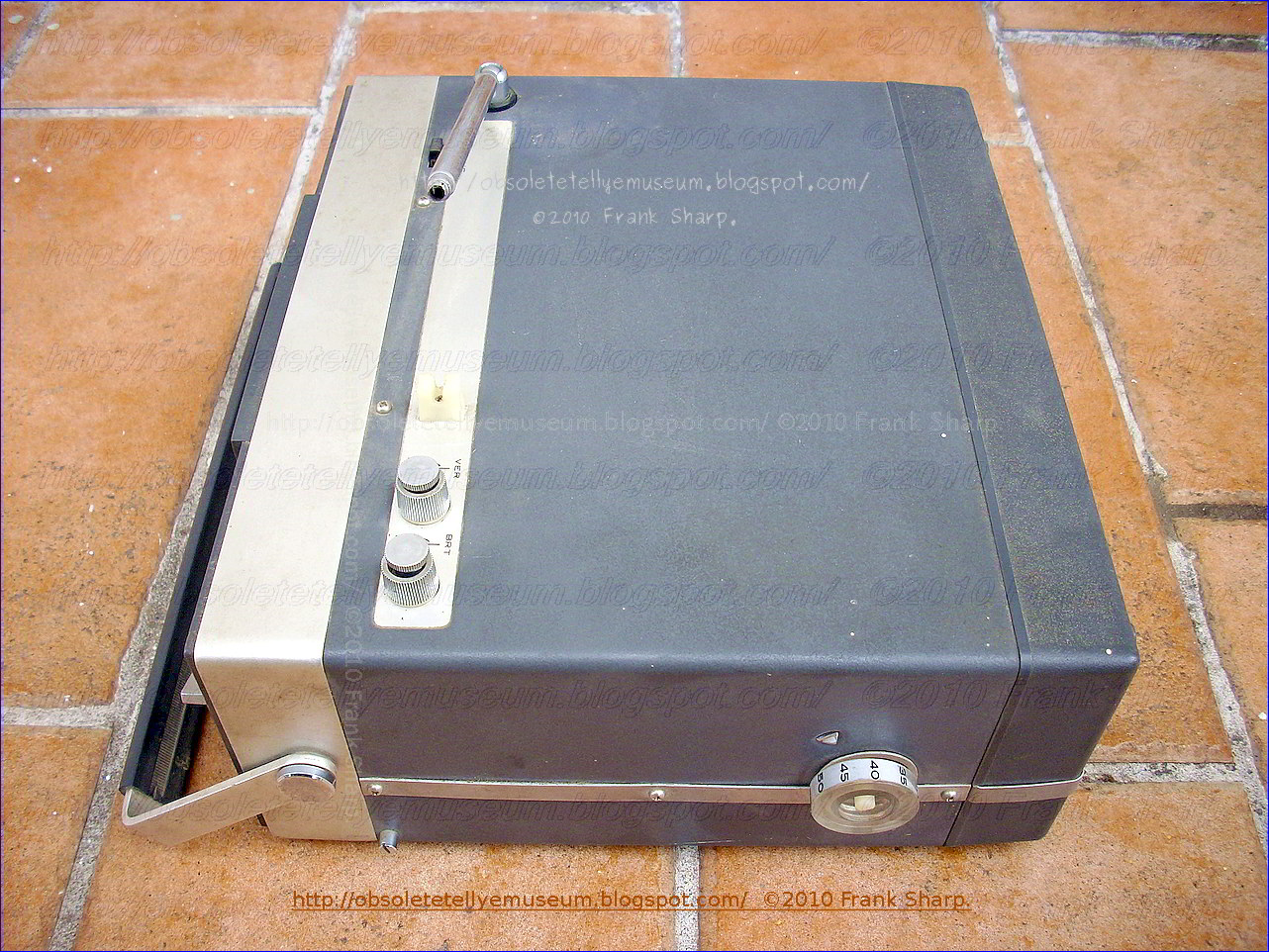
All the innards are in a sturdy sheet metal frame. The upper and lower casing shells are made of aluminum sheet. The lid on the back is made of plastic. The red and brown models are covered with imitation leather.

  • The TV line is easy to maintain, as it is equipped with fold-out modules that are plugged into female connectors.

It's, a nice, simple but solidly built device that is fun to work on. The technology is nice  and simple.
 

 The UNIVERSUM FK100 (ART.06664) (CROWN CTV-18)  tv  was manufactured in JAPAN , BY Crown Radio Corporation, 17-4, 3-Chome-Ueno, Taito-Ku, Tokyo. Production of radio receiving sets, television sets, tape recorders, transceivers, record players, pick-ups for record players, phonograph records, microphones, electric cells and electronic applied units.

 The  UNIVERSUM FK100 (ART.06664) GROSSVERSANDHAUS QUELLE GmbH (CROWN CTV-18) is an example of a light weight TV with great transportability feature and commodity.

  • Net weight (2.2 lb = 1 kg) 3.8 kg / 8 lb 5.9 oz (8.37 lb)

  •  Original price DM 295.

Quelle Group story

Nürnberger Strasse 91-95
8510 Fürth
Germany
(911) 742 3157
Fax: (911) 626 224

Private Company
Incorporated: 1927 as Gustav Schickedanz
Employees: 39,300
Sales: DM12.59 billion (US$8.31 billion)

The Quelle Group, headed by Gustav Schickedanz KG, is one of Germany’s largest retail and mail-order organizations. The mail-order business in Germany and adjacent countries is at the core of Quelle’s success. Quelle is the country’s second largest supplier of fashions and textiles, with its own trademarks and household catalog names: Shöpflin, Madeleine, Elégance, Peter Hahn, Euroval, and others. It makes its own Mars bicycles. Its own electrical goods are sold under the Matura, Universum, and Privileg trademarks. Quelle also operates 21 department stores, 151 technical speciality shops, 100 Apollo optical shops, 169 travel bureaus, 14 garden centers and is the franchiser of 1,103 partners in Foto-Quelle film and development shops. In the fiscal year ended January 1991, sales were up 23 % from the previous year.

Gustav Schickedanz, Quelle’s founder, was born in 1895, the son of a craft factory employee in Fürth, a small city adjacent to Nuremburg. He left school at the age of 15 to work at Speed and Son, the local branch of a sportswear firm. He soon was due to be appointed as a company representative in South America, but he decided to complete his army-service obligation first. World War I broke out and an expected service period of one year turned into seven. He was wounded and discharged in 1919. Schickedanz returned to Fürth where he worked as a salesman and married Anna Zehnder, a local master baker’s daughter, in September 1919. In 1922, he opened a small haberdashery business and struggled to keep the firm going in the midst of Germany’s period of hyperinflation. His employees were his father, wife, and sister.

Economic reforms led to a degree of stabilization and a short period of improvement. Schickedanz’s observations of customer behavior led him to believe that he could sell to a larger market through the mail. With the resulting low overheads and greater volume, he could offer lower prices. These ideas were not new, but hyperinflation presented great difficulties to mail-order firms. The new stabilization convinced him that mailorder could work. The mail-order venture opened in November 1927. The name chosen for the company, Quelle, means “source” in German. Schickedanz hired 15 new workers. One, Grete Lachner, would one day become his second wife and play an essential role in the company’s future.

His first catalogs emphasized wool, thread, and materials for home sewing, rather than ready-to-wear clothes. The company enjoyed a modest success in its first 18 months of operation. Schickedanz’s 33-year-old wife Anna and their 5-year-old son were killed in an auto accident in July 1929; his 72-year-old father died shortly afterward. His problems were compounded by the Wall Street crash, which halted the German economy’s faltering recovery and threw millions out of work. Schickedanz’s sister, Liesl Kiesling, stepped into Anna’s position in the company.

By the end of 1930, five million Germans were unemployed. Schickedanz’s new business survived, however, and, especially by the standards of the Great Depression, prospered. Quelle was able to offer lower prices than many shops, and quickly developed a reputation for reliability and good value. Soon Schickedanz began to offer more clothes and accessories. By 1934 Quelle had 250,000 customers. By 1936 this number had grown to a million, the majority of whom were women.

This success came about despite the restrictions on trade introduced by Adolf Hitler’s new Nazi regime, which came to power in January 1933. As Jews began to leave or face imprisonment, they disappeared as competitors in the clothing trade. In 1935 Schickedanz bought VP, a paper factory, to publish catalogs and make cartons. This factory had been Jewish property. Some suspected him of having an invisible Jewish partner, but this was never proved. World War II began on September 1, 1939, and the Nazis required that the paper factory be turned over to war work. Schickedanz continued to operate under severe restrictions and clothing rationing, but the dislocations of the war meant that mailorder provided an alternative source of supply to people in bombed-out cities. Schickedanz was offered several positions as an economic administrator, but he preferred to remain with the business.

In 1942 Schickedanz married Grete Lachner. One year later their only child was born in a bomb-proof bunker. As Allied bombers began to attack the Nuremburg-Fürth area, the Schickedanz family moved out to quarters in the nearby forest village of Hersbruck. In August 1943 Quelle was virtually put out of business when an Allied bombing raid destroyed 90% of the company’s warehouse in Fürth. On April 19, 1945, American troops occupied the ruins of Fürth and Nuremburg. Three weeks later, Germany surrendered. Although the Schickedanzes were fortunate to find themselves in the U.S. zone of occupation, their enterprise was not initially encouraged. Schickedanz was classified as a Nazi by the occupation authorities and prohibited from reopening his business. Buildings were in ruins or requisitioned by the occupation authorities and customer records had been lost.

Grete Schickedanz opened a small clothing shop in Hersbruck to support the family. It was a success, but was closed by the military authorities. Eventually, the Schickedanzes were able to use the influence of the anti-Nazi politician and economist Ludwig Erhard, a family friend who was also from Fürth, to gain permission to reopen. The Hersbruck shop remains open as one of Quelle’s smallest retail outlets.

Gustav Schickedanz remained under a prohibition and, in theory, could not even discuss business with former employees. The ban was removed in 1949. Former employees were found and Quelle was off to a fresh start. It was just in time to benefit from Ludwig Erhard’s currency reforms of the previous year. Following the founding of West Germany in 1949, Erhard moved as quickly as possible to remove restrictions and rationing and to encourage competition. He believed that sales of consumer goods would encourage production and jobs.

After many years of hardship, Germans responded by going on a buying spree. The Quelle name was remembered and respected by many former customers. By utilizing previous contacts, Grete Schickedanz was able to obtain superior but inexpensive goods for sale. It was on this foundation that the new Quelle was built. By the end of 1949 Quelle had a turnover of DM12 million and mailing list of 100,000 addresses, but the couple had also opened their first department store.

Germany, especially, benefited from the economic expansion stimulated by the Korean War in the early 1950s. Between 1949 and 1952 the company’s turnover rose by 900%. By 1952 Quelle had one million credit customers and sales of DM103 million. The company now faced the classic problems of a successful business: how to expand without overextending and damaging a reputation for quality. The answer was to invest in new computer and data processing technology that was just appearing in the United States and barely known in Europe.

Schickedanz hired the best experts and gave them a free hand to design systems that would enable Quelle to handle millions of mail-order and credit transactions per year. Thirtyfive engineers from the firm SEL in Stuttgart worked for two years to develop and set up a system appropriate for Quelle’s needs. In 1955 the first phase of the company’s new mailorder center was finished. By 1957 SEL had completed the building of the new system. It was one of the most sophisticated mail-order computer information systems and attracted worldwide interest. Quelle was able to rationalize its operations and achieve even greater efficiency. The company has continued to give high priority to updating its computer and data information systems. In 1990 it maintained information on some 32 million customers.

A new emphasis was placed on quality control. In 1953 Schickedanz set up an institute for testing products to be sold through Quelle. It became known as the Quelle Institute fur Warenprüfung and is the largest institute of its kind in German commerce. At first only textiles were tested, but gradually it began to examine other product types. In 1990 it had made more than 25,000 annual tests. The institute also attracted international interest.

Grete Schickedanz was increasingly responsible for buying. She also directed careful attention to new catalogs and added more color pages. By 1954 more than half the pages of the spring-summer catalog were in color. She carefully monitored fashion trends. Later, the company hired prominent German designers such as Heinz Oestergard as advisers.

The range of mail-order products was continually expanding. In 1954 the company bought a bicycle factory and began to sell bicycles. The next year, a favorable response to a line of small electronic appliances led to the introduction of washing machines and large appliances, which Quelle was able to offer at very competitive prices. In 1957 one of its most successful ventures was into photographic equipment, where it was able to offer large mail-order discounts. By the early 1960s it was even offering travel services.

Quelle learned how to target special-interest groups and to develop special catalogs alongside its main catalog to spotlight lifestyle groups and hobbies such as gardening. A bank, NORIS Bank GmbH (later Quelle Bank) was started in 1956 and developed to help customers with credit. By 1958 Quelle had a turnover of DM406 million. It had become the largest mail-order firm in West Germany.

From the early 1960s, Grete Schickedanz traveled to the Far East on buying trips. In 1962 Quelle opened an office in Hong Kong. Eventually, the region became one of the company’s most important sources of supply. Later, Grete Schickedanz established important business contacts in the People’s Republic of China and opened an office in Shanghai.

In 1964 Quelle had a turnover of DM1.64 billion and called itself “the largest mail-order house in Europe.” The 1960s and 1970s were a period of continued growth for Quelle in Germany, but unlike its competitor, Otto Versand, which made a very successful investment in Spiegel in the United States, Quelle has been more cautious about foreign expansion. The process has been slow, mainly into neighboring countries. It began in 1959 with Austria, where results were so encouraging that the company decided in 1966 to make a much more risky move into France, opening a new mail-order facility in Orleans.

Gustav Schickedanz died on March 27, 1977, in the 50th anniversary year of the company. He was succeeded as chairperson by Grete Schickedanz. Because the two had worked as partners for many years, Gustav’s death did not disrupt the company or bring about any major policy changes. Grete continued her worldwide buying trips. By 1981, Quelle had a turnover of DM10 billion.

In May 1985 Grete Schickedanz broke new ground in West German-East European trade politics by signing an agreement with Hungarotex, the Hungarian foreign trade organization. The agreement allowed Quelle to sell by mail in Hungary and included plans for a new chain of jointly owned department stores. In 1990 Quelle started Intermoda, a joint-venture catalog operation in the Soviet Union. In 1987 Grete Schickedanz relinquished her position as chairperson of the board of Quelle, but she remained as head of its supervisory board. Into the 1990s she still traveled widely on behalf of the company.

The speedy German reunification process, which began with the collapse of the East German regime in November 1989 and culminated a year later, presented both new markets and challenges from Otto and other German competitors. Quelle moved quickly to distribute its catalog to nine out of ten households in the former East Germany. New stores and facilities were opened in Gera, Jena, and Erfurt. A huge new regional mail-order complex was opened in Leipzig, creating 3,000 new jobs. Quelle described its investment in the new Germany as the largest in its history, creating a total of 7,000 new jobs.

At the end of 1990, Quelle surprised many German financial institutions by entering into a new agreement, through its subsidiary Quelle Bank, with the Bank of Scotland to enter the undeveloped German credit card market. The German market had been thought to be resistant to credit cards. According to the plan, Quelle was to offer direct banking and credit card services using its mail-order data base, with more than 30 million customers in Germany, France, and Austria. Bank of Scotland would handle the processing in its facilities in Dunfermline, Fife, Scotland. Quelle expected to issue about one million cards in its first five years. With the 1992 European economic unification approaching, Quelle sought to acquire a foothold in the United Kingdom and began negotiations with Littlewoods for its mail-order division.
Principal Subsidiaries

Quelle Beteiligungs GmbH; Quelle AG; Foto Quelle; Apollo-Optik GmbH; Möbel Hess GmbH; Quelle Bank GmbH (25%); Sinn AG (51%); Grossversandhaus Schöpflin GmbH (99%); Peter Hahn GmbH; Elégance; Madeleine Mode GmbH; UTS Universal Technik-Service GmbH; Quelle S.A. (France, 99%); Distribución Quelle S.A. (Spain, 51%); Peter Hahn AG (Switzerland).
Further Reading

Grete Schickedanz: Ein Leben für die Quelle, Fürth, Quelle, 1986.

some references:


Rüdiger Dingemann, Renate Lüdde: Die Quelle-Story. Ein deutsches Unternehmen im Spiegel der Zeit. Bucher, München 2007, ISBN 978-3-7658-1616-1.
Peter Zinke: „Er drohte wieder mit der Gauleitung“ – Gustav Schickedanz und die Arisierungen. In: Nurinst 2008. Beiträge zur deutschen und jüdischen Geschichte: Schwerpunktthema: Entrechtung und Enteignung. Antogo, Nürnberg 2008, ISBN 978-3-938286-34-0, S. 63–80

Weblinks


Commons: Quelle-Versandhaus – Sammlung von Bildern, Videos und Audiodateien
quelle.de
quelle.at
quelle.ch
travel.quelle.de (REISE QUELLE hat den Betrieb der reisequelle.de zum 30. November 2009 eingestellt)
Quelles düstere Vergangenheit. In: Cicero.
Gustav Schickedanz: Seine Nachfolger hatten nie eine Chance. In: FAZ.net, 20. Oktober 2009.
Gunhild Lütge: Maximaler Schaden - Quelle wird abgewickelt. In: Die Zeit. 44/2009, 22. Oktober 2009.
Abschied vom Quelle-Katalog - Der Besteller-Bestseller. In: Spiegel online. 23. Oktober 2009.
Gelungener Neustart – 100 Tage Quelle.de Pressemitteilung vom 1. August 2013
Quelle – von Versandkatalogen, Konsumgeschichte und Technikläden In: Retropie, 28. Dezember 2019.


Arcandor Konzerngeschäftsbericht 2007/2008 (Memento vom 11. Juni 2009 im Internet Archive) S. 112. (pdf; 1,8 MB)
Quelle ist wieder da – als Online-Marktplatz. auf: www.heise.de, 10. August 2011.

[Korrektur] Arcandor weist Quelle-Umsätze von 2,45 Mrd. Euro aus. (Memento vom 30. Januar 2013 im Internet Archive) www.excitingcommerce.de

(Seite nicht mehr abrufbar, Suche in Webarchiven: Impressum der Website)

Fräulein Gretel von der Quelle. In: Die Zeit. 24/2003, abgerufen am 24. Oktober 2009.

Süddeutsche Zeitung. 24. Juli 2009, S. 12.

Klaus-Dietmar Henke, Johannes Bähr, Dieter Ziegler, Harald Wixforth: Die Dresdner Bank im Dritten Reich. Band 2: Die Dresdner Bank und die deutschen Juden. Oldenbourg Wissenschaftsverlag, München 2006, ISBN 3-486-57781-6.

Familie Schickedanz: Mit dem Quelle-Katalog wurde sie steinreich. auf: www.bild.de, abgerufen am 24. Oktober 2009.

Biografie Grete Schickedanz. auf: www.whoswho.de, abgerufen am 19. Mai 2010.

Peter Zinke: „Er drohte wieder mit der Gauleitung“ – Gustav Schickedanz und die Arisierungen. In: nurinst 2008. ISBN 978-3-938286-34-0, S. 63–80 (antogo-verlag.de [PDF; 145 kB; abgerufen am 24. Oktober 2009]).

Quelle: „Wollen! Wägen! Wagen!“ auf: www.handelsblatt.com, abgerufen am 24. Oktober 2009.

Hans Dedi: Ein Quelle-Chef aus Murg. auf: suedkurier.de, 23. Oktober 2009, abgerufen 18. Dezember 2012.

Quelle-Verkauf: Otto kauft die Marke Quelle, zeit.de, 5. November 2009

(Seite nicht mehr abrufbar, Suche in Webarchiven: Quelle wird von Otto zum Leben erweckt.) auf: www.unternehmer.de

Quelle auf einen Blick: Größtes Homeshopping-Unternehmen in Europa. (Memento vom 29. Januar 2009 im Internet Archive) auf: www.quelle.com, abgerufen am 27. März 2009.

Spiegel Online vom 19. Dezember 2009: Quelle schließt endgültig seine Türen, abgerufen am 24. Juli 2019.

nordbayern.de vom 19. Dezember 2009: Quelle-Kaufhaus – Der allerletzte Feierabend, abgerufen am 24. Juli 2019.

Sabine Stoll: Der Quelle-Komplex geht an großen Immobilien-Entwickler. In: Nürnberger Nachrichten. 27. Juni 2018. (online auf www.nordbayern.de)

Neuer Investor: Quelle-Komplex wird kein Shoppingcenter. auf: www.nordbayern.de, 5. Juli 2018.

Druck des Quelle-Katalogs angelaufen. (Memento vom 28. März 2010 im Internet Archive) auf: druck-medien.net, 22. Juni 2009.

Archiv von Foto-Quelle-Katalogen, abgerufen am 6. August 2011.

Quelle nimmt Möbel-Eigenmarke Casamaxx in den Katalog auf. In: Horizont. (horizont.net [abgerufen am 31. Juli 2018]).

Deutschland liegt beim Internethandel zurück. In: IT Times. 13. Dezember 2007.

Arcandor stellt Insolvenzantrag. auf: finanznachrichten.de, 9. Juni 2009.

Zehn Gründe für den plötzlichen Quelle-Tod. auf: www.bild.de, abgerufen am 24. Oktober 2009.

Der Kredit für Quelle kann fließen. auf: www.focus.de, 7. Juli 2009, abgerufen am 24. Oktober 2009.

Notkredit für Quelle beschlossen. bei: tagesschau.de, 29. Juni 2009.

Massekredit für Quelle wird ausgezahlt. auf: www.focus.de, 10. Juli 2009, abgerufen am 24. Oktober 2009.

Der Quelle-Katalog kommt. auf: www.focus.de, 14. Juli 2009, abgerufen am 24. Oktober 2009.

Insolvenz – Quelle ist am Ende. (Memento vom 31. Juli 2012 im Webarchiv archive.today) In: Financial Times Deutschland. 19. Juli 2009.

Versandhaus Quelle vor dem Ende. auf: diepresse.com, 15. Oktober 2009.

Engültige Liquidation des Traditionshauses Quelle. (Memento vom 15. Dezember 2009 im Internet Archive) auf: www.unternehmer.de, 11. November 2009.

«Lagerräumung» - Quelle räumt die Lager - Kundenbestellungen werden ausgeführt. (Memento vom 20. Oktober 2009 im Webarchiv archive.today) In: AD HOC NEWS.

Schnäppchen-Jäger aufgepasst: Am Sonntag beginnt Quelle-Ausverkauf. auf: www.merkur.de, 30. Oktober 2010.

Zu hohe Kosten: Quelle stellt den Internet-Ausverkauf ein. auf: www.stern.de, 26. November 2009.

Bei Quelle gehen die Lichter für immer aus. (Memento vom 31. Juli 2012 im Webarchiv archive.today) In: Financial Times Deutschland. 18. Dezember 2009.

Abwicklung trotz Staatshilfe – Bei Quelle ist vor Weihnachten Schluss. (Memento vom 24. Oktober 2009 im Internet Archive) In: Financial Times Deutschland. 19. Okt. 2009.

Aus für Quelle: Region Nürnberg/Fürth unter Schock. auf: www.merkur.de, 21. Oktober 2009.

Aus für Quelle. (Memento vom 4. Januar 2010 im Internet Archive) auf: augsburger-allgemeine.de, 20. Oktober 2009.

Bei Quelle lächelt nur noch Madeleine Schickedanz. auf: www.welt.de, abgerufen am 24. Oktober 2009.

Nürnberg und die Quelle-Pleite. In: Spiegel online. 23. Oktober 2009, abgerufen am 24. Oktober 2009.

Arbeitsagentur richtet Außenstelle bei Quelle ein. auf: www.welt.de, abgerufen am 24. Oktober 2009.

Deutsche Post: Nach Quelle-Aus drohen Stellenstreichungen bei DHL. In: Focus Online. 22. Oktober 2009, abgerufen am 7. Dezember 2014.

Quelle Österreich-Konkurs. auf: www.konsument.at, 17. November 2009.

Kurier: Quelle-Packerln wandern ins Otto-Reich. (Memento vom 8. März 2010 im Internet Archive) auf: kurier.at, 5. März 2010.

QUICK 24 – Magazinul dumneavoastra online. (Memento vom 3. Januar 2013 im Internet Archive) Vorstellung der Umbenennung der Quelle Rumänien in Quick24.

Homepage von Quelle in Ungarn. Abgerufen am 19. Oktober 2010.

Bei Quelle gibt es keine Waschmaschinen mehr. auf: www.welt.de, abgerufen am 6. November 2009.

Quelle-Lieferanten fühlen sich von Görg betrogen. auf: www.welt.de, 6. November 2009, abgerufen am 6. November 2009.

Otto kauft die Marke Quelle. In: Spiegel Online. 5. November 2009, abgerufen am 7. Dezember 2014.

 (Seite nicht mehr abrufbar, Suche in Webarchiven)

Otto darf Quelle-Marken mit Einschränkungen nutzen. In: handelsblatt.com. 16. Februar 2010, abgerufen am 7. Dezember 2014.

Otto reaktiviert Quelle-Website. In: handelsblatt.com. 19. März 2010, abgerufen am 7. Dezember 2014.

Gläubigerausschuss genehmigt Verkauf von Home Shopping Europe. (Memento vom 13. November 2009 im Internet Archive) auf: www.arcandor.de.

Quelle-Call-Center werden übernommen. In: handelsblatt.com. 16. November 2009, abgerufen am 7. Dezember 2014.

Küchen-Quelle: Hamburg macht dicht - aber es besteht weiter Hoffnung. auf: www.moebelkultur.de

Investorengruppe „Franken“ übernimmt Küchen-QUELLE. (Memento vom 30. November 2009 im Internet Archive) auf: www.arcandor.de, 20. November 2009.

www.kuechen-quelle.de

Neustart für Website und Privileg - Quelle lebt. (Memento vom 27. März 2010 im Internet Archive)

ORWO Net übernimmt die Marke Foto Quelle. (Memento vom 20. August 2012 im Internet Archive) Pressemitteilung der ORWO Net GmbH, 27. November 2009. (PDF-Datei; 122 kB)

RTS Elektronik Systeme GmbH übernimmt Profectis. (Memento vom 4. Mai 2010 im Internet Archive) auf: www.profectis.de, 18. Dezember 2009.

https://web.archive.org/web/20160301103407/http://www.textilwirtschaft.de/business/Halens-uebernimmt-vier-Quelle-Landesgesellschaften_61507.html

Schwedischer Versandhändler kauft CEE-Quelle. auf: derstandard.at, 22. Jänner 2010.

 (Seite nicht mehr abrufbar, Suche in Webarchiven)

Investor für Quelle-Spezialkatalog gefunden - Mittelständler will Versand von Gesundheitsprodukten fortführen. (Memento vom 7. September 2012 im Webarchiv archive.today) In: Nürnberger Nachrichten. 6. Februar 2010.

www.dr-hein.com

Unito führt Quelle und Ackermann in der Schweiz weiter. auf: www.textilwirtschaft.de, 12. Mai 2010.

Otto erweckt Quelle 2011 wieder zum Leben. auf: www.nachrichten.at
 
* https://www.encyclopedia.com/books/politics-and-business-magazines/quelle-group

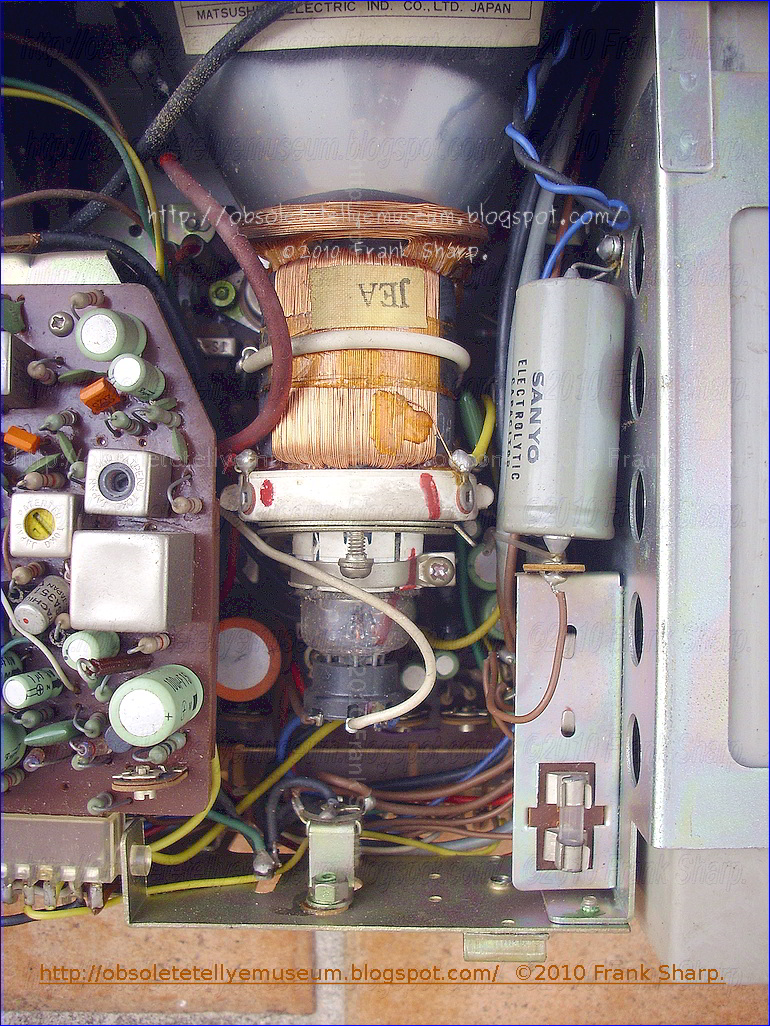
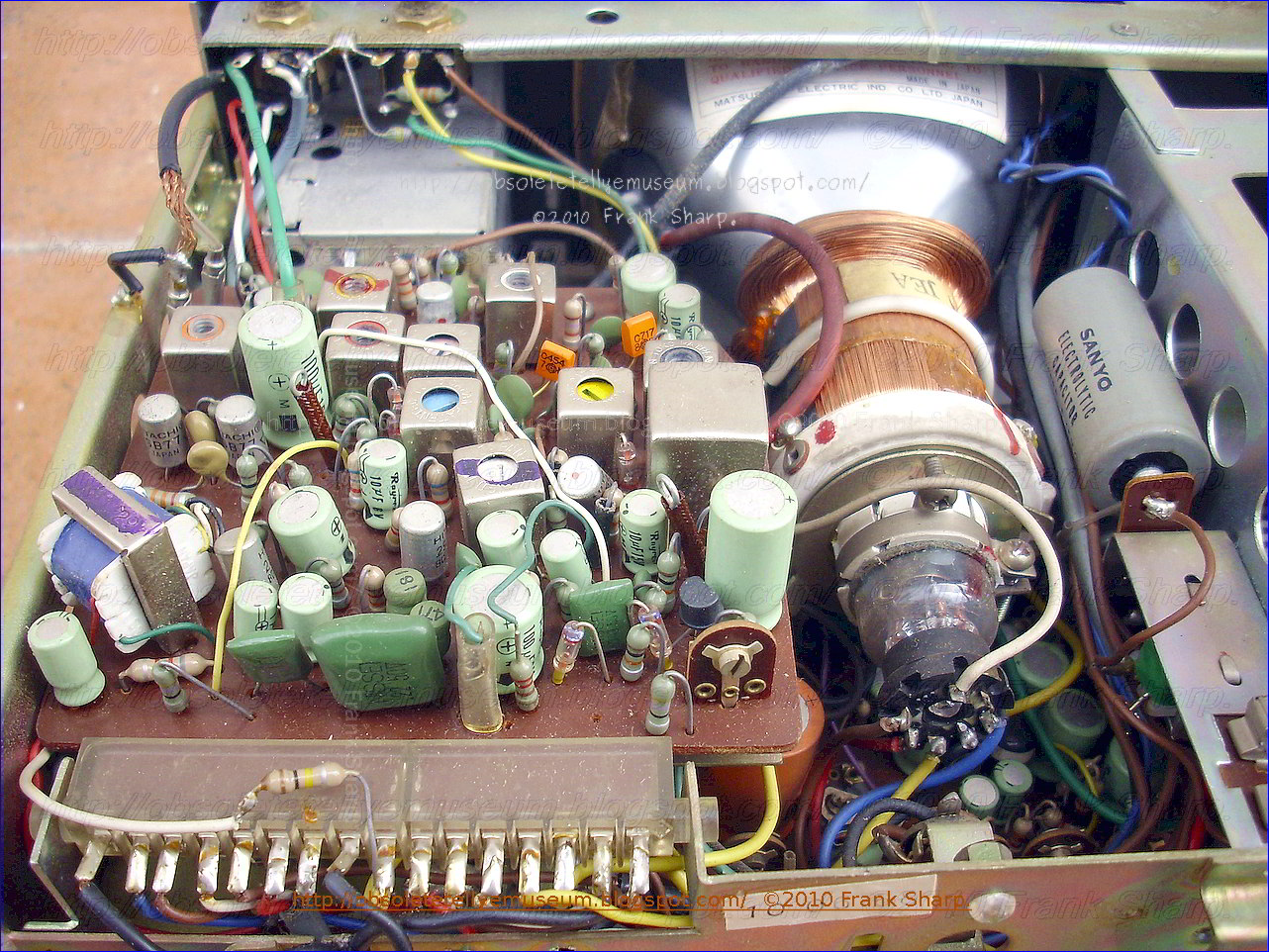
UNIVERSUM FK100 (ART.06664) (CROWN CTV-18) CHASSIS CROWN AM-B INTERNAL VIEW


Upside signals pwb, downside thw synch/deflections panels. 

  • A BLOCK CIRCUIT:  AM-B-332 ; 
  • B BLOCK CIRCUIT:  AM-B-323 ;
  • C BLOCK CIRCUIT:  AM-B-352; (SUPPLY OUT)
  • VHF TUNER:  AM UF-18
  • UHF TUNER: AM UF-12
  • EHT FLYBACK LOPT:  AM-WM-4
  • AUDIO OUT TRANSFORMER:  AM-T-229

The set can be powered both 110/220 volt mains AC or battery pack with modular power supply or even a 12volt DC car supply.

 In the device there is a battery box for 9 mono cells. However, with a power consumption of 5 watts, mains-independent TV was an expensive pleasure.
 A power supply and an adapter cable for operation on the car battery could be purchased for an additional charge.The power supply unit or the battery box are inserted into the housing, for which the rear cover can be removed by means of two knurled screws
 The power supply contains a simple (selenium) rectifier and an electrolytic capacitor. A regulation is not built in. The feedback of the mains voltage is not very lush and the picture can occasionally "belly dance".

All the innards are in a sturdy sheet metal frame. The upper and lower casing shells are made of aluminum sheet. The lid on the back is made of plastic. The red and brown models are covered with imitation leather.
 The TV line is easy to maintain, as it is equipped with fold-out modules that are plugged into female connectors.
It's, a nice, simple but solidly built device that is fun to work on. The technology is nice and simple.

UNIVERSUM FK100 (ART.06664) (CROWN CTV-18) CHASSIS CROWN AM-B CRT TUBE MATSUSHITA


Thursday, March 15, 2012

UNIVERSUM NOVA SI - AUTOVOX SK5124 YEAR 1973.


The UNIVERSUM NOVA SI - AUTOVOX SK5124 is a 16 inches B/W portable set with
6 programs mechanic keyboard and potentiometric tuning system.
The invention relates to a tuning unit with bandswitch for high frequency receivers, especially radio and television receivers, having a potentiometer system for the control of capacity diodes, the said potentiometer system consisting of a plurality of parallel resistance paths along which wiper contacts can be driven by means of screw spindles disposed adjacent one another in a common insulating material housing in which a bandswitch formed of metal rods is associated with each tuning spindle.

In these tuning units, the working voltages of the capacity diodes in the tuning circuits are recorded once a precise tuning to the desired frequency has been performed. A potentiometer tuning system has great advantages over the formerly used channel selectors operating with mechanically adjustable capacitors (tuning condensers) or mechanically adjustable inductances (variometers), mainly because it is not required to have such great precision in its tuning mechanism.

Tuning units with bandswitches formed of variable resistances and combined with interlocking pushbuttons controlling the supply of recorded working voltages to capacity diodes are known. Channel selection is accomplished by depressing the knobs, and the tuning or fine tuning are performed by turning the knobs. The resistances serving as voltage dividers in these tuning units are combined into a component unit such that they are in the form of a ladderlike pattern on a common insulating plate forming the cover of the housing in which the tuning spindles and wiper contacts corresponding to the variable resistances are housed. The number of resistances corresponds to the number of channels or frequencies which are to be recorded. The wiper contact picks up a voltage which, when applied to the capacity diodes determines their capacitance and hence the frequency of the corresponding oscillating circuit. The adjustment of the wipers is performed by turning the tuning spindle coupled to the tuning knob. By the depression of a button the electrical connection between a contact rod and a tuning spindle is brought about and thus the selected voltage is applied to the capacity diodes. Since the push buttons release one another, it is possible simply by depressing another button to tune to a different receiving frequency or a different channel, as the case may be.

In the end of the 60's  increasingly attention was focused on the varicap diode tuner as the latest, sophisticated means of television receiver frontend tuning in both colour and black and white sets.
 The main purpose of this article is to investigate the servicing problems associated with this comparatively new method of tuning.

First however let's briefly recap on the principles involved in this tuning system:

 The tuners use variable capacitance (or "varicap") diodes as the variable tuning elements: the effective capacitance of the diodes is controlled by the reverse bias applied across them, tuning being achieved by varying this voltage. As the reverse bias across a varicap diode is increased so its junction depletion region widens thus reducing its capacitance.

A VHF/ UHF television tuner is constructed in accordance with the present invention includes a preselector tuned circuit having a solid state voltage controlled capacitor as its tunable element, a radio frequency amplifier coupled to the preselector circuit and alsoother circuit to perfect the signal receiving capability and the application the like.

Considering the Mechanical Tuner Problems:

To get the servicing problems in perspective let us next consider the tuning arrangements previously used.
 The earliest of these, employed on v.h.f., was the switched tuner which was either of the turret or incremental type.
 The turret tuner substituted a coil bearing "biscuit" mounted on the rotating drum or turret when channels were changed. Twelve positions were normally provided, with a fine tuning knob to adjust the local oscillator frequency. As its name suggests the incremental tuner simply added more inductance to the tuned circuits at every downward channel movement: thus the highest inductance was present on channel one and the least on channel 12 (which normally covered 13 as well with manipulation of the fine tuner).
The movement towards u.h.f. TV working, initially with dual standard sets and later with single standard ones, brought about the need for u.h.f. tuners. In the earliest u.h.f. receivers valve tuners which were not particularly efficient were used.

The drive mechanism was usually a dual  speed rotary system calibrated from channels 21 to 68. Experience in the field indicated that 625 line television was in many cases considered by the viewer to be inferior to 405 -line reception, on account of the poor signal to noise ratio achieved by the valve tuners. Many viewers were not prepared to use external u.h.f. aerials of course, having achieved satisfactory reception on v.h.f. with an indoor aerial: this aggravated the situation even more.
Another aspect which caused difficulty was the care needed to tune in a u.h.f. channel using a rotary tuner covering the whole of Bands IV and V. Many viewers simply could not tune in BBC 2  or ZDF or ORF or any channel correctly with such a tuning mechanism, finding that they had passed right over the channel they wanted before realising what they had done.
The advent of transistor tuners rapidly improved the quality of u.h.f. reception but use of a rotary mechanism was continued by many manufacturers. Thus while potential reception was improved the same tuning difficulties remained and viewers continued to gravitate towards 405 line viewing using the "old faithful" switched tuner. The operational breakthrough came with the introduction of the push-button u.h.f. channel change. 

The mechanism is basically simple. Adjustable push buttons press down on a lever bar which in turn rotates the tuner's variable capacitors to the appropriate position. Each button is capable of tuning over the entire u.h.f. bands and this leads to customer confusion at times when after some adjustments which were too heavy handed they find themselves receiving ITV on a BBC button or a ORF and ZDF broadcasting or any channel possible !

Mechanical Faults:

 Mechanical tuning obviously has its snags. There are for example contact springs which earth the tuning capacitor and go intermittent. This gives rise to the most random tuning defects, capable of driving the. most patient viewer to a state of total exasperation. It is also possible for the rotation mechanism to hang up and jam intermittently, or just become sticky, so that the reset accuracy of the mechanism is impaired and the receiver has to be retuned every time the channel is changed.

The vanes in the tuning capacitor can also short out at different settings, thereby eliminating some channels. The  Varicap Tuner It will be seen then that mechanical defects can cause very irritating fault symptoms. If one thinks along the lines that anything mechanical is nasty, then the elimination of mechanical parts can only be to the good.

The logic of this is splendid provided the electronic replacement for the mechanical system is more reliable! Otherwise we are leaping out of the frying pan into the fire! In the light of experience gained with mechanical tuning devices it seems great that with the varicap tuner we have at last dispensed with the dreaded rotary tuning capacitor, replacing it instead with a variable voltage to the tuner. 
Let us think about this however since things are never quite as simple as they first appear. The tuning voltage has to be variable in order to tune the receiver. Obviously then a means of varying the voltage has to be provided to act as the tuning control.
As it is a voltage that has to be varied the tuning control takes the form of a potentiometer., Now we have returned to a mechanical system again, though in a less complex form.
A potentiometer is required for each channel, selected by pressing the appropriate channel button.

We have lost a tuning capacitor and its rotating mechanism and gained a set of pots and selector switches therefore. Provided the pots and switches are mechanically more reliable than the tuning capacitor we should be better off-or should we? 

Need for Voltage Stabilisation.
 The voltage selected by the pots cannot be allowed to drift otherwise the receiver will go off -tune. The voltage supply to the potentiometers has to be stabilised therefore and a stabilising zener diode or integrated circuit (TAA550) .is needed for this purpose.

Any failure in this part of the circuit will give rise to tuning drift or worse, a total loss of reception. A short-circuit TAA550 for example will completely remove the tuning voltage while if it is open circuit the tuning can vary with picture brightness. Likewise any intermittency in the potentiometers or associated switching and/or resistors can also cause problems.

Relative Reliability of Tuners:

 It  will be seen then that in order to lose our troublesome mechanical arrangement we have had to introduce considerably more electronics which we trust are going to be more reliable. In addition we have not so far considered the relative reliability of the varicap tuner itself compared with the mechanical type. Since two r.f. transistors are generally used to compensate for the reduced Q of the varicap tuned circuits we immediately have twice the likelihood of an r.f. stage breaking down! 

And being semiconductors the varicap diodes themselves are more likely to fail than the sections of a ganged tuning capacitor. It is reasonable then to conclude that if mechanical faults are the most prevalent the use of varicap tuners will make life easier. Mechanical faults are generally not too difficult to sort out however and the field engineer can often cope with them in the home. 
Can the same be said of the varicap tuner? It seems that this type of tuner does not need so much attention as its mechanical counterpart but is likely to throw up some much more difficult faults when it does, resulting in bench repairs being needed. So far my own experience has indicated that varicap tuning faults nearly always need servicing on the bench.
Generally speaking it seems true to say that varicap tuners themselves are adequately reliable: the snags result from the tuning system and stabilised power supply.

Tuning Drift with Varicap Tuners:

 If a varicap tuned receiver is constantly drifting off tune the +30V supply should be the number one suspect. It is best to connect an Avometer permanently to the supply so that it can be precisely monitored-if necessary write down the exact voltage measured.

 If the receiver drifts, check the voltage. If it has changed, even slightly, this may well be enough to be the cause of the fault. To pinpoint and confirm the diagnosis aerosol freezer should be applied to the stabiliser i.c. or zener. If the voltage returns to normal or changes wildly for the worse the stabiliser is almost certainly the cause of the trouble and should be replaced.
A prolonged soak test should then be carried out. Another point concerning varicap tuners arises with their use in colour receivers.


 There were  makers of the most expensive colour receiver on the market still didn't use a varicap tuner but instead use a mechanical one. The makers' claim is that the signal to-noise ratio of the varicap tuner is inadequate for their colour standards. Undoubtedly the results obtained on the receiver seem to confirm this. Interestingly, the same manufacturers use varicap tuners in their black -and -white receivers, and the tuning button system is often full of troublesome intermittent contacts. The varicap tuner has its advantages and disadvantages then. Probably the simplest comment would be to say that when it is good it is very very good but when it is bad it is horrid!
Springs component in old tv's tuner :
Most old televisions tuning mechanisms were incorporating coil springs in one form or another for various functions. They can be of the compression type which are wound with spaces between adjacent turns and are intended to be squeezed under pressure : when released they expand to their original form. The mounting springs under record-player turntable units are examples of this type. Alternatively the spring can be of the expanding variety. The coils are wound closely together with adjacent turns touching. The applied tension tends to pull them apart and they exert a contracting force to counteract this and pull the linked components together. In the majority of applications this type is used. Springs often become damaged by being over stretched, or the end loop breaks. More frequently the spring simply becomes detached and disappears. Thus the engineer is faced with the task of finding and fitting a replacement. While it is possible to apply to the makers of the equipment for the right spring this involves delay and of course there is always the problem of identifying the right one out of the many used in the particular mechanism. For this reason many engineers find it more convenient to make their own replacements.

Making a Coil Spring: The operation was quite simple, the equipment needed being a wheelbrace, vice, selection of long screwdrivers with varying diameter shanks and a supply of piano wire of various gauges. The wheelbrace is mounted horizontally in the vice with the wheel uppermost and a screwdriver chosen and inserted into the chuck with the blade foremost. This serves as a mandrel on which the spring can be wound. Because a spring expands slightly in diameter after it is wound the diameter of the screwdriver shank should be a little less than the required inside diameter of the spring. One end of the piano wire should be inserted in the chuck and secured to prevent it coming free. The wheel is then slowly turned and the wire taken up around the screwdriver shank. Keep the wire taut and pull it backward (see Fig. 1) toward the chuck at an angle which keeps the adjacent turns together but does not make a turn ride over the top of its predecessor. When the spring has reached the required length cut the wire and remove the springand screwdriver from the chuck.
As an aid in determining the size of the spring required-especially if the original is lost and there is no pattern to make a comparison with-here are a few observations on the characteristics of coil springs as determined by their dimensions.
Properties of Coil Springs: There are two main properties of a spring, the length to which it can be expanded in comparison to its closed length and its tension or strength in the expanded state. If a coil spring is expanded too far its coils will not return to their original position and the spring is said to be stretched. The amount that a spring can be expanded without becoming stretched is governed by the number of turns and the diameter. The greater the number of turns the less each one has to deviate from its resting position for the complete spring to reach a particular length. Also the greater the diameter the smaller the strain and therefore the more the spring can be expanded. The strength of a spring is related to the gauge of wire and the diameter. A heavy gauge will obviously give greater tension than a lighter one but also a spring with a large diameter will exert less force than a smaller one because as we have seen there is less strain when it is expanded. More force is exerted when the spring is well expanded than when it is nearly closed. If therefore we need a spring that is strong and will stretch a long way we need a large number of turns but not so many that the spring is too long in its closed position. It needs to be of fairly large diameter but as this will make it weaker we must compensate by using a heavy gauge of wire. A weak spring with a long stretch is easily made with thinner wire and a large diameter while a strong spring with a short stretch need have few turns and small diameter. So the various factors are interdependent and although spring design can be quite an exact art-by varying the various parameters-something suitable for the job can usually be made up by judicously estimating the size from the foregoing principles. If a spring has become stretched nothing can be done to restore it by squeezing it up as it has now become a compression spring and the expanded state is its normal one. Rather than winding a completely new spring however the old one can be unwound on a wheelbrace-by reversing the winding process and then rewound tightly. Proper unwinding is essential, not just pulling the spring out straight, because this will produce kinks.
Leaf Springs: From coil springs we turn to leaf springs. These were used as contacts in tuner units and are also were used in the press  button channel selector of the Philips colour TV range and other fabricants. To make a positive contact the leaf spring must be tensioned just right. In the case of the turret tuner the leaf must be so sprung that the contacting stud moves it about a tenth of an inch away from the resting position. If as sometimes happens contact is made without much movement of the leaf there will be little if any pressure and the contact will very likely be intermittent. If on the other hand the leaf is adjusted too far forward it may be caught by the edge of the coil biscuit and crumpled when the turret is rotated.
 Moreover, using this arrangement, the only indication--during adjustment--of which channel is selected is by station identification.

It has a Transistorized horizontal deflection circuits  made up of a horizontal switching or output transistor, a diode, one or more capacitors and a deflection winding. The output transistor, operating as a switch, is driven by a horizontal rate square wave signal and conducts during a portion of the horizontal trace interval. A diode, connected in parallel with the transistor, conducts during the remainder of the trace interval. A retrace capacitor and the deflection yoke winding are coupled in parallel across the transistor-diode combination. Energy is transferred into and out of the deflection winding via the diode and output transistor during the trace interval and via the retrace capacitor during the retrace interval.
In some television receivers, the collector of the horizontal output transistor is coupled to the B+ power supply through the primary windings of the high voltage transformer.
It's an unusual and sligltly rare set by form and type.

It's made by AUTOVOX and it's branded with UNIVERSUM Brand name because it was made for export model series.

AUTOVOX SpA HISTORY

Giordano Bruno Verdesi founded in Rome in 1933 the Industry Italian Radio engineering, IRI, for the production of professional apparates, but this had its single development in 1945 with the war reconstruction post.

Previewing a strong development of the motorization, with Carlo Daroda, it comes up the Autovox SpA, with the specialization car radio production.

In 1953 the company is upgraded and constructed on the way Pays wages to Rome, the new plant for the production of television sets, antennas, car radio, transistor radio receivers, beyond a production of radiosondes and professional apparatuses for the aeronautical meteorology.

With the planning of the first car radio in the world, the leggendaria Bikini, in 1942 it begins a long season of successes like with the car radio Piper, the blue line with the first tuning electronic, the Kanguro the first car extractable stereo, mythical the Shuttle and Challenger the first car radio with the frequency synthesis, represents for Autovox, the flag stones in the development of new technologies, beyond to a complete range of television set (in black and white) of great reliability and from the pretty aesthetic.

Successively it realizes first in Europe, a color television set with fully transistorized chassis.

UNIVERSUM NOVA (quelle)
In 2005, the corporation had about 68,000 employees and annual sales of €15.5 billion. Its stocks were traded on the Mid Cap DAX until September 2009. The company's largest store is Kaufhaus des Westens (KaDeWe) in Berlin, while the largest store under the name Karstadt is in Frankfurt. On May 11, 2009, the company requested government financial assistance due to liquidity problems. On June 6, 2009, the company announced that it is no longer able to pay rent for its departments stores, which the company had previously sold and leasebacked.[2] On June 9, 2009, the company filed for bankruptcy.

Arcandor AG (KarstadtQuelle AG until June 30, 2007) (FWB: AROG) is a holding company located in Essen, Germany that oversees companies operating in the businesses of mail order and internet shopping, department stores and tourism services. It was created in 1999 through the merger of Karstadt Warenhaus AG, which was founded in 1920, and Quelle Schickedanz AG & co

On 14 May 1881, Rudolph Karstadt founded his first store Tuch-, Manufaktur- und Konfektionsgeschäft Karstadt (Cloth, Manufacture, and Mass Production Business Karstadt) in Wismar. In 1884, a second store was opened in Lübeck. Soon, 24 stores had been opened in all of Northern Germany. In 1920, the business was turned into a joint stock company. In 1984, Karstadt acquired the mail-order business Neckermann Versand. In 1994, it acquired the department store chain Hertie, to which KaDeWe belonged. In 1999 it finally merged with Quelle AG to become KarstadtQuelle AG, only to be renamed Arcandor AG on July 1, 2007. The current chief executive officer is Karl-Gerhard Eick (since 2009).
On June 5, 2009, investigations started into possible breach of trust offenses by Arcandor's former CEO Thomas Middelhoff.

In June 2009, Arcandor filed for bankruptcy protection after its request for loan guarantees of up to 650 million Euros had been rejected by the German government; After the bankruptcy, Thomas Cook is not a part of Arcandor anymore, as shares of the travel group which formerly served as collateral against the loans taken out were sold by Arcandor's creditor banks.


Some references and  Notes:

^ AA.VV., Capitolium vol. 43, 1968, p. 14 ^ "L' agonia dell'Autovox, cinquant'anni di fatti e misfatti romani" - Corriere della Sera, 10 aprile 1996 ^ Bruce Weber, Kusisto envisions rainbows ahead, in Billboard, 15 gennaio 1972. ^ Richard Robson, Motorola UK bows cassette units, in Billboard, 1º luglio 1972.
Istituto Mobiliare Italiano, SpA v. Motorola, 689 F. Supp. 812 (N.D. Ill. 1988), su Justia Law. URL consultato il 26 gennaio 2016. ^ Aldo Grandi, Insurrezione Armata, BUR - Rizzoli, 2005, ISBN 978-88-17-00758-0. ^ Il Mondo vol. 36, 1985, p. 65 ^ "ALLA FINANZIARIA PUBBLICA REL IL 54% DELLA NUOVA AUTOVOX" - Repubblica, 8 giugno 1985 ^ "CONVOCATI DAL TRIBUNALE I CREDITORI DELL' AUTOVOX" - Repubblica, 12 novembre 1987 ^ "AUTOVOX, BATTAGLIA VUOLE IL FALLIMENTO" - Repubblica, 19 novembre 1987 ^ "NOVE ' IN CORDATA' PER SALVARE L' AUTOVOX" - Repubblica, 4 luglio 1992 ^ *** ATTO COMPLETO ***, su www.gazzettaufficiale.it. URL consultato il 21 gennaio 2016. ^ nuova autovox: a nissan Italia complesso aziendale Capena | Agi Archivio, su archivio.agi.it. URL consultato il 20 gennaio 2016 (archiviato dall'url originale l'8 marzo 2016). ^ LA NISSAN FAVORITA PER L'ACQUISTO AUTOVOX - la Repubblica.it, su Archivio - la Repubblica.it. URL consultato il 20 gennaio 2016. ^ AUTOVOX, cordata romana per riaccendere l'autoradio, su archiviostorico.corriere.it. URL consultato il 20 gennaio 2016. ^ Nuova autovox:commissariata anche la autovox video system | Agi Archivio, su archivio.agi.it. URL consultato il 20 gennaio 2016 (archiviato dall'url originale il 2 febbraio 2016). ^ Rifiuti: a Roma nuovo impianto e prima centrale biogas | Agi Archivio, su archivio.agi.it. URL consultato il 20 gennaio 2016 (archiviato dall'url originale il 2 febbraio 2016). ^ ACCORDO AMA - AUTOVOX RISCHIO DI ROTTURA - la Repubblica.it, su Archivio - la Repubblica.it. URL consultato il 20 gennaio 2016. ^ "OCCUPAZIONE. L' Autovox licenzia 234 lavoratori" - Corriere della Sera, 11 giugno 1996 ^ Italia lavoro dismette quota in Roma multiservizi | Agi Archivio, su archivio.agi.it. URL consultato il 20 gennaio 2016 (archiviato dall'url originale il 2 febbraio 2016). ^ Studio Multimediale Hangloose, Impianto di selezione e produzione CDR Salario - Ama Roma S.p.A., su www.amaroma.it. URL consultato il 26 gennaio 2016.

Further reading;

P. Toscano - Le origini del capitalismo industriale nel Lazio: imprese e imprenditori a Roma dall'unità alla seconda guerra mondiale - Cassino, Università degli studi di Cassino, 2002, ISBN 888317089X.

Further notes:

http://www.profectis.de/Aktuelles.125.0.html#c512

Hamburger Abendblatt: Otto-Versand kauft die Markenrechte von Quelle, 5. November 2009

EU-Kommission:: Otto darf Quelle-Marken mit Einschränkungen nutzen. (handelsblatt.com [abgerufen am 3. Februar 2017]).

Eintrag im Deutschen Patent- und Markenregister, letzter Eintrag vom 30. November 2012