TODAY A GOOD EXAMPLE ON HOW TRENDY IS BECOMED
Obsolete Technology Tellye ! EVEN IN THE KITCHEN:
One of the last days I have had a talk on the phone with a to me known person.
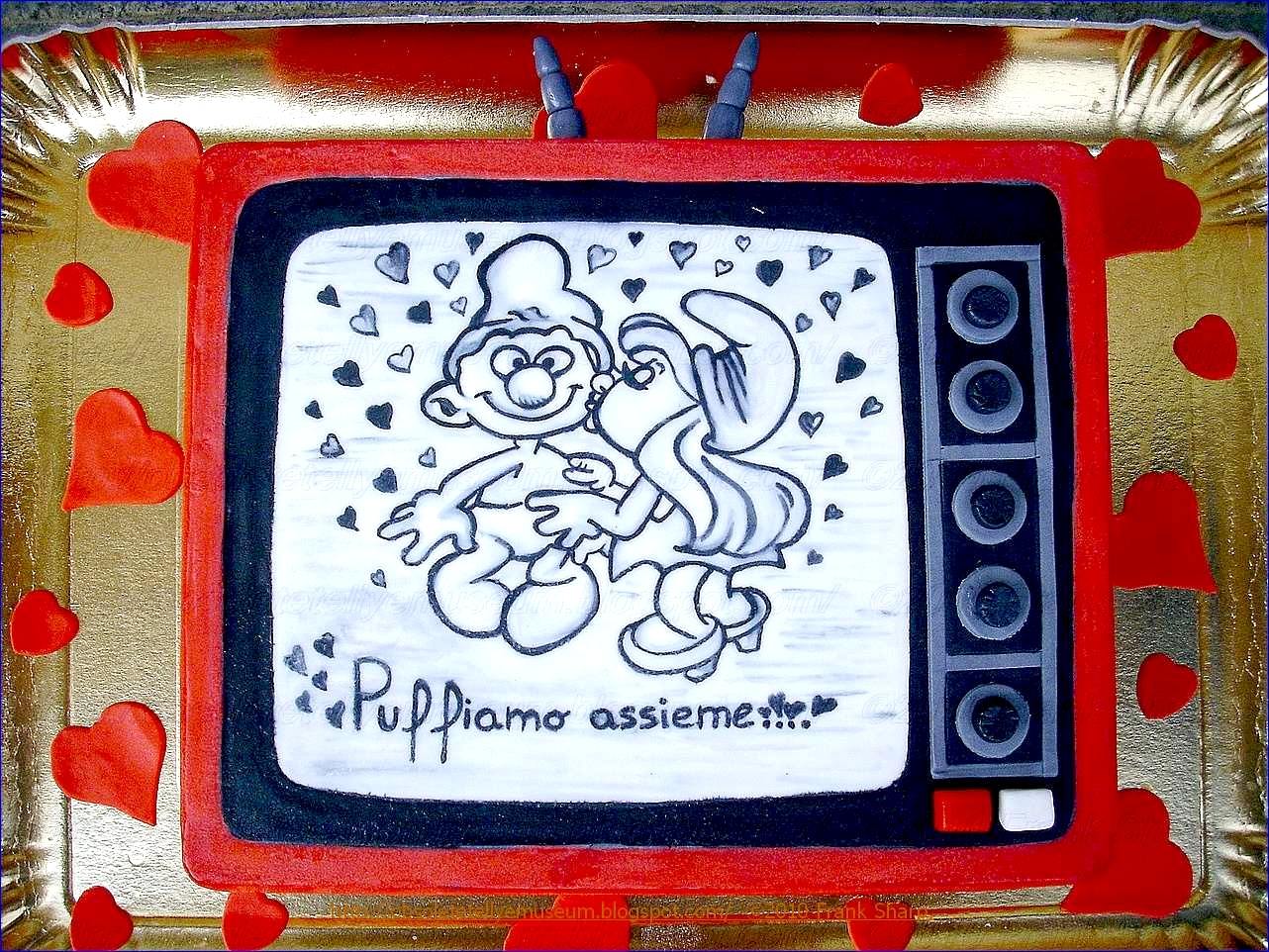
During the conversation he sayd that his wife have done the funnyest cake of the world for their 15th anniversary.
After some words he stated that I must see..........that cake............... absolutely.
In a brief time he was at my home and showed my the............cake and guess what ??
Seeing it (see the pictures) I was speechless, couldn't believe.
I've always believed that In its oldest forms, cakes were normally fried breads or cheesecakes, and normally had a disk shape. Determining whether a given food should be classified as bread, cake, or pastry can be difficult.
Cake is often the dessert of choice for meals at ceremonial occasions, particularly weddings, anniversaries, and birthdays. There are countless cake recipes; some are bread-like, some rich and elaborate, and many are centuries old. Cake making is no longer a complicated procedure; while at one time considerable labor went into cake making (particularly the whisking of egg foams), baking equipment and directions have been simplified so that even the most amateur cook may bake a cake.
But a cake in OLD CRT television format is the ultimate funnyest thing i've never seen.
Cakes may be classified according to the occasion for which they are intended. For example, wedding cakes, birthday cakes, cakes for first communion, Christmas cakes, Halloween cakes and Passover plava (a type of sponge cake sometimes made with matzo meal) are all identified primarily according to the celebration they are intended to accompany.
The cutting of a wedding cake constitutes a social ceremony in some cultures. The Ancient Roman marriage ritual of confarreatio originated in the sharing of a cake.
Particular types of cake may be associated with particular festivals, such as stollen or chocolate log (at Christmas), babka and simnel cake (at Easter), or mooncake. There has been a long tradition of decorating an iced cake at Christmas time; other cakes associated with Christmas include chocolate log and mince pies.
A finished cake is often enhanced by covering it with icing, or frosting, and toppings such as sprinkles, which are also known as "jimmies" in certain parts of the United States and "hundreds and thousands" in the United Kingdom. Frosting is usually made from powdered (icing) sugar, sometimes a fat of some sort, milk or cream, and often flavorings such as vanilla extract or cocoa powder. Some decorators use a rolled fondant icing. Commercial bakeries tend to use lard for the fat, and often whip the lard to introduce air bubbles. This makes the icing light and spreadable. Home bakers either use lard, butter, margarine or some combination thereof. Sprinkles are small firm pieces of sugar and oils that are colored with food coloring. In the late 20th century, new cake decorating products became available to the public. These include several specialized sprinkles and even methods to print pictures and transfer the image onto a cake.
Special tools are needed for more complex cake decorating, such as piping bags or syringes, and various piping tips. To use a piping bag or syringe, a piping tip is attached to the bag or syringe using a coupler. The bag or syringe is partially filled with icing which is sometimes colored. Using different piping tips and various techniques, a cake decorator can make many different designs. Basic decorating tips include open star, closed star, basketweave, round, drop flower, leaf, multi, petal, and specialty tips.
Royal icing, marzipan (or a less sweet version, known as almond paste), fondant icing (also known as sugarpaste) and buttercream are used as covering icings and to create decorations. Floral sugarcraft or wired sugar flowers are an important part of cake decoration. Cakes for special occasions, such as wedding cakes, are traditionally rich fruit cakes or occasionally Madeira cakes, that are covered with marzipan and iced using royal icing or sugar-paste. They are finished with piped borders (made with royal icing) and adorned with a piped message, wired sugar flowers, hand-formed fondant flowers, marzipan fruit, piped flowers, or crystallized fruits or flowers such as grapes or violets or television buttons for controls of volume, on -off, bright, color, programs.......................
The wife of my friend with the purpose to surprise with a special gift to his husband has searched for a very special thing and charged the job to a qualified professional cooker to create this specifically designed cake because she's aware that her husband has a "small" collection of old television sets and some old radios
lying around their house.

The professional cooker who was charged for this job for clear reasons haven't had a real idea on how to aquire a model but the wife of my friend has adressed intentionally good the cooker to do some WEB search and visit
Obsolete Technology Tellye ! on the WEB.
She showed her some pictures of old televisions and the cooker and wife, after looking toghether at some posts, dropped a quick look at main page showing the GRUNDIG SUPER COLOR 1631 in the snow.
After a brief talk the 2 womans decided to use this pictured television set as model for the cake, and draw a fotonovela picture like on the "cake screen" in a B/W sligltly noisy style and further drawing at bottom a subtitle "Puffiamo Insieme" which stays for Smurfing/ Loving toghether reffering to a an anime called "I Puffi" (SMURFS) broadcasted in the 70's - 80's.
 The Smurfs (French: Les Schtroumpfs) is a Belgian comic and television franchise centered on a group of small Smurfs who are small blue fictional creatures that lives in mushroom houses in a forest. The Smurfs was first created and first introduced as a series of comic characters by the Belgian comics artist Peyo (pen name of Pierre Culliford) in 1958. The word “Smurf” is the original Dutch translation of the French "Schtroumpf", a word invented when during a meal with fellow cartoonist André Franquin, Peyo couldn’t remember the word salt. There are more than one hundred Smurfs, whose names are based on adjectives that emphasize their characteristics, e.g. 'Jokey Smurf', who likes to play practical jokes on his fellow smurfs, 'Clumsy Smurf', who has a habit of creating havoc unintentionally, and 'Smurfette' (In Italian La Puffetta ) – the first female Smurf to be introduced in the series. The Smurfs wear Phrygian caps, which represented freedom in Roman times.
A characteristic of the Smurf language is the frequent use of the undefinable word "smurf" and its derivatives in a variety of meanings. The Smurfs frequently replace both nouns and verbs in everyday speech with the word "smurf": "We're going smurfing on the River Smurf today." When used as a verb, the word "Smurf" typically means "to make," "to be," "to like," or "to do."

Humans have found that replacing ordinary words with the term "smurf" at random is not enough: in one adventure, Peewit explains to some other humans that the statement "I'm smurfing to the smurf" means "I'm going to the wood," but a Smurf corrects him by saying that the proper statement would be "I'm smurfing to the smurf"; whereas what Peewit said was "I'm warbling to the dawn." So "I'm smurfing to the smurf" is not the same as "I'm smurfing to the smurf."
In the animated series, only some words (or a portion of the word) are
replaced with the word "smurf." Context offers a reliable understanding
of this speech pattern, but common vocabulary includes remarking that
something is "just smurfy" or "smurftastic."
------------------------------------------------------------------------------------------------------------------------------
This Post is dedicated to 2 high quality people having the
15th anniversary on 21/05/2013 and to
MAX GRUNDIG who was the fabricant of the television set used for the...................cake.
 Max Grundig
 (7
May 1908 – 8 December 1989) was the founder of electronics company
Grundig AG.Max Grundig is one of the leading business personalities of
West German post-war society, one of the men responsible for the German
“Wirtschaftswunder” (post-war economic boom).
GRUNDIG Early years
Max
Grundig was born in Nuremberg on May 7, 1908. His father died early, so
Max and his three sisters grew up in a home without a father. At 16,
Max Grundig began to be fascinated by radio technology, which at the
time was gaining in popularity. He built his first detector in the
family’s apartment, which he had turned into his own laboratory. In
1930, he turned his hobby into his profession and opened a shop for
radio sets in Fürth with an associate. The business prospered and soon
Grundig was able to employ his sisters and buy out his associate. By
1938, he was already manufacturing 30,000 small transformers.
GRUNDIG Success after World War II
Max
Grundig’s real success story began after World War II. On May 15, 1945,
Grundig opened a production facility for universal transformers at
Jakobinerstraße 24 in Fürth. Using machines and supplies from the war
era, he established the basis for what would turn into a global company
at this address. In addition to transformers, Grundig soon manufactured
tube-testing devices. As manufacturing radios was subject to a licence,
Grundig had the brilliant idea of developing a kit that would allow
anyone to quickly build a radio on their own. This kit was sold as a
“toy” called “Heinzelmann”.
Following
the monetary reform, Max Grundig quickly expanded his production under
the new company name “Grundig Radio-Werke GmbH” and served the expanding
mass market. From 1952, his company was the biggest European
manufacturer of radios and the worldwide leader in the production of
audio tape recorders.
Grundig
became a real pioneer in consumer electronics. From 1951, the company’s
portfolio also included the production and distribution of television
sets, and dictaphones were added in 1954. The company was turned into a
shareholding company, the Grundig AG, in 1971. In the 1970s, the company
was one of the leading companies in Germany, employing more than 38,000
people in 1979. Max Grundig had built a strong company from the ruins
of the war.
GRUNDIG and the rules are changing

In
the second half of the 1970s, another innovation entered the market for
consumer electronics, the VCR. And with the VCR, competitors from Japan
and later other countries of the Far East entered the world market.
Even though the European competitors Philips and Grundig had developed
the superior technology for recording video, the Japanese VHS succeeded
on the market. The rules of the game changed dramatically in the field
of consumer electronics. The competition for establishing the video
standard proved that companies could only succeed in consumer
electronics with the financial power of global corporations. In 1979,
Max Grundig decided to sell some shares to his Dutch competitor Philips,
and in 1984 he began the process of restructuring the ownership of the
Grundig companies, which would be completed two decades later.
Max
Grundig died on December 8, 1989 in Baden-Baden. The Grundig name
continues to be known to this day and is now a globally recognised brand
for innovative consumer electronics. Max Grundig is remembered in
Germany as a dynamic entrepreneur from the post-war era.
 Max GRUNDIG:
 Born on 7 May 1908 in the Denis Street 3 in Nuremberg
workers
district Gostenhof Parents of "Magaziners" or warehouse worker Max Emil
and his wife Marie. The enlargement of the family through the birth of
three sisters require in the aftermath several moves within Nuremberg.
In
1920, his father
died unexpectedly at the consequences of an
appendectomy. The already poor family is financially worse rapidly. This
is followed by further moves into ever smaller and cheaper housing. Max
Grundig starts in April 1922 commercial apprenticeship at the
installation company Jean Hilpert in Nuremberg. His interest lies in the
crafting of radios, a hobby, the early 1920s was indulged by tech-savvy
youngsters often. But Max Grundig tinkering not only simple radios, but
also more complex technical equipment such as image receiver.(Photos
refering to
Father and Mother of Max GRUNDIG.)
After
the end of his teaching is Max Grundig 1927 Head of a new branch of the
company in Fürth Hilpert and supervised by commercial side of the
installation work of the under construction Municipal Hospital Fürth. In
May 1928 and in October 1930 Grundig also occurs on a radio dealer and
take part in an event organized by Workers' Radio Association Germany on
the occasion of Fürth Kirchweih 1930 radios exhibition. A first
marriage in 1929 held only briefly. From her daughter Inge comes.
Following
the closure of Fürth Branch company Hilpert for the finished
installation works at the hospital, Max Grundig together with Karl
Wurzer, who was funders primarily, on 15 November 1930 as a radio dealer
in Sternstraße 4 in Fürth independently. Today this street
Ludwig-Erhard-Straße is, since there - was directly opposite the first
by Max Grundig Radio Load - - the business of the parents of the future
economy minister and Chancellor Ludwig Erhard (1977 1897).
His radio
action called Max Grundig "Radio Sales Fürth" short RVF. On June 21,
1934, a procession of RVF in the Schwabacher Straße carried 1. The
partnership Karl Wurzer is paid, Max Grundig is now the sole owner. In
addition to selling and repairing radios Grundig starts construction of
transformers. In 1938, he is Sales millionaire. In the same year he
married the singer and manufacturer's daughter Annelie Jorgensen. The
marriage remains childless.

During
the Second World War Grundig continues its production of small
transformers continued on a larger scale in the Fürth suburb Vach, where
he rents rooms in three inns. He himself is in 1941 drafted into the
army, some time must remain as a corporal in Paris, but shortly before
his entire company is reassigned to the East - also because of its
possibilities, to provide supervisors with radios - "indispensable" (uk)
provided and forwards Fuerth his company to continue the war.
On
18 May 1945, the US Army occupied the suburb Vach. Grundig's stock will
not be plundered, neither of German or foreign looters nor by the US
military because the workforce that consists partly of Ukrainian slave
laborers, has a sign "Off limits" - "no trespassing" - at the door,
protects the company. In June 1945, Grundig rented a factory building in
the Jakobinenstraße 24 in Fürth. are manufactured now transformers and
measuring instruments: The tube tester "Tubatest" and the fault locator
"Nova Test". The commercial license is replaced by the Radio-sales Fürth
on 7 November 1945. In December 1945, Grundig has 42 employees.
On April 10, 1946 Max Grundig starts own production of radios.

His first instrument is the "
Heinzelmann"
This radio can also complete as a kit or under the hand, but are always
acquired without tubes. But the tubes are widely available on the black
markets of the early postwar years. Since a wireless without tubes per
se is not operational, allowing the American military government Max
Grundig, "no quota", ie without limitation in quantity, produce radio
and distribute. With the mass sale of "Heinzelmann" Max Grundig creates
the basis for further economic success of the company as a manufacturing
company after the Second World War.
As of August 1, 1946 is the
company "RVF - Electrotechnical Factory". Beginning in March 1947, work
began in the Kurgartenstraße 37 in Fuerth, the later main plant of the
company Grundig. On 7 July 1948 re-naming of the company is carried out
in "Grundig radio-Werk GmbH". As of spring 1948, the superhit radio
"Weltklang" comes on the market. In February 1949, the 100,000th
Wireless is already prepared. In the same year built a Grundig FM radio
stations trying to prepare for the introduction of the ultra-short wave
on 15 March 1950. In December 1949 the company Grundig counts 1,600
employees.
In May 1951 Max Grundig acquires Lumophon radio
stations in Nuremberg and Georgensgmünd and integrates them into its
"Grundig radio-Werke GmbH". In September and October 1951, he is with a
purpose-built television station Directorate building his company in
Fürth the first public television broadcasts in Southern Germany. he
produced 94 televisions this year. The production of tape recorders
starts 1951st
1954 lets Max Grundig his first dictation machine, the
"Stenorette" build. In 1957 he buys the office machine manufacturer
Triumph-Adler in Nuremberg and Adler in Frankfurt that remain until 1968
in his possession. In 1958 he founds the Grundig Bank in Fürth. In the
same year, with the introduction of the transistor instead of the Radio
tube, penetrate the first Japanese companies like Sony in the European
and German market, initially still in the lowest price segment. 1960
Grundig has 16,495 employees.
The 1960s are marked by the further
expansion of the company: Grundig is the biggest radio manufacturer in
Europe. In 1961 he acquired a large area in Nuremberg-Langwasser, on the 1963 first tape recorders are produce

d. In other parts of Germany companies to buy or newly built shortly afterwards in Italy and Austria.
1964
leads the Dutch company Philips in tape recorders, the compact cassette
CC and thus the cassette recorder, and it initially in the lower price
range. The leader Grundig countered in 1965 with the cassette system DC
International, but can not prevail.
After 1967, the beginning of
color television initially causes a strong boom in the production of
related hardware. This results not only in their own country
overcapacity, but the Japanese competition suppressed due to lower wages
and production costs at the same time always noticeable with affordable
devices on the European and German market.
1969 bring the company
Philips and Grundig together the first video recorder for home
appliances on the market. It is still a tape machine. But soon the world
led the struggle for the enforcement of various video cassette systems begins.
In
1970, Grundig has approximately 25,000 employees. This year, Max
Grundig builds to his company. He built on 22 February 1970, the "Max
Grundig Foundation", added on 12 March 1970, the "Grundig-family club".
The Max Grundig Foundation is now the sole owner. In addition, on 1
April 1972, the "Grundig-Werke GmbH" in a corporation, the "Grundig AG"
converted. The foundation holds about 94% of the capital.
From 1970,
the television production is relocated to Nuremberg-Langwasser. The
expectations regarding equipment sales for the 1972 Olympic Games in
Munich true. With the Super-Color TVs a new product range is presented
in a modular design. In Nuremberg-Langwasser,
daily production reached
1,200 color TV.
1977 founds the Grundig "Hotel Management Max Grundig
Foundation". The Hotel Forsthaus Fuerth and Hotel Fuschl near Salzburg
to buy. A year later Grundig donates 30 million DM for the "Grundig
Academy of Economics and Technology", which serves the training of
professionals and executives. 1978 produced in Langwasser also a new VCR
plant.
Increasingly Max Grundig is weakened by illness, repeated he
needs surgery. The European consumer electronics industry is committed
to strategies against existing overcapacity and the growing economic
influence of companies from the Far East. In Europe, these are mainly
the French state company Thomson-Brandt, the Dutch company Philips and
Grundig.
The cooperation with the Dutch company Philips thickens in
the VCR production. In 1979 share swaps. Philips makes 24.5% of the
shares of Grundig AG, Grundig 6% of Philips and is thereby the largest
single shareholder.
1979 achieved the Grundig AG with
38,460 employees 
worldwide their personal peak.
The company has 31 plants, nine branches with 20 branches and three
Werksvertretungen, eight sales companies and 200 worldwide export
missions. Also, sales continue to rise. But the profit is shrinking. In
1981, the Grundig AG writes first losses. After divorcing his second
wife Annelie Max Grundig marries 1980, the French woman Chantal Girard.
In the same year the daughter Marie was born.
1982 at the
presentation of "Eduard Rhein honor ring" and before the European
Commission, presents Max Grundig be EURO concept, the united front of
the European consumer electronics market to Japanese companies: "Acting
together, jointly produce, market share". But he can not prevail. Too
much stalking and distrusts you also mutually in the European
broadcasting industry. And Japan is not the only competitor. An
agreement between the companies Grundig and Thomson-Brandt, which is
scheduled also built in 1982, can - among other things due to the
resistance of the Bundeskartellamt and because the company Philips is
involved in Grundig - not be implemented.
On 26 March 1984 Philips
increased its share of Grundig AG by 7.1% to 31.6%. In April 1984, the
Federal Cartel Office approved the merger of Grundig and Philips under
the condition that Grundig sells its voice recorders range. New CEO of
Grundig AG is the Dutchman Hermanus Koning on April 1 (1924 - 1998).
From 1984 to 1998, the Dutch have entrepreneurial saying. Max Grundig
receives for his departure from the company, among other things a
guaranteed 20-year-income annual return of 50 million marks.
Not
quite voluntarily leaving Max Grundig the company he has built up and
which bears his name. But there can be only one boss. 1985 must Grundig
also his top job at the Grundig-Bank ad, which is sold to a Swiss
institute.
Grundig expands its hotel ownership, 1986, he acquired the
luxury hotel "Bühlerhöhe", which he renovated at great expense.
On 8
December 1989 Max Grundig dies. Under
great public participation he will
be buried in Baden-Baden.
After a brief economic boom as a
result of German reunification takes place until 1991 a rapid decline of
the company Grundig. Between 1992 and 1996 the Grundig Group makes
almost two billion marks loss. The number of employees decreased from
16,250 to 8,580 employees.
1998, the Philips Group withdraws.
According to its own description Philips has been paying 1.5 billion
marks. A consortium of banks and insurance companies under the
leadership of the antenna manufacturer Kathrein, the personally liable
partners of Kathrein Werke KG, takes on 18 December 1998 the Grundig AG.
In
2000 and 2001, the company headquarters and the remaining departments
of Fürth be routed to Nuremberg. But Grundig continues to make losses.
On 1 April 2003, Grundig AG announces insolvency.
2004 Turkey company
Beko electronics in Istanbul, belonging to the Turkish Koc Holding,
together with the British company Alba Radio Ltd. accepts the division
consumer electronics. This company is now called "Grundig Intermedia".
Both companies each own fifty percent of "Grundig Multimedia B.V.",
which is a holding full ownership of Grundig Intermedia GmbH. In
addition, proceeds from the office equipment division as buy-out the
company "Grundig Business Systems" produced. The car radio range is
taken from the Delphi Corporation, the activities of the former Grundig
range satellites for "Grundig SAT Systems GmbH".
In October 2006 and
January 2007, two production lines for TV at Grundig Elektronik in
Istanbul are put into operation. On 18 December 2007, Koç Group acquires
through its subsidiary Arçelik A.S. the shares of Alba plc. And that is
the sole owner of Grundig Multimedia B.V. or the Grundig Intermedia
GmbH. The development area in Nuremberg closes the end of 2008 as part
of an ending in 2009 the restructuring process. When Grundig
headquarters in Nuremberg with around 140 employees Sales, marketing,
communications, design, quality assurance, customer service and the
office staff remain. The Turkish Grundig Intermedia GmbH is now divided
into six product areas: TV, Audio, HiFi, "Personal Care", "Floor Care"
and kitchen appliances.
The Radio Museum in Fürth, located in the
former Directorate of Max Grundig, shows in addition to the history of
the development of broadcasting in Germany and the corporate and
entrepreneurial story of Max Grundig, the man who the radio and
television development in Germany after the Second World War three has
for decades dominated the market leader.
He was married lastly to Chantal Grundig.
Early history
The
history of the company began in 1930 with the establishment
of a store named Fuerth, Grundig & Wurzer (RVF), which
sold radios. After World War II Max Grundig recognized the
need for radios in Germany, and in 1947 produced a kit, while a
factory and administration centre were under construction at
Fürth. In 1951 the first televisions were manufactured at the
new facility with the company and the surrounding area growing
rapidly. At the time Grundig was the largest radio
manufacturer in Europe. Divisions in Nuremberg, Frankfurt and
Karlsruhe were set up.
Grundig in Belfast
 A
plant was opened in 1960 to manufacture tape recorders in
Belfast, Northern Ireland, the first production by Grundig
outside Germany. The managing director of the plant Thomas
Niedermayer, was kidnapped and later killed by the Provisional
IRA in December 1973. The factory was closed with the loss of around 1000 jobs in 1980.
A
plant was opened in 1960 to manufacture tape recorders in
Belfast, Northern Ireland, the first production by Grundig
outside Germany. The managing director of the plant Thomas
Niedermayer, was kidnapped and later killed by the Provisional
IRA in December 1973. The factory was closed with the loss of around 1000 jobs in 1980.
Philips takeover
In
1972, Grundig GmbH became Grundig AG. After this Philips
began to gradually accumulate shares in the company over the
course of many years, and assumed complete control in 1993.
Philips resold Grundig to a Bavarian consortium in 1998 due to
unsatisfactory performance.
Later history
At
the end of June 2000 the company relocated its headquarters
in Fürth and Nuremberg. Grundig lost €1.281 million the
following year. In autumn 2002, Grundig's banks did not extend
the company's lines of credit, leaving the company with an
April 2003 deadline to announce insolvency. Grundig AG
declared bankruptcy in 2003, selling its satellite equipment
division to Thomson. In 2004 Britain's Alba plc and the Turkish Koc's Beko
jointly took over Grundig Home InterMedia System, Grundig's
consumer electronics division. In 2007 Alba sold its half of
the business to Beko for US$50.3 million, although it retained the licence to use the Grundig brand in the UK until 2010, and in Australasia until 2012.
HISTORY OF GRUNDIG IN GERMAN:
1930
gründet der Kaufmann und Radiobastler Max Grundig (1908-1989) den
Radio-Vertrieb Fürth, Grundig & Wurzer (RVF), ein
Radio-Fachgeschäft mit Werkstatt. Bald fabriziert der Betrieb auch
Transformatoren und Spulen, später zudem Prüfgeräte. 1934 zahlt Grundig
den Teilhaber und Freund Karl Wurzer aus. 1938 beträgt der Umsatz mehr
als 1 Mio. RM. Während des Krieges fabriziert Grundig im Dorf Vach mit
etwa 600 Personen, darunter vielen Ukrainerinnen, Kleintrafos,
elektrische Zünder und Steuergeräte für die V-Raketen. Das
Grundig-Vermögen schätzt man am Kriegsende auf 17,5 Mio. RM
Ab
18. Mai 1945 kann Grundig wieder in Fürth produzieren. Er lässt
Transformatoren wickeln, Reparaturen ausführen und stellt kurz darauf
das Röhrenprüfgerät «Tubatest» und das Fehler-Suchgerät «Novatest» her.
Ab 15.1.46 lässt Grundig den externen Ing. Hans Eckstein, den früheren
Konstrukteur bei Lumophon, einen Einkreiser-Baukasten mit späterem
Namen «Heinzelmann» entwickeln. Anfang 1946 beschäftigt Grundig ca. 100
Personen. Ab Oktober 1946 läuft die Produktion des «Heinzelmann» und
die Firma stellt bis Ende 1946 391 Baukästen her. Die vierseitige
Geschichte dazu findet sich in der Zeitschrift «rft» 1991, ab Seite 421.
Grundig hat auch 1947 grossen Erfolg, denn ein Baukasten ist ohne
Bezugsschein erhältlich. Das erste Modell (A) ist ein
Zwei-Röhren-Allstromempfänger mit Wehrmachtsröhren RV12P2000. Die
Produktion findet bald mit 120 Mitarbeitern auf 400 qm statt. Anfang
1947 folgt Modell W [634701]. Der Baukasten erreicht 1948 eine Stückzahl
von 39'256 [DRM].
Am 15.3.47
beginnt Grundig mit dem Bau eines modernen Fabrikgebäudes auf 8000 qm
Fläche. Mitte 1948 kann die Firma den Superhet «Weltklang» anbieten; er
findet ebenfalls guten Absatz. 400 Personen arbeiten auf 3000 qm
Fläche. Im Juli 1948 benennt Grundig seine Firma in Grundig-Radiowerke
GmbH um. Jetzt arbeiten 650 Personen im Betrieb. 1949 kommt als erstes
deutsches Nachkriegs-Koffergerät der «Grundig-Boy» auf den Markt. Die
Firma bringt eine Neukonstruktion des «Heinzelmann» auf den Markt.
Zudem entsteht der Vier-Kreis-Super «Weltklang 268GW». Im Mai 1949
erreicht der Betrieb in der Bizone (eigentlich Trizone!) 20 %
Marktanteil [664905]. Die Bizone ist der Zusammenschluss der amerikan.
und brit. Besatzungszone von 1947 bis 8.4.49, die sich ab dann durch den
Anschluss der frz. Besatzungszone zur Trizone erweitert.
Am
16. Mai 1951 übernimmt Grundig die Lumophon-Werke (ebenfalls in Fürth)
für den Betrag von 1,7 Mio. DM. Im gleichen Jahr entstehen erste
Grundig-Tonbandgeräte. 1952 beginnt die Produktion von Fernsehgeräten.
Das Unternehmen beschäftigt nun 6000 Personen und feiert am 12. Mai 1952
den millionsten Rundfunkempfänger. Die Baureihe von 1952/53 ist
erstmals technisch und formal einheitlich gestaltet, wobei Grundig die
prinzipielle Form bis 1956/57 beibehält. Ausser Typ 810 mit
Flankengleichrichter enthalten alle Geräte einen integrierten FM-Teil
mit Ratiodetektor. 1955 bezeichnet sich Grundig als den grössten
Tonbandgeräte-Hersteller der Welt. 1956 kauft er das
Telefunken-Rundfunkgerätewerk Dachau [639071]. 1959 besteht Grundig aus
sieben Werken, zwei Tochtergesellschaften plus einer Neugründung in den
USA. 1964 übernimmt Grundig die Tonfunk-Werke, Karlsruhe. 1969
beteiligt sich Grundig mehrheitlich an der Kaiser-Radio in Kenzingen.
Max Grundig ist seit 1970 gesundheitlich angeschlagen.
1978
gehören 31 Werke, 9 Niederlassungen mit 20 Filialen und drei
Werksvertretungen, 8 Vertriebs- und 200 Exportvertretungen zur Grundig
AG. 1979 beschäftigt das Unternehmen 38'000 Personen; der Umsatz liegt
bei 3 Mrd. DM. Ein Hauptstandort ist Nürnberg. Grundig muss sich jedoch
einer Umstrukturierung unterziehen und Philips erhält 1979 eine
Beteiligung von rund 25 %. 1980/81 muss Grundig einen Verlust von 187
Mio. DM hinnehmen. Zusätzlich scheitert das Gerät «VIDEO 2000»
finanziell.
Eine detaillierte Firmengeschichte enthält das 1983 erschienene Buch: «Sieben Tage im Leben des Max Grundig» von Egon Fein.
Allerdings lässt sich aus [481, Saba] auch wenig Schmeichelhaftes über das Machtstreben von Max Grundig erfahren.
1984
erhöht Philips die Beteiligung um 7 % und übernimmt die
unternehmerische Verantwortung. 1986/87 kann das Unternehmen mit noch
19'500 Mitarbeitern wieder schwarze Zahlen schreiben. 1987/88
beschäftigt Grundig noch 18'700 Personen bei einem Umsatz von
 3,2
Mrd. DM, wovon 90 % auf die Unterhaltungselektronik entfallen. In
diesem Geschäftsjahr verlassen 2 Mio. Farbfernsehgeräte und 750'000
Videorecorder die Bänder. Max Grundig stirbt im Dezember 1989 [639071] -
letztlich hatte er nicht das vierblättrige, sondern das dreiblättrige
Kleeblatt als Firmenemblem gewählt.
3,2
Mrd. DM, wovon 90 % auf die Unterhaltungselektronik entfallen. In
diesem Geschäftsjahr verlassen 2 Mio. Farbfernsehgeräte und 750'000
Videorecorder die Bänder. Max Grundig stirbt im Dezember 1989 [639071] -
letztlich hatte er nicht das vierblättrige, sondern das dreiblättrige
Kleeblatt als Firmenemblem gewählt.
Philips hat das
Unternehmen vollständig übernommen. Mitte 90er Jahre beschäftigt
Grundig noch 8000 Personen. Eine detaillierte Firmengeschichte findet
sich in «kleeblatt radio» ab 5/93 des Förderverein des Rundfunkmuseums
der Stadt Fürth eV.
1998 verkaufte Philips das
Unternehmen an ein Konsortium unter Führung von Anton Kathrein von den
Kathrein-Werken. Im Jahre 2001 wurde bei einem Umsatz von 1,2
Milliarden Euro ein Verlust von 150 Millionen Euro erwirtschaftet.
Daher verlängerten die Banken im Herbst 2002 die Kreditlinien nicht
mehr, was zur Insolvenz im April 2003 führte. In der Folgezeit wurden
gewinnbringende Sparten (wie z.B. Bürogeräte, Autoradios) aus dem
Konzern herausgelöst und einzeln verkauft. Verlustreiche Sparten wurden
stillgelegt und die Mitarbeiter entlassen. Heute erhältliche Neuware
von Grundig ist kaum noch "made in Germany".


 FIGURE 91.1 Example of a typical CRT with electromagnetic focus, and electromagnetic deflection. This type of tube d...
 The supply is based on MOTOROLA MC44603p which is a MIXED FREQUENCY MODE GR...
 CRT TUBE SONY TRINITRON A34JBU10X VIEW. ...
 A Top television set with top features...
 The PHILIPS 25ML8766/08B IDTV 100HZ MATCH LINE is Another top series mod...
 GENERAL Circuit Description for ITT DIGI...
 SOUND BOARD 450918-9 6611 37 27 ITT DIGIVI...
 The THOMSON CHASSIS ICC5 Is a highly engineered ...

 The set is based on the ...
 The SAMSUNG MOD:CZ-6844W is a 28 inches (70cm) DIGITAL color television with 99 programs,OSD, STEREO DIGITAL SOUND, TELETEXT, 120...
 GRUNDIG XS70/1 CHASSIS CUC6360 (29701-088) : CPU - XC68HC11F1B4 EEPROM...
 The PHILIPS CHASSIS L6 is the most compact mini chassis for a color tv. The chassis was even featured for a 110° degree crt tu...
 ITT IDEAL COLOR 3426 CHASSIS COMPACT B 110° S4-SQ / IFB-491 D F - Tuning Controls View. Cont...
 The TELEFUNKEN PALCOLOR 5600 SUPERCONTROL is a 20 inches color television with 12 programs and infra red remote control. Tunin...
 The PHILIPS 14CT3205 PHILETTA COLOR is a 14 inches (37cm) Portable color television with 12 programs. The set has a rem...
 THE GRUNDIG COLOR 5050 ULTRA ELECTRONIC is a 26 inches color television with 7 programs sensor button changer and potentiometers t...
 The FERGUSON Mod. 38030 is a portable 12 inches B/W Screen with ONLY UHF Channels reception capability. marketed with the FERGUSO...