Richtige Fernseher haben Röhren!

Richtige Fernseher haben Röhren!

In Brief: On this site you will find pictures and information about some of the electronic, electrical and electrotechnical Obsolete technology relics that the Frank Sharp Private museum has accumulated over the years .
Premise: There are lots of vintage electrical and electronic items that have not survived well or even completely disappeared and forgotten.

Or are not being collected nowadays in proportion to their significance or prevalence in their heyday, this is bad and the main part of the death land. The heavy, ugly sarcophagus; models with few endearing qualities, devices that have some over-riding disadvantage to ownership such as heavy weight,toxicity or inflated value when dismantled, tend to be under-represented by all but the most comprehensive collections and museums. They get relegated to the bottom of the wants list, derided as 'more trouble than they are worth', or just forgotten entirely. As a result, I started to notice gaps in the current representation of the history of electronic and electrical technology to the interested member of the public.

Following this idea around a bit, convinced me that a collection of the peculiar alone could not hope to survive on its own merits, but a museum that gave equal display space to the popular and the unpopular, would bring things to the attention of the average person that he has previously passed by or been shielded from. It's a matter of culture. From this, the Obsolete Technology Tellye Web Museum concept developed and all my other things too. It's an open platform for all electrical Electronic TV technology to have its few, but NOT last, moments of fame in a working, hand-on environment. We'll never own Colossus or Faraday's first transformer, but I can show things that you can't see at the Science Museum, and let you play with things that the Smithsonian can't allow people to touch, because my remit is different.

There was a society once that was the polar opposite of our disposable, junk society. A whole nation was built on the idea of placing quality before quantity in all things. The goal was not “more and newer,” but “better and higher" .This attitude was reflected not only in the manufacturing of material goods, but also in the realms of art and architecture, as well as in the social fabric of everyday life. The goal was for each new cohort of children to stand on a higher level than the preceding cohort: they were to be healthier, stronger, more intelligent, and more vibrant in every way.

The society that prioritized human, social and material quality is a Winner. Truly, it is the high point of all Western civilization. Consequently, its defeat meant the defeat of civilization itself.

Today, the West is headed for the abyss. For the ultimate fate of our disposable society is for that society itself to be disposed of. And this will happen sooner, rather than later.

OLD, but ORIGINAL, Well made, Funny, Not remotely controlled............. and not Made in CHINA.

How to use the site:
- If you landed here via any Search Engine, you will get what you searched for and you can search more using the search this blog feature provided by Google. You can visit more posts scrolling the left blog archive of all posts of the month/year,
or you can click on the main photo-page to start from the main page. Doing so it starts from the most recent post to the older post simple clicking on the Older Post button on the bottom of each page after reading , post after post.

You can even visit all posts, time to time, when reaching the bottom end of each page and click on the Older Post button.

- If you arrived here at the main page via bookmark you can visit all the site scrolling the left blog archive of all posts of the month/year pointing were you want , or more simple You can even visit all blog posts, from newer to older, clicking at the end of each bottom page on the Older Post button.
So you can see all the blog/site content surfing all pages in it.

- The search this blog feature provided by Google is a real search engine. If you're pointing particular things it will search IT for you; or you can place a brand name in the search query at your choice and visit all results page by page. It's useful since the content of the site is very large.

Note that if you don't find what you searched for, try it after a period of time; the site is a never ending job !

Every CRT Television saved let revive knowledge, thoughts, moments of the past life which will never return again.........

Many contemporary "televisions" (more correctly named as displays) would not have this level of staying power, many would ware out or require major services within just five years or less and of course, there is that perennial bug bear of planned obsolescence where components are deliberately designed to fail and, or manufactured with limited edition specificities..... and without considering........picture......sound........quality........
..............The bitterness of poor quality is remembered long after the sweetness of todays funny gadgets low price has faded from memory........ . . . . . .....
Don't forget the past, the end of the world is upon us! Pretty soon it will all turn to dust!

Have big FUN ! !
-----------------------
©2010, 2011, 2012, 2013, 2014 Frank Sharp - You do not have permission to copy photos and words from this blog, and any content may be never used it for auctions or commercial purposes, however feel free to post anything you see here with a courtesy link back, btw a link to the original post here , is mandatory.
All sets and apparates appearing here are property of Engineer Frank Sharp. NOTHING HERE IS FOR SALE !
All posts are presented here for informative, historical and educative purposes as applicable within Fair Use.


Showing posts with label Rigonda. Show all posts

Friday, June 17, 2011

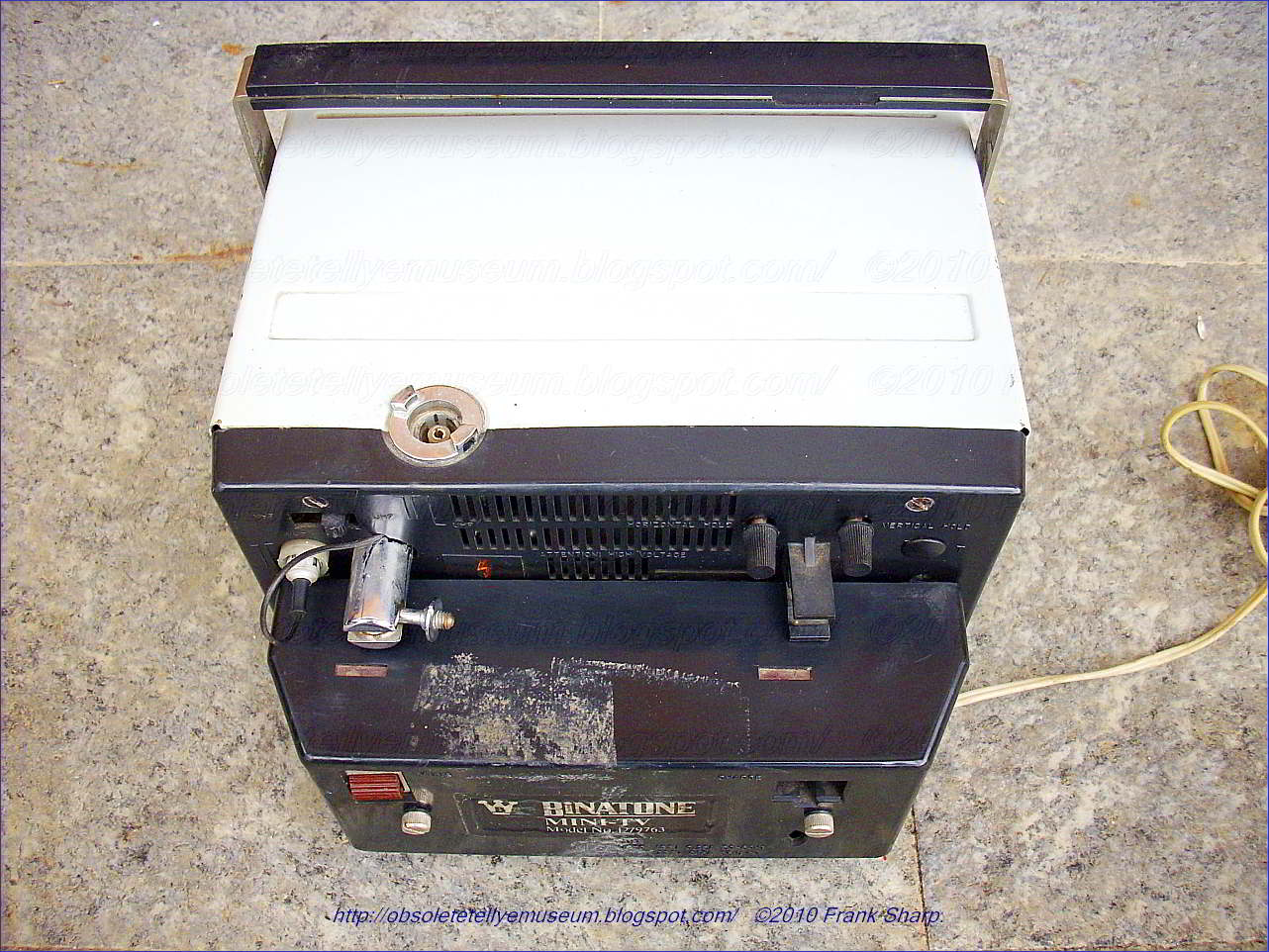
BINATONE MINI-TV MODEL NO. 12/9763 (ŠILJALIS) (RIGONDA) YEAR 1977.


 The BINATONE MINI-TV Model no. 12/9763  (ŠILJALIS) (RIGONDA)  is A  rare television set branded BINATONE but constructed In the C.C.C.P The Union of Soviet Socialist Republics (USSR, Russian: Сою́з Сове́тских Социалисти́ческих Респу́блик, tr. Soyuz Sovietskikh Sotsialisticheskikh Respublik IPA: [sɐˈjus sɐˈvʲetskʲɪx sətsɨəlʲɪˈstʲitɕɪskʲɪx rʲɪsˈpublʲɪk], abbreviated СССР, SSSR).

The BINATONE MINI-TV Model no. 12/9763 ('VEGA 402DE') (RIGONDA)  is a VHF/UHF 6" screen mono TV for System B/G operation (5.5MHz sound) and is ideal for basic TV/DXing for Continental travel use. Operation is from a removable heavy duty mains PSU or an external 12 volt source (all plugs etc supplied). The receiver has rugged construction and contained within a metal cabinet, the carrying handle doubling as a receiver stand. The BINATONE MINI-TV Model no. 12/9763 (402DE) features very good sensitivity and sharp selectivity with its 4 individually tuned IF stages (5 stage at UHF). Aerial input is via separate VHF/UHF 75 ohm coaxial sockets, in addition a strong integral whip (40" extended) is provided to rear. The VHF tuner is an 11 position 'click stop' turret covering all Band 1/3 'E' channels - adjust the ch.E2 coil to include ch.1A allowing ALL Band 1 TV/DX channels to be received - the fine tuning range in Band 3 is sufficient to cover virtually all European channels without adjustment. UHF coverage uses a small rotary tuner control (with varicap fine tune) covering the ch.21-68 range.

Rigonda BINATONE sets originate from the USSR and were imported into the UK from the 1972 season until the late 1980s. Most were 4 1/2” monochrome portables of an advanced design sold at very low prices to earn much needed foreign currency for Mother Russia.
The tellye has a very small screen and metal cabinet and can be powered by battery or adaptor like photographed.
It has only 2 bands VHF and UHF Channels and the screen is a REAL FLAT small format B/W type.
The hand grip can both used for transport or to support the tellye in a inclined position when watched. The same hand grip can be blocked in a desired position pulling it in the direction of the cabinet to lock it.

These were sold under both the Rigonda and Vega BINATONE marques and came housed in neat metal cabinets painted in various dreary 3-year-plan colours. Later Vega sets came in a slightly bigger plastic cabinet, usually red (naturally…) or dog poo brown.
These sets come from a completely separate engineering culture to those from Western Europe and Japan, so the circuit designs and fault patterns differ to what one is normally comfortable with. The components too are quite different, most particularly the transistors. These are difficult to substitute, not least because they are of different physical sizes and shapes to our “normal” types.

The set is fully transistorized and has a uncommon technology development type.

I like sets which are unusual and technically interesting, which usually means CRT'S. One make which I’ve always struggled with though is URSS made crt's sets , and I suspect that I am not alone…
Black and white portable television set equipped with  semiconductors. Screen with a diagonal of 16 cm. Two tuners separately for I-III. and IV.-V. zone. Metal cabinet, plastic mask screens. Volume control, brightness, contrast and tune to the right of the screen, the power switch on the back of a removable source (can be removed in case of operation at 12V.)

Binatone is a private company owned by brothers Partap and Gulu Lalvani. Binatone was started in the United Kingdom in 1958 to import and distribute consumer electronics. In the 1980s offices were opened in Spain, Japan, South Korea, Hong Kong, India, Nigeria and Taiwan.
In 1989 the company was divided, with Gulu Lalvani, chairman of Binatone Electronics International (BEIL), retaining the European and Hong Kong businesses, and Partap Lalvani (now Chairman of Binatone Industries, Ltd.) retaining the group's businesses in Eastern Europe, Africa and South Asia. An office in Moscow was opened in 1994 and an office in Dubai was opened in 2002.
Partap Lalvani's Binatone employs 350 people in 10 countries and the product range consists of small electronics like personal care products, cooking appliances and DECT telephones.
Binatone was founded in 1959 by two brothers, Gulu and Partap Lalvani. The company was named after Bina, their younger sister. In 1959 Binatone was the first company to import transistor radios into the UK from Japan. In 1970 Binatone opened buying offices in Hong Kong. In 1974 Binatone entered the TV games market, growing the sector five times in two years. In 1978 Binatone had the best selling TV game in the UK. In 1980 Binatone introduced its version of the Walkman and in 1981 it sold more Walkman's than Sony. In 1983 Binatone was the first in Europe with fixed line telecom. In 1989 Binatone opened its Hong Kong headquarters. In 1996 Binatone was the first company in Europe to introduce DECT telephones. In 2002 Binatone was the 2nd DECT telephone manufacturer in the world. Binatone was the official shirt sponsor of Queens Park Rangers Football Club in 2003/2004, 2004/2005 and 2005/2006. In 2004 Binatone entered the Russian telephone market with the Voxtel brand. In 2005 Binatone Telecom was in 55 countries with average growth of 30% per annum. In 2006 Binatone was the 3rd largest telephone manufacturer in Russia with 25% market share. In 2007 Binatone introduced its satellite navigation (GPS) range in Europe and Asia Pacific. In 2007 Binatone was appointed as one of five council board members of Deutsche Telecom. In 2008 Binatone was purchased by Dino Lalvani, son of Gulu Lalvani and formerly its COO and Sales and Marketing Director. Dino Lalvani, 35, has been primarily responsible for Binatone's international expansion and success. In 2008 Binatone was appointed Global Licensee of Motorola Digital Photo Frames, Video and Baby Monitors and North American Licensee of Motorola Digital Corded and Cordless Phones. In 2009 Binatone celebrated its 50th anniversary. In 2009 Binatone is the third largest in satellite navigation (GPS) with 10% market share in the UK. Binatone has 28% market share in the UK in telephones.


Radiotehnika / Par uzņēmumu Archived 2010. gada 10. jūlijā, Wayback Machine vietnē., rrr.lv

Gubins Mihails. «История рождения и смерти завода "Радиотехника"». lv.sputniknews.ru (krievu), 2017-10-13. Skatīts: 2019-01-15.

"Tiesa. Rīgas Centra rajona prokuratūrā.". Cīņa. 1.03.1941.

"Nelietīgi izmantojusi uzticību". Padomju Latvija, laikraksts 71. 22.03.1941.

Sputnik. «"Radiotehnikas" vietā parādīsies "Depo"». sputniknewslv.com (en-us). Skatīts: 2019-01-15.


BINATONE MINI-TV Model no. 12/9763 (Šiljalis) CHASSIS INTERNAL VIEW.


The BINATONE MINI-TV Model no. 12/9763 CHASSIS set is constructed In the C.C.C.P The Union of Soviet Socialist Republics in 1977 and it's developed around NON USA and NON EUROPEAN and even NON JAPAN Semiconductors.
Even the design of circuitry is singular.

Developed in a multiboard design it's easy to service except for the components which are particular and customized.

Particular is the EHT Transformer which is even derived from the Line output transformer in a very uncommon way.

Only one IC is visible in the entire system and channel selectors are all mechanic types.

An amazing example of compactness and engineering  for this Black and white portable television set equipped with  semiconductors. Screen with a diagonal of 16 cm. Two tuners separately for I-III. and IV.-V. zone. Metal cabinet, plastic mask screens. Volume control, brightness, contrast and tune to the right of the screen, the power switch on the back of a removable source (can be removed in case of operation at 12V.


 Power supply is realized with mains transformer and Linear transistorized power supply stabilizer, A DC power supply apparatus includes a rectifier circuit which rectifies an input commercial AC voltage. The rectifier output voltage is smoothed in a smoothing capacitor. Voltage stabilization is provided in the stabilizing circuits by the use of Zener diode circuits to provide biasing to control the collector-emitter paths of respective transistors.A linear regulator circuit according to an embodiment of the present invention has an input node receiving an unregulated voltage and an output node providing a regulated voltage. The linear regulator circuit includes a voltage regulator, a bias circuit, and a current control device.

In one embodiment, the current control device is implemented as an NPN bipolar junction transistor (BJT) having a collector electrode forming the input node of the linear regulator circuit, an emitter electrode coupled to the input of the voltage regulator, and a base electrode coupled to the second terminal of the bias circuit. A first capacitor may be coupled between the input and reference terminals of the voltage regulator and a second capacitor may be coupled between the output and reference terminals of the voltage regulator. The voltage regulator may be implemented as known to those skilled in the art, such as an LDO or non-LDO 3-terminal regulator or the like.
The bias circuit may include a bias device and a current source. The bias device has a first terminal coupled to the output terminal of the voltage regulator and a second terminal coupled to the control electrode of the current control device. The current source has an input coupled to the first current electrode of the current control device and an output coupled to the second terminal of the bias device. A capacitor may be coupled between the first and second terminals of the bias device.
In the bias device and current source embodiment, the bias device may be implemented as a Zener diode, one or more diodes coupled in series, at least one light emitting diode, or any other bias device which develops sufficient voltage while receiving current from the current source. The current source may be implemented with a PNP BJT having its collector electrode coupled to the second terminal of the bias device, at least one first resistor having a first end coupled to the emitter electrode of the PNP BJT and a second end, a Zener diode and a second resistor. The Zener diode has an anode coupled to the base electrode of the PNP BJT and a cathode coupled to the second end of the first resistor. The second resistor has a first end coupled to the anode of the Zener diode and a second end coupled to the reference terminal of the voltage regulator. A second Zener diode may be included having an anode coupled to the cathode of the first Zener diode and a cathode coupled to the first current electrode of the current control device.
A circuit is disclosed for improving operation of a linear regulator, having an input terminal, an output terminal, and a reference terminal. The circuit includes an input node, a transistor, a bias circuit, and first and second capacitors. The transistor has a first current electrode coupled to the input node, a second current electrode for coupling to the input terminal of the linear regulator, and a control electrode. The bias circuit has a first terminal for coupling to the output terminal of the linear regulator and a second terminal coupled to the control electrode of the transistor. The first capacitor is for coupling between the input and reference terminals of the linear regulator, and the second capacitor is for coupling between the output and reference terminals of the linear regulator. The bias circuit develops a voltage sufficient to drive the control terminal of the transistor and to operate the linear regulator. The bias circuit may be a battery, a bias device and a current source, a floating power supply, a charge pump, or any combination thereof. The transistor may be implemented as a BJT or FET or any other suitable current controlled device.