Richtige Fernseher haben Röhren!

Richtige Fernseher haben Röhren!

In Brief: On this site you will find pictures and information about some of the electronic, electrical and electrotechnical Obsolete technology relics that the Frank Sharp Private museum has accumulated over the years .
Premise: There are lots of vintage electrical and electronic items that have not survived well or even completely disappeared and forgotten.

Or are not being collected nowadays in proportion to their significance or prevalence in their heyday, this is bad and the main part of the death land. The heavy, ugly sarcophagus; models with few endearing qualities, devices that have some over-riding disadvantage to ownership such as heavy weight,toxicity or inflated value when dismantled, tend to be under-represented by all but the most comprehensive collections and museums. They get relegated to the bottom of the wants list, derided as 'more trouble than they are worth', or just forgotten entirely. As a result, I started to notice gaps in the current representation of the history of electronic and electrical technology to the interested member of the public.

Following this idea around a bit, convinced me that a collection of the peculiar alone could not hope to survive on its own merits, but a museum that gave equal display space to the popular and the unpopular, would bring things to the attention of the average person that he has previously passed by or been shielded from. It's a matter of culture. From this, the Obsolete Technology Tellye Web Museum concept developed and all my other things too. It's an open platform for all electrical Electronic TV technology to have its few, but NOT last, moments of fame in a working, hand-on environment. We'll never own Colossus or Faraday's first transformer, but I can show things that you can't see at the Science Museum, and let you play with things that the Smithsonian can't allow people to touch, because my remit is different.

There was a society once that was the polar opposite of our disposable, junk society. A whole nation was built on the idea of placing quality before quantity in all things. The goal was not “more and newer,” but “better and higher" .This attitude was reflected not only in the manufacturing of material goods, but also in the realms of art and architecture, as well as in the social fabric of everyday life. The goal was for each new cohort of children to stand on a higher level than the preceding cohort: they were to be healthier, stronger, more intelligent, and more vibrant in every way.

The society that prioritized human, social and material quality is a Winner. Truly, it is the high point of all Western civilization. Consequently, its defeat meant the defeat of civilization itself.

Today, the West is headed for the abyss. For the ultimate fate of our disposable society is for that society itself to be disposed of. And this will happen sooner, rather than later.

OLD, but ORIGINAL, Well made, Funny, Not remotely controlled............. and not Made in CHINA.

How to use the site:
- If you landed here via any Search Engine, you will get what you searched for and you can search more using the search this blog feature provided by Google. You can visit more posts scrolling the left blog archive of all posts of the month/year,
or you can click on the main photo-page to start from the main page. Doing so it starts from the most recent post to the older post simple clicking on the Older Post button on the bottom of each page after reading , post after post.

You can even visit all posts, time to time, when reaching the bottom end of each page and click on the Older Post button.

- If you arrived here at the main page via bookmark you can visit all the site scrolling the left blog archive of all posts of the month/year pointing were you want , or more simple You can even visit all blog posts, from newer to older, clicking at the end of each bottom page on the Older Post button.
So you can see all the blog/site content surfing all pages in it.

- The search this blog feature provided by Google is a real search engine. If you're pointing particular things it will search IT for you; or you can place a brand name in the search query at your choice and visit all results page by page. It's useful since the content of the site is very large.

Note that if you don't find what you searched for, try it after a period of time; the site is a never ending job !

Every CRT Television saved let revive knowledge, thoughts, moments of the past life which will never return again.........

Many contemporary "televisions" (more correctly named as displays) would not have this level of staying power, many would ware out or require major services within just five years or less and of course, there is that perennial bug bear of planned obsolescence where components are deliberately designed to fail and, or manufactured with limited edition specificities..... and without considering........picture......sound........quality........
..............The bitterness of poor quality is remembered long after the sweetness of todays funny gadgets low price has faded from memory........ . . . . . .....
Don't forget the past, the end of the world is upon us! Pretty soon it will all turn to dust!

Have big FUN ! !
-----------------------
©2010, 2011, 2012, 2013, 2014 Frank Sharp - You do not have permission to copy photos and words from this blog, and any content may be never used it for auctions or commercial purposes, however feel free to post anything you see here with a courtesy link back, btw a link to the original post here , is mandatory.
All sets and apparates appearing here are property of Engineer Frank Sharp. NOTHING HERE IS FOR SALE !
All posts are presented here for informative, historical and educative purposes as applicable within Fair Use.


Showing posts with label Battery. Show all posts

Monday, April 4, 2022

UNIVERSUM FK100 (ART.06664) (CROWN CTV-18) YEAR 1968.


 The  UNIVERSUM FK100 (ART.06664) GROSSVERSANDHAUS QUELLE GmbH (CROWN CTV-18)  is a portable 8 inches ( 12 cm ) B/W television with VHF and UHF Rotatable transistorized tuners.Superheterodyne (common); ZF/IF 38400/5500 kHz,

Reception ranges : TV bands I and III with drum tuner, bands IV and V with capacitive tuned tuner without preamplifier.
 

The tuning has a automatic discrete AFC .
 The general concept of Automatic Frequency Control (AFC) for television receivers is known in the art and has been adapted to radio receivers as well as to television receivers of both the monochrome and color variety. The general purpose of such a system is to assist the user in attaining proper fine-tuning of the receiver without requiring critical manual adjustment. The advantage of such a system is self-evident but its value to a color receiver is markedly increased due to the fact that improper tuning of a color receiver manifests itself in incorrect colors, or even a total lack of color, in the reproduced image.
 Typically, the AFC system is tuned to a reference or center frequency corresponding to the desired video IF frequency and so long as the tuning is reasonably close, within the response of the AFC system, an error voltage is developed to correct the tuning. If the user of the television receiver makes the fine-tuning adjustment while the AFC system is operative, he may adjust it to a point where the picture is acceptable but a substantial amount of AFC correction voltage is required.

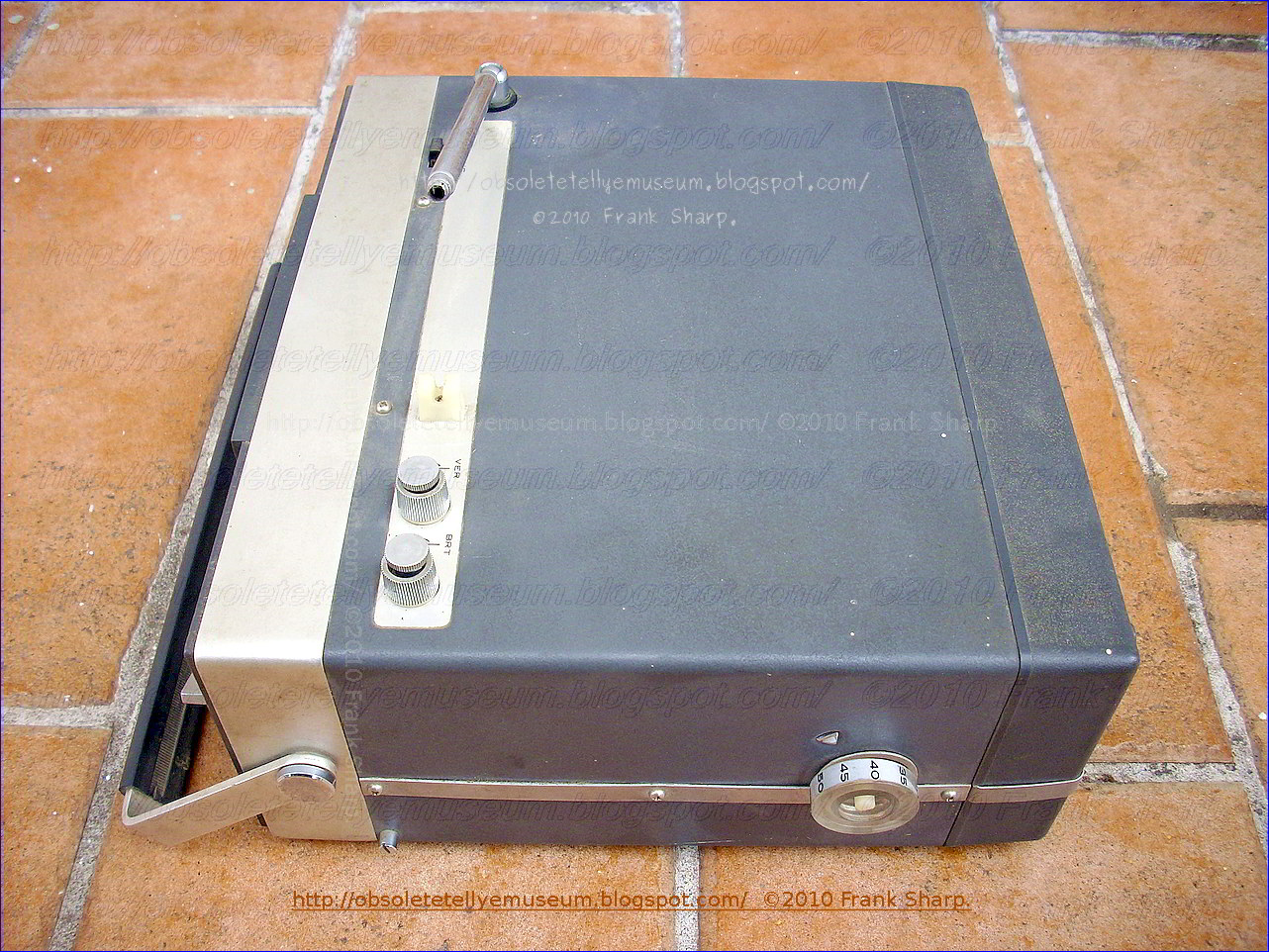
With dimensions of 255x95x230 mm and a screen diagonal of 12 cm, the device is no larger than a normal portable radio at that time.

  • The set can be powered both 110/220 volt mains AC or battery pack with modular power supply or even a 12volt DC car supply.
  •  In the device there is a battery box for 9 mono cells. However, with a power consumption of 5 watts, mains-independent TV was an expensive pleasure.
    A power supply and an adapter cable for operation on the car battery could be purchased for an additional charge.The power supply unit or the battery box are inserted into the housing, for which the rear cover can be removed by means of two knurled screws
    The power supply  contains a simple (selenium) rectifier and an electrolytic capacitor. A regulation is not built in. The feedback of the mains voltage is not very lush and the picture can occasionally "belly dance".

Loudspeaker:   Permanent Magnet Dynamic (PDyn) Loudspeaker (moving coil)  Power out  0.1 W

  • The FK100 was also installed as a control monitor in the desks of news editors at German ZDF in Studio 3 "Unter den Eichen".
  • In Wolfgang Menges WDR feature german  film "Das Millionenspiel" this radio version can also be seen.


  • The following accessories were available: Antenna adapter for 240Ohm, battery box, earphone (all three included), cable set for car connection and carrying case with shoulder strap. The instruction manual was also accompanied by the circuit diagram,
  • optionally, the RF signal can be fed in via an RCA socket on the right side or via the built-in telescopic antenna.


All the innards are in a sturdy sheet metal frame. The upper and lower casing shells are made of aluminum sheet. The lid on the back is made of plastic. The red and brown models are covered with imitation leather.

  • The TV line is easy to maintain, as it is equipped with fold-out modules that are plugged into female connectors.

It's, a nice, simple but solidly built device that is fun to work on. The technology is nice  and simple.
 

 The UNIVERSUM FK100 (ART.06664) (CROWN CTV-18)  tv  was manufactured in JAPAN , BY Crown Radio Corporation, 17-4, 3-Chome-Ueno, Taito-Ku, Tokyo. Production of radio receiving sets, television sets, tape recorders, transceivers, record players, pick-ups for record players, phonograph records, microphones, electric cells and electronic applied units.

 The  UNIVERSUM FK100 (ART.06664) GROSSVERSANDHAUS QUELLE GmbH (CROWN CTV-18) is an example of a light weight TV with great transportability feature and commodity.

  • Net weight (2.2 lb = 1 kg) 3.8 kg / 8 lb 5.9 oz (8.37 lb)

  •  Original price DM 295.

Quelle Group story

Nürnberger Strasse 91-95
8510 Fürth
Germany
(911) 742 3157
Fax: (911) 626 224

Private Company
Incorporated: 1927 as Gustav Schickedanz
Employees: 39,300
Sales: DM12.59 billion (US$8.31 billion)

The Quelle Group, headed by Gustav Schickedanz KG, is one of Germany’s largest retail and mail-order organizations. The mail-order business in Germany and adjacent countries is at the core of Quelle’s success. Quelle is the country’s second largest supplier of fashions and textiles, with its own trademarks and household catalog names: Shöpflin, Madeleine, Elégance, Peter Hahn, Euroval, and others. It makes its own Mars bicycles. Its own electrical goods are sold under the Matura, Universum, and Privileg trademarks. Quelle also operates 21 department stores, 151 technical speciality shops, 100 Apollo optical shops, 169 travel bureaus, 14 garden centers and is the franchiser of 1,103 partners in Foto-Quelle film and development shops. In the fiscal year ended January 1991, sales were up 23 % from the previous year.

Gustav Schickedanz, Quelle’s founder, was born in 1895, the son of a craft factory employee in Fürth, a small city adjacent to Nuremburg. He left school at the age of 15 to work at Speed and Son, the local branch of a sportswear firm. He soon was due to be appointed as a company representative in South America, but he decided to complete his army-service obligation first. World War I broke out and an expected service period of one year turned into seven. He was wounded and discharged in 1919. Schickedanz returned to Fürth where he worked as a salesman and married Anna Zehnder, a local master baker’s daughter, in September 1919. In 1922, he opened a small haberdashery business and struggled to keep the firm going in the midst of Germany’s period of hyperinflation. His employees were his father, wife, and sister.

Economic reforms led to a degree of stabilization and a short period of improvement. Schickedanz’s observations of customer behavior led him to believe that he could sell to a larger market through the mail. With the resulting low overheads and greater volume, he could offer lower prices. These ideas were not new, but hyperinflation presented great difficulties to mail-order firms. The new stabilization convinced him that mailorder could work. The mail-order venture opened in November 1927. The name chosen for the company, Quelle, means “source” in German. Schickedanz hired 15 new workers. One, Grete Lachner, would one day become his second wife and play an essential role in the company’s future.

His first catalogs emphasized wool, thread, and materials for home sewing, rather than ready-to-wear clothes. The company enjoyed a modest success in its first 18 months of operation. Schickedanz’s 33-year-old wife Anna and their 5-year-old son were killed in an auto accident in July 1929; his 72-year-old father died shortly afterward. His problems were compounded by the Wall Street crash, which halted the German economy’s faltering recovery and threw millions out of work. Schickedanz’s sister, Liesl Kiesling, stepped into Anna’s position in the company.

By the end of 1930, five million Germans were unemployed. Schickedanz’s new business survived, however, and, especially by the standards of the Great Depression, prospered. Quelle was able to offer lower prices than many shops, and quickly developed a reputation for reliability and good value. Soon Schickedanz began to offer more clothes and accessories. By 1934 Quelle had 250,000 customers. By 1936 this number had grown to a million, the majority of whom were women.

This success came about despite the restrictions on trade introduced by Adolf Hitler’s new Nazi regime, which came to power in January 1933. As Jews began to leave or face imprisonment, they disappeared as competitors in the clothing trade. In 1935 Schickedanz bought VP, a paper factory, to publish catalogs and make cartons. This factory had been Jewish property. Some suspected him of having an invisible Jewish partner, but this was never proved. World War II began on September 1, 1939, and the Nazis required that the paper factory be turned over to war work. Schickedanz continued to operate under severe restrictions and clothing rationing, but the dislocations of the war meant that mailorder provided an alternative source of supply to people in bombed-out cities. Schickedanz was offered several positions as an economic administrator, but he preferred to remain with the business.

In 1942 Schickedanz married Grete Lachner. One year later their only child was born in a bomb-proof bunker. As Allied bombers began to attack the Nuremburg-Fürth area, the Schickedanz family moved out to quarters in the nearby forest village of Hersbruck. In August 1943 Quelle was virtually put out of business when an Allied bombing raid destroyed 90% of the company’s warehouse in Fürth. On April 19, 1945, American troops occupied the ruins of Fürth and Nuremburg. Three weeks later, Germany surrendered. Although the Schickedanzes were fortunate to find themselves in the U.S. zone of occupation, their enterprise was not initially encouraged. Schickedanz was classified as a Nazi by the occupation authorities and prohibited from reopening his business. Buildings were in ruins or requisitioned by the occupation authorities and customer records had been lost.

Grete Schickedanz opened a small clothing shop in Hersbruck to support the family. It was a success, but was closed by the military authorities. Eventually, the Schickedanzes were able to use the influence of the anti-Nazi politician and economist Ludwig Erhard, a family friend who was also from Fürth, to gain permission to reopen. The Hersbruck shop remains open as one of Quelle’s smallest retail outlets.

Gustav Schickedanz remained under a prohibition and, in theory, could not even discuss business with former employees. The ban was removed in 1949. Former employees were found and Quelle was off to a fresh start. It was just in time to benefit from Ludwig Erhard’s currency reforms of the previous year. Following the founding of West Germany in 1949, Erhard moved as quickly as possible to remove restrictions and rationing and to encourage competition. He believed that sales of consumer goods would encourage production and jobs.

After many years of hardship, Germans responded by going on a buying spree. The Quelle name was remembered and respected by many former customers. By utilizing previous contacts, Grete Schickedanz was able to obtain superior but inexpensive goods for sale. It was on this foundation that the new Quelle was built. By the end of 1949 Quelle had a turnover of DM12 million and mailing list of 100,000 addresses, but the couple had also opened their first department store.

Germany, especially, benefited from the economic expansion stimulated by the Korean War in the early 1950s. Between 1949 and 1952 the company’s turnover rose by 900%. By 1952 Quelle had one million credit customers and sales of DM103 million. The company now faced the classic problems of a successful business: how to expand without overextending and damaging a reputation for quality. The answer was to invest in new computer and data processing technology that was just appearing in the United States and barely known in Europe.

Schickedanz hired the best experts and gave them a free hand to design systems that would enable Quelle to handle millions of mail-order and credit transactions per year. Thirtyfive engineers from the firm SEL in Stuttgart worked for two years to develop and set up a system appropriate for Quelle’s needs. In 1955 the first phase of the company’s new mailorder center was finished. By 1957 SEL had completed the building of the new system. It was one of the most sophisticated mail-order computer information systems and attracted worldwide interest. Quelle was able to rationalize its operations and achieve even greater efficiency. The company has continued to give high priority to updating its computer and data information systems. In 1990 it maintained information on some 32 million customers.

A new emphasis was placed on quality control. In 1953 Schickedanz set up an institute for testing products to be sold through Quelle. It became known as the Quelle Institute fur Warenprüfung and is the largest institute of its kind in German commerce. At first only textiles were tested, but gradually it began to examine other product types. In 1990 it had made more than 25,000 annual tests. The institute also attracted international interest.

Grete Schickedanz was increasingly responsible for buying. She also directed careful attention to new catalogs and added more color pages. By 1954 more than half the pages of the spring-summer catalog were in color. She carefully monitored fashion trends. Later, the company hired prominent German designers such as Heinz Oestergard as advisers.

The range of mail-order products was continually expanding. In 1954 the company bought a bicycle factory and began to sell bicycles. The next year, a favorable response to a line of small electronic appliances led to the introduction of washing machines and large appliances, which Quelle was able to offer at very competitive prices. In 1957 one of its most successful ventures was into photographic equipment, where it was able to offer large mail-order discounts. By the early 1960s it was even offering travel services.

Quelle learned how to target special-interest groups and to develop special catalogs alongside its main catalog to spotlight lifestyle groups and hobbies such as gardening. A bank, NORIS Bank GmbH (later Quelle Bank) was started in 1956 and developed to help customers with credit. By 1958 Quelle had a turnover of DM406 million. It had become the largest mail-order firm in West Germany.

From the early 1960s, Grete Schickedanz traveled to the Far East on buying trips. In 1962 Quelle opened an office in Hong Kong. Eventually, the region became one of the company’s most important sources of supply. Later, Grete Schickedanz established important business contacts in the People’s Republic of China and opened an office in Shanghai.

In 1964 Quelle had a turnover of DM1.64 billion and called itself “the largest mail-order house in Europe.” The 1960s and 1970s were a period of continued growth for Quelle in Germany, but unlike its competitor, Otto Versand, which made a very successful investment in Spiegel in the United States, Quelle has been more cautious about foreign expansion. The process has been slow, mainly into neighboring countries. It began in 1959 with Austria, where results were so encouraging that the company decided in 1966 to make a much more risky move into France, opening a new mail-order facility in Orleans.

Gustav Schickedanz died on March 27, 1977, in the 50th anniversary year of the company. He was succeeded as chairperson by Grete Schickedanz. Because the two had worked as partners for many years, Gustav’s death did not disrupt the company or bring about any major policy changes. Grete continued her worldwide buying trips. By 1981, Quelle had a turnover of DM10 billion.

In May 1985 Grete Schickedanz broke new ground in West German-East European trade politics by signing an agreement with Hungarotex, the Hungarian foreign trade organization. The agreement allowed Quelle to sell by mail in Hungary and included plans for a new chain of jointly owned department stores. In 1990 Quelle started Intermoda, a joint-venture catalog operation in the Soviet Union. In 1987 Grete Schickedanz relinquished her position as chairperson of the board of Quelle, but she remained as head of its supervisory board. Into the 1990s she still traveled widely on behalf of the company.

The speedy German reunification process, which began with the collapse of the East German regime in November 1989 and culminated a year later, presented both new markets and challenges from Otto and other German competitors. Quelle moved quickly to distribute its catalog to nine out of ten households in the former East Germany. New stores and facilities were opened in Gera, Jena, and Erfurt. A huge new regional mail-order complex was opened in Leipzig, creating 3,000 new jobs. Quelle described its investment in the new Germany as the largest in its history, creating a total of 7,000 new jobs.

At the end of 1990, Quelle surprised many German financial institutions by entering into a new agreement, through its subsidiary Quelle Bank, with the Bank of Scotland to enter the undeveloped German credit card market. The German market had been thought to be resistant to credit cards. According to the plan, Quelle was to offer direct banking and credit card services using its mail-order data base, with more than 30 million customers in Germany, France, and Austria. Bank of Scotland would handle the processing in its facilities in Dunfermline, Fife, Scotland. Quelle expected to issue about one million cards in its first five years. With the 1992 European economic unification approaching, Quelle sought to acquire a foothold in the United Kingdom and began negotiations with Littlewoods for its mail-order division.
Principal Subsidiaries

Quelle Beteiligungs GmbH; Quelle AG; Foto Quelle; Apollo-Optik GmbH; Möbel Hess GmbH; Quelle Bank GmbH (25%); Sinn AG (51%); Grossversandhaus Schöpflin GmbH (99%); Peter Hahn GmbH; Elégance; Madeleine Mode GmbH; UTS Universal Technik-Service GmbH; Quelle S.A. (France, 99%); Distribución Quelle S.A. (Spain, 51%); Peter Hahn AG (Switzerland).
Further Reading

Grete Schickedanz: Ein Leben für die Quelle, Fürth, Quelle, 1986.

some references:


Rüdiger Dingemann, Renate Lüdde: Die Quelle-Story. Ein deutsches Unternehmen im Spiegel der Zeit. Bucher, München 2007, ISBN 978-3-7658-1616-1.
Peter Zinke: „Er drohte wieder mit der Gauleitung“ – Gustav Schickedanz und die Arisierungen. In: Nurinst 2008. Beiträge zur deutschen und jüdischen Geschichte: Schwerpunktthema: Entrechtung und Enteignung. Antogo, Nürnberg 2008, ISBN 978-3-938286-34-0, S. 63–80

Weblinks


Commons: Quelle-Versandhaus – Sammlung von Bildern, Videos und Audiodateien
quelle.de
quelle.at
quelle.ch
travel.quelle.de (REISE QUELLE hat den Betrieb der reisequelle.de zum 30. November 2009 eingestellt)
Quelles düstere Vergangenheit. In: Cicero.
Gustav Schickedanz: Seine Nachfolger hatten nie eine Chance. In: FAZ.net, 20. Oktober 2009.
Gunhild Lütge: Maximaler Schaden - Quelle wird abgewickelt. In: Die Zeit. 44/2009, 22. Oktober 2009.
Abschied vom Quelle-Katalog - Der Besteller-Bestseller. In: Spiegel online. 23. Oktober 2009.
Gelungener Neustart – 100 Tage Quelle.de Pressemitteilung vom 1. August 2013
Quelle – von Versandkatalogen, Konsumgeschichte und Technikläden In: Retropie, 28. Dezember 2019.


Arcandor Konzerngeschäftsbericht 2007/2008 (Memento vom 11. Juni 2009 im Internet Archive) S. 112. (pdf; 1,8 MB)
Quelle ist wieder da – als Online-Marktplatz. auf: www.heise.de, 10. August 2011.

[Korrektur] Arcandor weist Quelle-Umsätze von 2,45 Mrd. Euro aus. (Memento vom 30. Januar 2013 im Internet Archive) www.excitingcommerce.de

(Seite nicht mehr abrufbar, Suche in Webarchiven: Impressum der Website)

Fräulein Gretel von der Quelle. In: Die Zeit. 24/2003, abgerufen am 24. Oktober 2009.

Süddeutsche Zeitung. 24. Juli 2009, S. 12.

Klaus-Dietmar Henke, Johannes Bähr, Dieter Ziegler, Harald Wixforth: Die Dresdner Bank im Dritten Reich. Band 2: Die Dresdner Bank und die deutschen Juden. Oldenbourg Wissenschaftsverlag, München 2006, ISBN 3-486-57781-6.

Familie Schickedanz: Mit dem Quelle-Katalog wurde sie steinreich. auf: www.bild.de, abgerufen am 24. Oktober 2009.

Biografie Grete Schickedanz. auf: www.whoswho.de, abgerufen am 19. Mai 2010.

Peter Zinke: „Er drohte wieder mit der Gauleitung“ – Gustav Schickedanz und die Arisierungen. In: nurinst 2008. ISBN 978-3-938286-34-0, S. 63–80 (antogo-verlag.de [PDF; 145 kB; abgerufen am 24. Oktober 2009]).

Quelle: „Wollen! Wägen! Wagen!“ auf: www.handelsblatt.com, abgerufen am 24. Oktober 2009.

Hans Dedi: Ein Quelle-Chef aus Murg. auf: suedkurier.de, 23. Oktober 2009, abgerufen 18. Dezember 2012.

Quelle-Verkauf: Otto kauft die Marke Quelle, zeit.de, 5. November 2009

(Seite nicht mehr abrufbar, Suche in Webarchiven: Quelle wird von Otto zum Leben erweckt.) auf: www.unternehmer.de

Quelle auf einen Blick: Größtes Homeshopping-Unternehmen in Europa. (Memento vom 29. Januar 2009 im Internet Archive) auf: www.quelle.com, abgerufen am 27. März 2009.

Spiegel Online vom 19. Dezember 2009: Quelle schließt endgültig seine Türen, abgerufen am 24. Juli 2019.

nordbayern.de vom 19. Dezember 2009: Quelle-Kaufhaus – Der allerletzte Feierabend, abgerufen am 24. Juli 2019.

Sabine Stoll: Der Quelle-Komplex geht an großen Immobilien-Entwickler. In: Nürnberger Nachrichten. 27. Juni 2018. (online auf www.nordbayern.de)

Neuer Investor: Quelle-Komplex wird kein Shoppingcenter. auf: www.nordbayern.de, 5. Juli 2018.

Druck des Quelle-Katalogs angelaufen. (Memento vom 28. März 2010 im Internet Archive) auf: druck-medien.net, 22. Juni 2009.

Archiv von Foto-Quelle-Katalogen, abgerufen am 6. August 2011.

Quelle nimmt Möbel-Eigenmarke Casamaxx in den Katalog auf. In: Horizont. (horizont.net [abgerufen am 31. Juli 2018]).

Deutschland liegt beim Internethandel zurück. In: IT Times. 13. Dezember 2007.

Arcandor stellt Insolvenzantrag. auf: finanznachrichten.de, 9. Juni 2009.

Zehn Gründe für den plötzlichen Quelle-Tod. auf: www.bild.de, abgerufen am 24. Oktober 2009.

Der Kredit für Quelle kann fließen. auf: www.focus.de, 7. Juli 2009, abgerufen am 24. Oktober 2009.

Notkredit für Quelle beschlossen. bei: tagesschau.de, 29. Juni 2009.

Massekredit für Quelle wird ausgezahlt. auf: www.focus.de, 10. Juli 2009, abgerufen am 24. Oktober 2009.

Der Quelle-Katalog kommt. auf: www.focus.de, 14. Juli 2009, abgerufen am 24. Oktober 2009.

Insolvenz – Quelle ist am Ende. (Memento vom 31. Juli 2012 im Webarchiv archive.today) In: Financial Times Deutschland. 19. Juli 2009.

Versandhaus Quelle vor dem Ende. auf: diepresse.com, 15. Oktober 2009.

Engültige Liquidation des Traditionshauses Quelle. (Memento vom 15. Dezember 2009 im Internet Archive) auf: www.unternehmer.de, 11. November 2009.

«Lagerräumung» - Quelle räumt die Lager - Kundenbestellungen werden ausgeführt. (Memento vom 20. Oktober 2009 im Webarchiv archive.today) In: AD HOC NEWS.

Schnäppchen-Jäger aufgepasst: Am Sonntag beginnt Quelle-Ausverkauf. auf: www.merkur.de, 30. Oktober 2010.

Zu hohe Kosten: Quelle stellt den Internet-Ausverkauf ein. auf: www.stern.de, 26. November 2009.

Bei Quelle gehen die Lichter für immer aus. (Memento vom 31. Juli 2012 im Webarchiv archive.today) In: Financial Times Deutschland. 18. Dezember 2009.

Abwicklung trotz Staatshilfe – Bei Quelle ist vor Weihnachten Schluss. (Memento vom 24. Oktober 2009 im Internet Archive) In: Financial Times Deutschland. 19. Okt. 2009.

Aus für Quelle: Region Nürnberg/Fürth unter Schock. auf: www.merkur.de, 21. Oktober 2009.

Aus für Quelle. (Memento vom 4. Januar 2010 im Internet Archive) auf: augsburger-allgemeine.de, 20. Oktober 2009.

Bei Quelle lächelt nur noch Madeleine Schickedanz. auf: www.welt.de, abgerufen am 24. Oktober 2009.

Nürnberg und die Quelle-Pleite. In: Spiegel online. 23. Oktober 2009, abgerufen am 24. Oktober 2009.

Arbeitsagentur richtet Außenstelle bei Quelle ein. auf: www.welt.de, abgerufen am 24. Oktober 2009.

Deutsche Post: Nach Quelle-Aus drohen Stellenstreichungen bei DHL. In: Focus Online. 22. Oktober 2009, abgerufen am 7. Dezember 2014.

Quelle Österreich-Konkurs. auf: www.konsument.at, 17. November 2009.

Kurier: Quelle-Packerln wandern ins Otto-Reich. (Memento vom 8. März 2010 im Internet Archive) auf: kurier.at, 5. März 2010.

QUICK 24 – Magazinul dumneavoastra online. (Memento vom 3. Januar 2013 im Internet Archive) Vorstellung der Umbenennung der Quelle Rumänien in Quick24.

Homepage von Quelle in Ungarn. Abgerufen am 19. Oktober 2010.

Bei Quelle gibt es keine Waschmaschinen mehr. auf: www.welt.de, abgerufen am 6. November 2009.

Quelle-Lieferanten fühlen sich von Görg betrogen. auf: www.welt.de, 6. November 2009, abgerufen am 6. November 2009.

Otto kauft die Marke Quelle. In: Spiegel Online. 5. November 2009, abgerufen am 7. Dezember 2014.

 (Seite nicht mehr abrufbar, Suche in Webarchiven)

Otto darf Quelle-Marken mit Einschränkungen nutzen. In: handelsblatt.com. 16. Februar 2010, abgerufen am 7. Dezember 2014.

Otto reaktiviert Quelle-Website. In: handelsblatt.com. 19. März 2010, abgerufen am 7. Dezember 2014.

Gläubigerausschuss genehmigt Verkauf von Home Shopping Europe. (Memento vom 13. November 2009 im Internet Archive) auf: www.arcandor.de.

Quelle-Call-Center werden übernommen. In: handelsblatt.com. 16. November 2009, abgerufen am 7. Dezember 2014.

Küchen-Quelle: Hamburg macht dicht - aber es besteht weiter Hoffnung. auf: www.moebelkultur.de

Investorengruppe „Franken“ übernimmt Küchen-QUELLE. (Memento vom 30. November 2009 im Internet Archive) auf: www.arcandor.de, 20. November 2009.

www.kuechen-quelle.de

Neustart für Website und Privileg - Quelle lebt. (Memento vom 27. März 2010 im Internet Archive)

ORWO Net übernimmt die Marke Foto Quelle. (Memento vom 20. August 2012 im Internet Archive) Pressemitteilung der ORWO Net GmbH, 27. November 2009. (PDF-Datei; 122 kB)

RTS Elektronik Systeme GmbH übernimmt Profectis. (Memento vom 4. Mai 2010 im Internet Archive) auf: www.profectis.de, 18. Dezember 2009.

https://web.archive.org/web/20160301103407/http://www.textilwirtschaft.de/business/Halens-uebernimmt-vier-Quelle-Landesgesellschaften_61507.html

Schwedischer Versandhändler kauft CEE-Quelle. auf: derstandard.at, 22. Jänner 2010.

 (Seite nicht mehr abrufbar, Suche in Webarchiven)

Investor für Quelle-Spezialkatalog gefunden - Mittelständler will Versand von Gesundheitsprodukten fortführen. (Memento vom 7. September 2012 im Webarchiv archive.today) In: Nürnberger Nachrichten. 6. Februar 2010.

www.dr-hein.com

Unito führt Quelle und Ackermann in der Schweiz weiter. auf: www.textilwirtschaft.de, 12. Mai 2010.

Otto erweckt Quelle 2011 wieder zum Leben. auf: www.nachrichten.at
 
* https://www.encyclopedia.com/books/politics-and-business-magazines/quelle-group

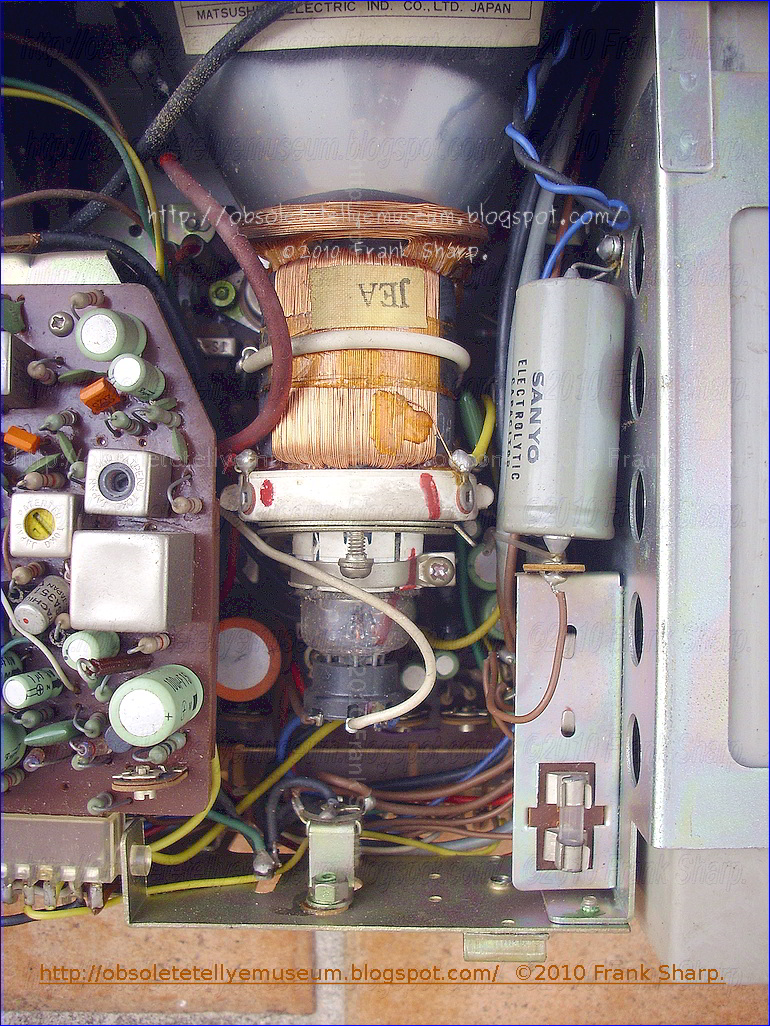
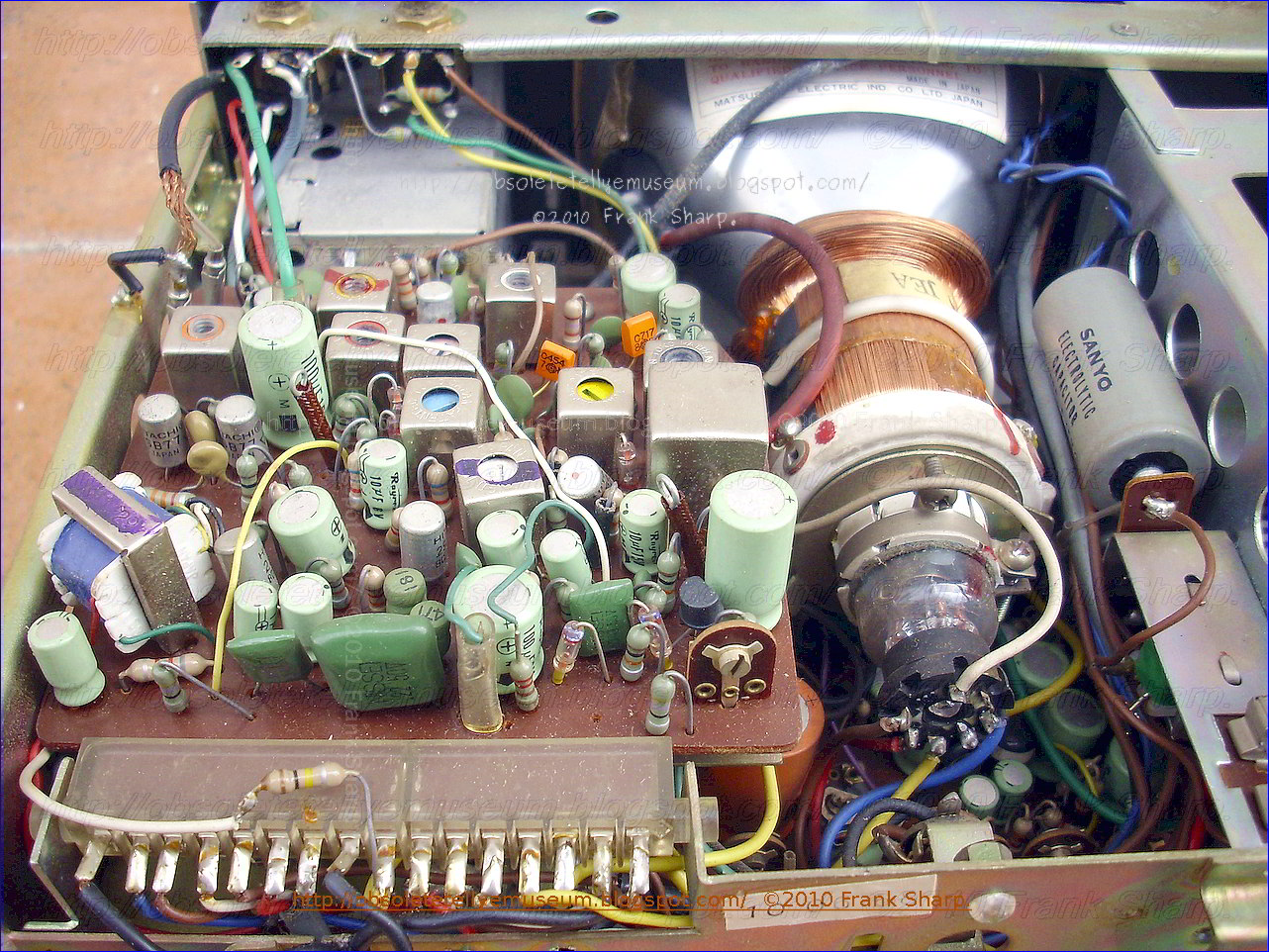
UNIVERSUM FK100 (ART.06664) (CROWN CTV-18) CHASSIS CROWN AM-B INTERNAL VIEW


Upside signals pwb, downside thw synch/deflections panels. 

  • A BLOCK CIRCUIT:  AM-B-332 ; 
  • B BLOCK CIRCUIT:  AM-B-323 ;
  • C BLOCK CIRCUIT:  AM-B-352; (SUPPLY OUT)
  • VHF TUNER:  AM UF-18
  • UHF TUNER: AM UF-12
  • EHT FLYBACK LOPT:  AM-WM-4
  • AUDIO OUT TRANSFORMER:  AM-T-229

The set can be powered both 110/220 volt mains AC or battery pack with modular power supply or even a 12volt DC car supply.

 In the device there is a battery box for 9 mono cells. However, with a power consumption of 5 watts, mains-independent TV was an expensive pleasure.
 A power supply and an adapter cable for operation on the car battery could be purchased for an additional charge.The power supply unit or the battery box are inserted into the housing, for which the rear cover can be removed by means of two knurled screws
 The power supply contains a simple (selenium) rectifier and an electrolytic capacitor. A regulation is not built in. The feedback of the mains voltage is not very lush and the picture can occasionally "belly dance".

All the innards are in a sturdy sheet metal frame. The upper and lower casing shells are made of aluminum sheet. The lid on the back is made of plastic. The red and brown models are covered with imitation leather.
 The TV line is easy to maintain, as it is equipped with fold-out modules that are plugged into female connectors.
It's, a nice, simple but solidly built device that is fun to work on. The technology is nice and simple.

UNIVERSUM FK100 (ART.06664) (CROWN CTV-18) CHASSIS CROWN AM-B CRT TUBE MATSUSHITA


Friday, October 26, 2018

GOODWILL GW503 5.5 PERSONAL BLACK & WHITE TV AM/FM RADIO YEAR 2003


This set is a 5 inches mini personal portable TV radio powered both battery and DC 12 volt adapter.

On front side bottom screen they're placed the selectors for Radio Tv mode and VHF UHF selectors and a headphones jack.

It' has full continuos tuning for all bands VHF UHF and radio AM FM like pocket radios and backside are located RCA connectors.

The set is based on only 2 analog ICs one for radio and one for TV featuring all functions needed.

The set is very light weight and the quality of the construction isn't that shiny, but far better than any actual crap around.

Screen size: 5.5-inch
Full channel TV reception
Advanced electronic tuner
High resolution function display
High sensitivity receiving antenna
China/Hong Kong dual-line
Unique cable TV antenna interface
Power supply: 110 to 220V AC rectifier, 12V DC cigarette lighter for car and boats
Supports FM radio
System: PAL/NTSC/SECAM
Battery quantity: 10 pieces

Shenzhen GOODWILL Electronics Co., Ltd. was established in November 1988 . By the Hong Kong Sheng Xiang Investment Co., Ltd. set up investment . Registered capital of 2.1 million U.S. dollars. The company has import and export right .

Company specializing in the development, production, sales of household , car color TVs, set-top boxes , computer boards , burn , etc. with various electronic tuner , radio tuner
The company has a number of rich practical experience and theoretical level of high, intermediate engineering and technical personnel and management personnel specializing in product development, quality control and business management.

Company's products are used every piece of advanced equipment at home and abroad to conduct a comprehensive quality testing , strict quality control network, from components to finished factory acceptance and service to establish a set of strict quality assurance system. And successfully obtained the ISO9002 international quality assurance system certification. The company has a production capacity of RoHS compliant products , and obtain SGS approved by the company .

Company is equipped with advanced surface mount systems and complete production lines , component mount speeds of up to each 0.03S. Factory under the patch, plug , assembly execution debugging, and testing section . Placement centers have a variety of high , medium-speed placement machine 15 daily capacity of up to 3500K SMD chip components only , workshop and plug-in line , assembly and commissioning of the three lines as well as screen printing , reflow ovens , wave soldering furnace, high temperature box and other large equipment more than ten kinds of sophisticated electronic equipment and more than 300 units

The company has 12 million tuners production capacity. Our main products are color TV with TDQ-3D Series electronic tuner , LCD TV TDQ-3T, TDQ-5E, XF-6A, XF-6C Series electronic tuner , computer boards with TDQ-6B electronic tuner series , digital TV with XF-1DT, XF-1A series digital tuner , home and vehicle TDQ-9A, TDQ-9B series radio tuner . product quality and technical indicators have reached international standards. Company customers include TCL, Shanghai Dong Jie , Shenzhen JEJA , Apollo, Shanghai Hua Yi and other products are exported around the world . The company's advanced production technology, favorable price , good service , has won the praise of many customers . Company operating in good condition, has been awarded the Foreign Investment - Excellent Enterprise.

GOODWILL GW503 5.5 PERSONAL BLACK & WHITE TV AM/FM RADIO CHASSIS 501C-TV + TV501A-R INTERNAL VIEW.


The chassis is a little center placed PCB with all part on it.
  The whole board is built around the CD5151CP. Excluding passives this chip seems to have everything needed to build a TV receiver : video and audio intermediary frequency, tuner frequency control, automatic gain control, FM detector for audio, detection of synchronization pulses and horizontal and vertical deflection oscillators and drivers. There is also a TA8164P, which is a radio tuner IC. The CD5151CP already has integrated FM decoding circuitry. It may have something to do with the SECAM-L standard.


CSC5151 - AN5151 TV VIF & SIF & DEFLECTION SYSTEM (FOR TV LARGE INTEGRATION)

DESCRIPTION
The UTC AN5151 is a monolithic integrated circuit containing
all stage for the VIF,SIF and deflection of television receivers.
 GENERALLY, the operation of a conventional television receiver includes two main components. First, the receiver receives the incoming television signal in radio frequency (RF) and converts the incoming RF signal to an intermediate frequency (IF) signal. Then, the receiver converts the IF signal to a video baseband signal and an audio baseband signal. The baseband signals are coupled to appropriate video and audio decoders to generate the display video signals (e.g. RGB or only luminance for b/w) or sound. In general, the conventional television receiver includes a tuner for receiving the input RF signal and converting the RF signal to an IF signal by one or more frequency conversions. The frequency conversions are generally implemented as single or dual super-heterodyne conversions. In conventional television receivers, the intermediate frequency is dictated by the geographical area the receivers are to be used.
FEATURES
*Hight integrated technology makes it possible the integration of
video IF circuit tuner AFC circuit sound. IF circuit and
deflection.-jungle circuit on one single chip.
*supply voltage range:8V to 12V

Also, the conventional television receiver also includes a channel filter and a demodulator for converting the IF signal to video and audio baseband signals. The channel filter is typically a discrete filter implemented as a SAW (Surface Acoustic Wave) filter see pictures. The shape of the SAW filter is designed specifically for the format (analog or digital TV) and the television standard (NTSC, PAL or SECAM) of the television signals being received. The demodulator is typically a dedicated component and designed specifically for a predetermined television signal format and a predetermined television standard. For analog television signal reception, the demodulator is a VIF/SIF module. The VIF/SIF module provides a video output called CVBS (Composite Video Baseband Signal) and audio outputs, such as MPX or A2.

FUNCTIONS
*IF Amplifier, IF AGC
*Video Amplifier, Video Detector
*Noise Canceller, Forward RF AGC
*Tuner AFT,SIF Amplifier
*Sound Detector, sync separation
*Vertical oscillation trigger and driver
*Horizontal oscillation driver and AFC


The circuit here shown is an extreme example of semplification of a b/w tv receiver in accordance of above statements.

TA8164P 3V MONAURAL RADIO IC
The TA8164P is AM/FM Tuner (FM F/E + AM/FM IF) IC, which is designed for AM/FM monaural radio. Combining with the TA7368P (Mono PW IC), a suitable monaural AM/FM radio system is able to be constituted.
FEATURES
Common output for AM/FM Switch over between AM/FM mode is possible with one- wake switch

GOODWILL GW503 5.5 PERSONAL BLACK & WHITE TV AM/FM RADIO CHASSIS 501C-TV + TV501A-R CRT TUBE HAI-SHI 14SX5Y4


Chungwha Picture Tubes, Ltd. (CPT) is one of Taiwan's, and the world' s, leading manufacturers of thin-film transistor liquid crystal displ ays, or TFT-LCDs. Ranked number three in the Taiwan TFT panel market, the company is also a leading producer of cathode ray tubes (CRTs), color picture tubes, and electron guns used for CRT-based monitors an d televisions. While those markets represent the group's traditional business, CPT responded quickly to the rise of flat-panel technologie s at the dawn of the 21st century, embracing both LCD and plasma-base d technologies. The company has manufacturing operations in Taiwan (i ncluding a 6G plant expected to reach full production by the end of 2 005) and in mainland China and Malaysia. Listed on the Taiwan Stock E xchange, CPT was founded by Taiwan's Tatung Corporation, which remain s its major shareholder with more than 32 percent of the company's st ock. The bruising competition with Japanese and especially Korean fla t-panel producers has left CPT, like most of the Taiwanese flat-panel sector, struggling to keep up and maintain profitability. As a resul t, CPT has long been rumored to be seeking a merger with a fellow Tai wanese LCD producer in order to gain greater scale. In 2004, CPT post ed sales of TWD 117 billion ($3.67 billion).

Tatung Offshoot in the 1970s
Chungwha Picture Tubes had its origins as an offshoot of the fast-gro wing Tatung Corporation, one of the motors of Taiwan's industrial dev elopment in the second half of the 20th century. Tatung's roots lay i n the post-World War I period, when Shan-Chih Lin went into business, founding the Shan-Chih Business Association in 1918. Lin's business flourished and by 1939 Lin's interests had grown to include the newly founded Tatung Iron Works. That company became known as Tatung Steel and Machinery Corporation following World War II.
Tatung was to play an important role in the development of the new Ta iwanese state in the 1950s. The company diversified, adding an applia nce manufacturing component. In 1949, Tatung launched production of i ts first appliance, an electric fan. That product soon brought the co mpany to the export market, with its first international sales shippi ng to the Philippines.
By the early 1960s, Tatung had added refrigerators and automatic stea mers to its list of appliances. The company then began construction o f two new factories, one for the production of air conditioners, and another for the manufacture of television sets. This latter category represented Tatung's introduction to the large electronics sector. Pr oduction of televisions began in 1964; the following year, the compan y incorporated a new subsidiary, Tatung Electronics.

By 1968, Tatung had extended its television production expertise to t he production of color televisions. The company also began to explore the potential for broadening its technology, namely for the producti on of the cathode ray tubes at the heart of the television industry. This effort led the company to create a new dedicated subsidiary, Chu ngwha Picture Tubes (CPT), in 1970. Construction of the company's fir st production facility in Taoyuan began in 1971.

CPT initially focused on the black and white tube sector, launching a test production run in 1972. By 1973, the company had perfected its production technique, and began full-scale production. CPT's prior ex port experience enabled it to gain a solid foothold in international markets, shipping CRTs to the Americas and to Europe, as well as to T hailand and other Asian markets. In 1974, as well, CPT added producti on of another important television component, the electron gun. In th at year, the group's tubes received certification by the United State s, giving the company entry into that market as well.
The rise of new graphics-based computers in the late 1970s gave CPT a fresh outlet for its cathode ray tubes. While computer monitors rema ined black and white, the television market had by then largely switc hed over to the color television standard. CPT responded by launching production of its own color CRTs at a new dedicated production facil ity in Taoyuan in 1978. Sales of the new tubes were swift; by the ear ly 1980s, the company had produced more than one million color CRTs.

The Taiwanese government adopted a new policy in the early 1980s of e ncouraging Taiwan's shift away from its position as a low-cost, low-t echnology industrial producer toward a high-technology model. Tatung and CPT responded by expanding their operations to include the fast-g rowing computer sector, and especially the personal computer market. In 1983, CPT sought to extend its own display expertise into a new an d promising display type, a flat-panel display based on liquid crysta ls. Whereas liquid crystals had been discovered in the 19th century, practical applications of the material only appeared toward the end o f the 1960s, when RCA in the United States developed the first liquid crystal displays. By the end of the 1970s, however, Japan had become the focal point for LCD technologies.

Chungwha became the first Taiwanese company to attempt to enter the L CD market in 1983. Yet CPT proved unable to develop the necessary tec hnology on its own, and the Japanese LCD industry jealously guarded i ts own technology advantage. Instead CPT returned its focus to the CR T market. In 1985, the company succeeded in developing a technology t ransfer partnership with Japan's Toshiba, not for the production of L CDs, but rather for the production of 14-inch color CRTs for computer and other monitor displays. By the end of that year, CPT had begun p roducing medium-resolution 14-inch CRTs as well as related components .
CPT launched its first flat-screen CRT in 1986 based on a 5.5-inch tu be. By the end of that year, the company also ramped up production of a 14-inch flat rectangular CRT. In order to meet rising demand for i ts CRT, the company built a new facility in Yang Mei, started in 1987 and completed in less than a year. That facility began producing 14- inch high-resolution displays, as well as 21-inch flat rectangular CR Ts.

LCD Beginnings in the 1990s
CPT followed Tatung overseas in the early 1990s. While Tatung built a new construction facility in Thailand, CPT turned to Malaysia, where it began building a plant for the production of color electron guns in 1990. The Malaysian subsidiary reached full production by 1991, th en quickly expanded to eight production lines by the middle of the de cade. The addition of the Malaysian production capacity helped CPT cl aim the leading position in the global CRT industry.
The mid-1990s also marked a new effort by CPT to enter the LCD market . In 1994, the company began building a dedicated facility in Fuzhou. In the meantime, the company continued to boost its CRT capacity. A major step in the group's development came with a new technology tran sfer agreement with Toshiba in 1995, enabling CPT to launch productio n of 28-inch and larger color picture tubes. The following year, CPT established a manufacturing presence in the European market, opening a production subsidiary in Scotland.
Yet the future of the display industry lay in the fast-developing LCD technology. CPT's efforts paid off by 1996 with the production of th e group's first LCD module. By 1996, the company's factory prepared t o launch full-scale production.

CPT's efforts to crack the LCD sector were aided by the economic down turn in Japan. Into the late 1990s, that country's LCD giants began t o find it difficult to raise the funds needed for further investment. These companies risked falling behind in the newly launched LCD race , as new competitors, especially in Korea, emerged. Meanwhile, the LC D industry was set to take off, as more and more users adopted portab le computers, but especially as the world prepared for the sudden exp losion in portable telephones. Slightly further down the road lay the promise of new high-definition television standards, which would req uire consumers to upgrade their sets, and the coming of the flat-scre en televisions as well.
In search of funding, the Japanese LCD makers turned to Taiwan for in vestment capital, launching a series of technology transfer agreement s with the island's manufacturers. CPT proved to be among the first t o find a partner, signing an agreement with Mitsubishi in 1997. By 19 99, the company had completed its new production facility and it beca me the first in Taiwan to produce 14-inch and 15-inch LCD modules.

Display Leader in the 2000s 
CPT's LCD production gained quickly, and by 2001, the company had add ed a second factory, in Fu Chou. The following year, the company adde d two more production facilities, in Wujiang, in mainland China, and in Lungtan. The company continued to produce CRTs, but the future cle arly lay in flat-panel technologies.
In the early 2000s, CPT began developing production capacity for plas ma screens as well. By 2001, the company had successfully launched pr oduction of display panels ranging up to 46 inches in size. The compa ny continued to develop its technology, and by 2004, CPT debuted its first high-definition large-screen panels.
As for its Taiwanese counterparts, including AU Optronics and Chi Mei Optoelectronics, the early 2000s proved a difficult period for CPT. The economic downturn had suppressed sales; at the same time, the com pany faced heavy competitive pressure from its deep-pocketed rivals i n South Korea. The result was a swift drop in the prices of LCD and f lat-panel displays. Although this stimulated massive consumer demand for these display types, the falling prices sent most of the Taiwanes e sector into losses. In order to compete, CPT, like the other Taiwan ese display leaders, was forced to invest heavily in expanding its pr oduction, building new fifth-generation plants. By 2005, the company had also committed to expanding production with a new sixth-generatio n plant, to be completed by the end of that year.

Continued losses (CPT's losses topped $226 million for the first half of 2005 alone) made it difficult for CPT to raise needed investm ent capital. At the same time, Tatung was said to be seeking to offlo ad its money-losing subsidiary, which had been dragging down its own profits. Into the mid-2000s, rumors began to circulate that Tatung wa s preparing to merge CPT with one of its rivals. By September 2005, t he rumor, although denied by Tatung, appeared to become more of a cer tainty. At that time, two likely candidates emerged. The first was Ho n Hai-owned Innolux Display Corp., the current number six in Taiwan. The second was Quanta Display Inc., the market's number five, part of the Quanta Group. The merger with either of these candidates was exp ected to boost CPT, the market's number three, into the industry's nu mber two position, ahead of Chi Mei Optoelectronics, and trailing onl y AU Optronics. CPT remained a key player in Taiwan's effort to lead the global flat-panel display market.

Principal Subsidiaries: CPT (Malaysia) Co. Ltd.; Kamper Plant Co. Ltd.; CPTF Optronics Co., Ltd.; Wujiang Plant Co., Ltd.; CPTF Vis ual Display (Fuzhou) Ltd.; CPT Display Technology (Fujian) Ltd.
Principal Competitors: Samsung Corporation; LG-Philips; Sharp Corporation; AU Optronics; Chi Mei Optoelectronics Corporation.

Chronology


  • Key Dates:
  • 1971: Tatung of Taiwan begins manufacturing cathode ray tubes, establishing Chungwha Picture Tubes.
  • 1974: The company begins production of electron guns.
  • 1978: The company launches production of color CRTs.
  • 1983: The company first attempts to enter LCD production.
  • 1985: The company enters a technology transfer agreement with Toshiba.
  • 1990: A subsidiary in Malaysia is established.
  • 1994: The company re-enters the LCD sector and begins construc tion on a new factory.
  • 1997: The company reaches an LCD technology transfer agreement with Mitsubishi.
  • 1998: The company becomes the first in Taiwan to produce 14-in ch TFT-LCD panels.
  • 2001: New factories are added in Wujiang and Lungtan.
  • 2005: Construction begins on a sixth generation TFT-LCD plant; CPT is rumored to be considering a merger with another display produ cer in Taiwan.

Additional Details


  • Public Company
  • Incorporated: 1971
  • Employees: 20,000
  • Sales: TWD 117 billion ($3.67 billion) (2004)
  • Stock Exchanges: Taiwan
  • Ticker Symbol: CPT
  • NAIC: 334411 Electron Tube Manufacturing; 334419 Other Electro nic Component Manufacturing

Further Reference:


  • "Chungwha Picture World's No. 1 Maker of 15-Inch TFT-LCD Pane ls," Taiwan Economic News, May 6, 2004.
  • "Chunghwa to Build Gen6 LCD Plant," EBN, August 11, 2003, p. 16.
  • "CPT to Decide Merger with Local Counterpart in One Month," Ta iwan Economic News, September 12, 2005.
  • "CPT to Expand LCM Capacity at Mainland China Plants," Taiwan Economic News, August 19, 2005.
  • "CPT to Inaugurate 6G TFT-LCD Panel Line," Taiwan Economic New s, September 19, 2005.
  • Einhorn, Bruce, and Ihlwan Moon, "A Fierce Fight to Stay in the F lat-Panel Game," Business Week, September 16, 2002, p. 23.
  • Wang, Lisa, "Chunghwa Picture Tubes Shares Rise on Talk of Merger ," Taipei Times, September 09, 2005, p. 10.